Fictional client — portfolio build · targets, not field results
L&D Operations Triage: Solve, Escalate, Document
Monday 08:40. Eight emails, three lanes, and an SOP that names which is which.
The Audience
L&D coordinators and operations staff in firms with centralized learning-admin teams — plus anyone inheriting a shared inbox.
Responsibilities
Inbox-family design · SOP voice · timing-pressure mechanic · pattern debrief — triage as three answerable questions.
The Build
Triage design · SOP writing · pressure mechanics · AI-assisted drafting (disclosed)
How I used AI in this case
AI drafted variant inbox emails and SOP phrasing options; the triage lanes, the SOP voice, the combo-timer mechanic and the debrief scoring were designed by hand. Edited, verified and disclosed.
LO1 · Apply
Route eight Monday-morning emails into SOLVE, ESCALATE or DOCUMENT with an SOP-cited reason.
LO2 · Discriminate
Resist hero mode and escalitis under morning pressure — the rush flag never penalises, the debrief names both.
LO3 · Perform
Document so the next reader can act without asking you anything.
By the end of this experience a learner can do the three things above — assessed by the defensible-desk pattern score in the Monday debrief. Every interaction in the build exists to create the evidence for one of them.
Shared inboxes drift into two ruts, both rational, both expensive:
Training had taught the tools. Nobody had practiced the lane decision under a real clock — with a director's office on one side and a timezone-shifted admin team on the other.
Hero
solving what you cannot see — provisioning, GDPR, policy exceptions
Escal
escalating what the desk exists to solve — confirmations, rebookings
The problem was the client's. These were mine — the design and build constraints that shaped the solution.
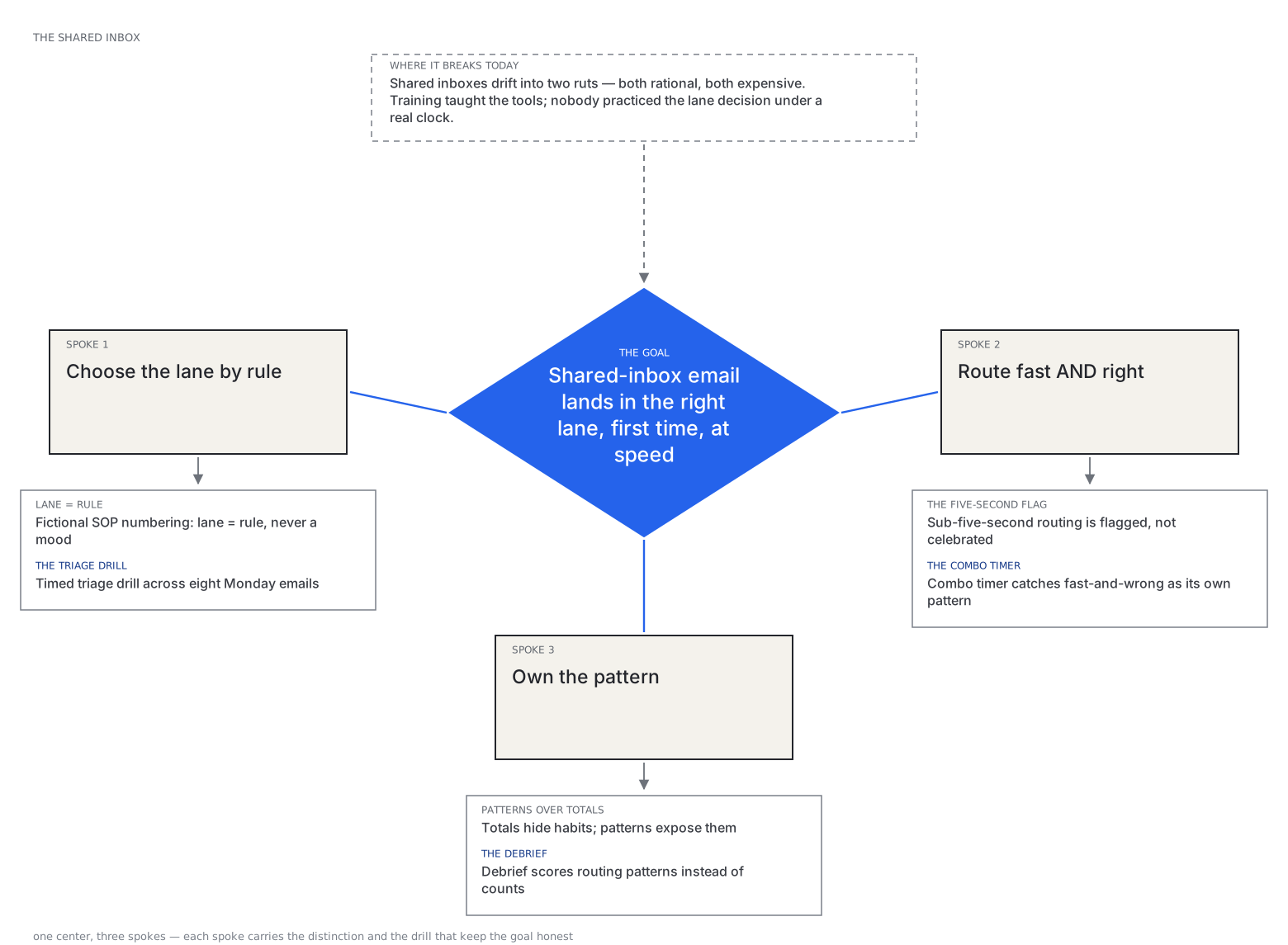
Lanes as rules, not moods
Triage feedback cites fictional SOP numbers so the lane is always a rule. Writing SOPs worth citing — specific enough to judge, short enough to skim — was the real work.
Speed that punishes the right thing
The combo-timer flags sub-five-second routing: fast-and-right is experience, fast-and-wrong is autopilot. Calibrating the threshold rewards pattern recognition, not reflex.
Eight emails, one Monday
The set must cover the inbox families without feeling like a catalog; each email earns its place by testing a different routing judgment.
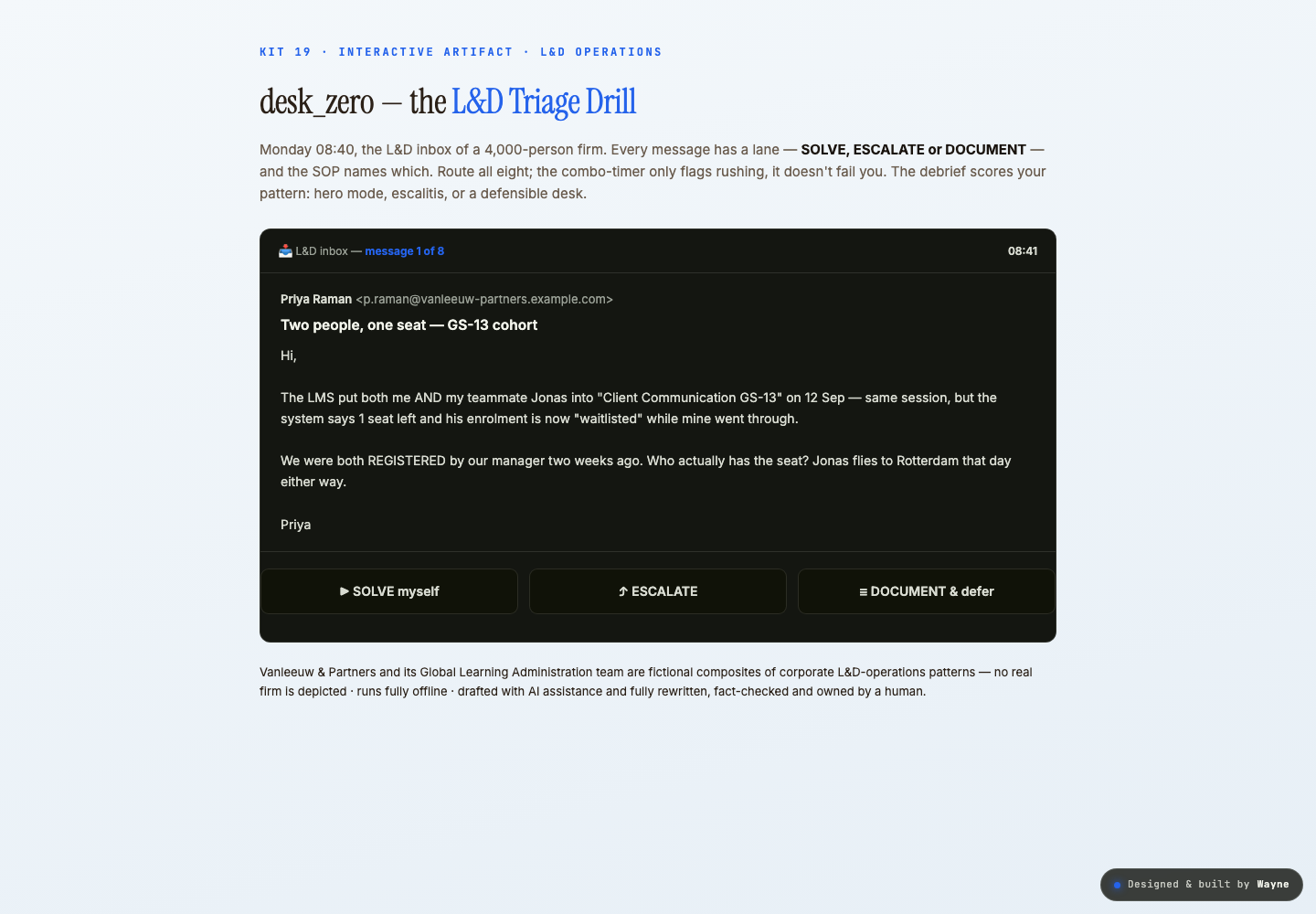
A timed triage drill: eight Monday emails, three lanes, feedback citing fictional SOP numbers so the lane is always a rule and never a mood. The combo-timer flags sub-five-second routing — fast-and-right is experience, fast-and-wrong is autopilot — and the debrief scores your pattern, not just your total.
The build itself, not a video about it — open it, make the calls, and read what each one costs.
From inbox-family analysis to a timed triage drill — the stages below are the actual production sequence.
Mapped from the two ruts shared inboxes drift into — both rational, both expensive. Training had taught the tools; nobody had practiced the lane decision under a real clock, so the map puts the clock in the middle.
The instructional-design foundations that informed this build:
Action Mapping (Clark)
Every behavior the kit produces is traced back to a business goal and a specific practice activity. See the linked action map for the full chain.
Cognitive Load Theory
The Three.js scene reduces extraneous load by visualising abstract systems. Learners focus on the decision, not the interface.
Situated Cognition
The environment matches the real context. Practice happens where the skill will be performed.
Kirkpatrick L1-L4
Evaluation designed for all four levels: reaction, learning, behavior, results. See the linked evaluation plan.
Pre-committed targets (agreed with stakeholders before build, not retrofitted):
Coordinators rate the inbox ≥4/5 for realism
L1 · Reaction
Coordinators rate the inbox ≥4/5 for realism
L2 · Learning
≥75% correct lanes; rushed-but-wrong rate visible per learner
L3 · Behavior
Escalation queue volume normalizes within a quarter
L4 · Results
SLA misses on confirmable items drop; audit trail quality rises
L&D-operations desks drift into two ruts: hero mode (solving what you cannot see — provisioning, GDPR, policy exceptions) and escalitis (escalating what the desk exists to solve). Both are rational; both are expensive. The proposal was a timed triage drill: eight realistic Monday emails, three lanes — SOLVE, ESCALATE, DOCUMENT — with every lane's feedback citing the SOP rule, and a rush flag that asks whether you read the message or recognized its shape.
An SOP handbook and a reading assignment considered · rejected
Accurate and already written. Rejected because the failure is lane selection under a live inbox, not lane knowledge — every coordinator in the study could name the lanes and still routed the director's-office email to 'solve' when it arrived at 08:56.
Shadowing an experienced coordinator considered · rejected
Genuinely valuable. Rejected as the core format because shadowing exposes you to whatever arrives that day — no guarantee the eight high-signal email families ever come up. The drill guarantees coverage of all of them, with the timer adding the pressure shadowing lacks.