Fictional client — portfolio build · targets, not field results
Vetting Adjudication: Weight the Pattern, Not the Story
One vivid disclosure, one quiet pattern — adjudication is weighting, not counting.
The Audience
Screening and vetting adjudicators in trust-critical hiring — plus HR teams building defensible appointment cases.
Responsibilities
Document-family design · converging-evidence architecture · weight-scoring logic · trap calibration — adjudication as a distribution problem.
The Build
Evidence-weighting design · adjudication rubric · decoy calibration · AI-assisted drafting (disclosed)
How I used AI in this case
AI drafted document-family variants and candour phrasings for the dossier set; the converging-evidence architecture, weight-scoring logic and trap calibration were designed by hand. Edited, verified and disclosed.
LO1 · Apply
Weight each of the twelve documents as PATTERN, ISOLATED or CONTEXT before any verdict.
LO2 · Discriminate
Resist the vivid-disclosure trap: one loud admission does not outweigh a quiet pattern of omissions.
LO3 · Perform
Commit to a verdict justified on weight distribution, not on outcome.
By the end of this experience a learner can do the three things above — assessed by the weight-distribution verdict score, not the outcome. Every interaction in the build exists to create the evidence for one of them.
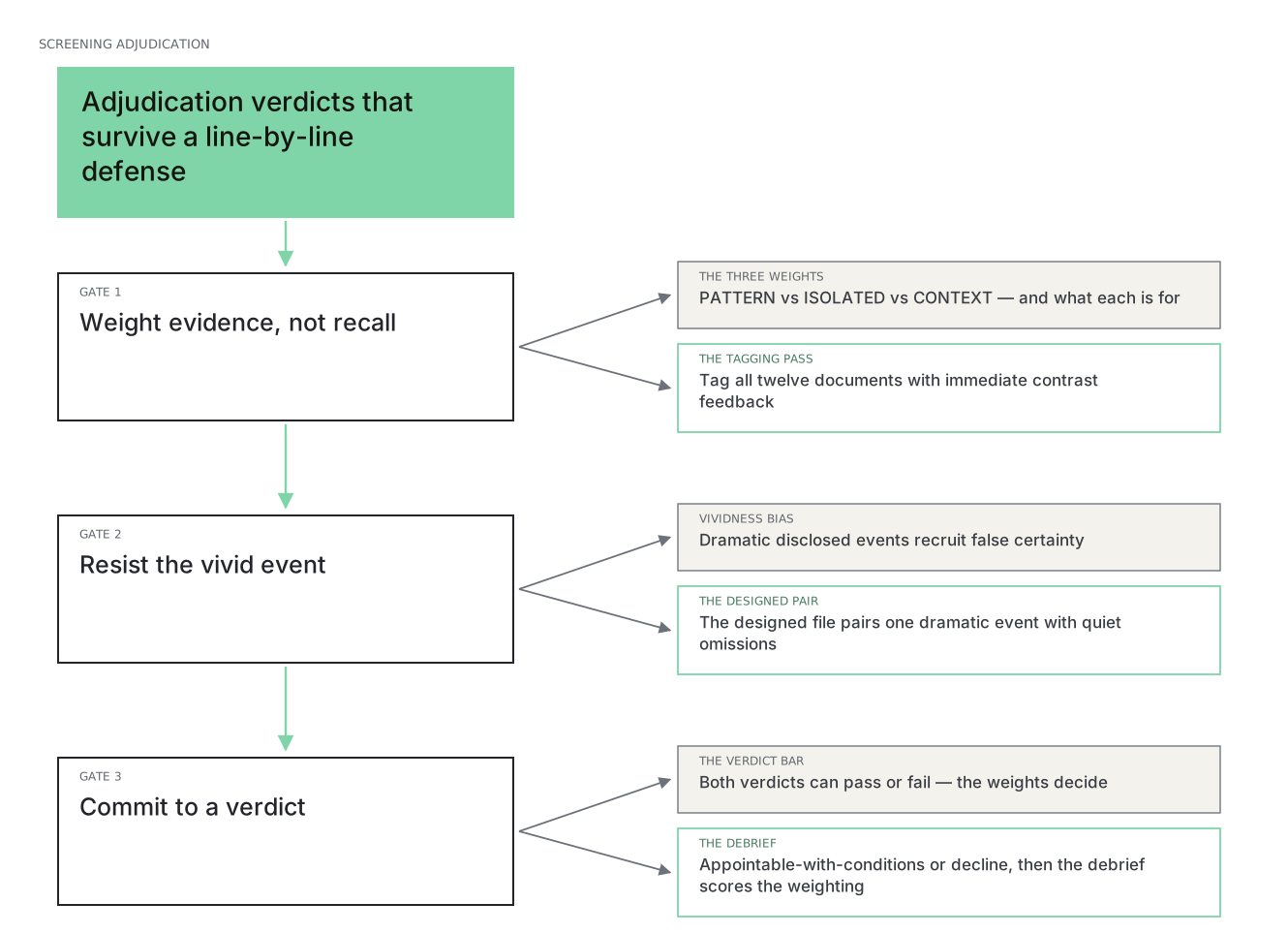
Screening files mislead in a predictable direction: vivid, disclosed events recruit certainty; quiet, repeated omissions hide in plain sight. The designed file shows both:
Rules training produces rule-recall. Adjudication demands weighting: what counts as pattern, what stays isolated, what is merely context — and a verdict the committee can defend line by line.
3
versions of one "leadership certificate" across three application forms
2 yrs
since the repaid train-ticket charge — disclosed, unsolicited, clean since
The problem was the client's. These were mine — the design and build constraints that shaped the solution.
Twelve documents, one distribution
The evidence has to converge without a smoking gun: PATTERN, ISOLATED and CONTEXT tags must each matter to the verdict, or tagging becomes decoration.
Both failure modes are real
Over-flagging an honest anomaly and under-flagging a rehearsed story must both cost. The debrief names each failure mode by name.
The commit is the lesson
Tagging is rehearsal; the appointable-with-conditions vs decline verdict is where judgment is scored — and conditions must be written, not clicked.
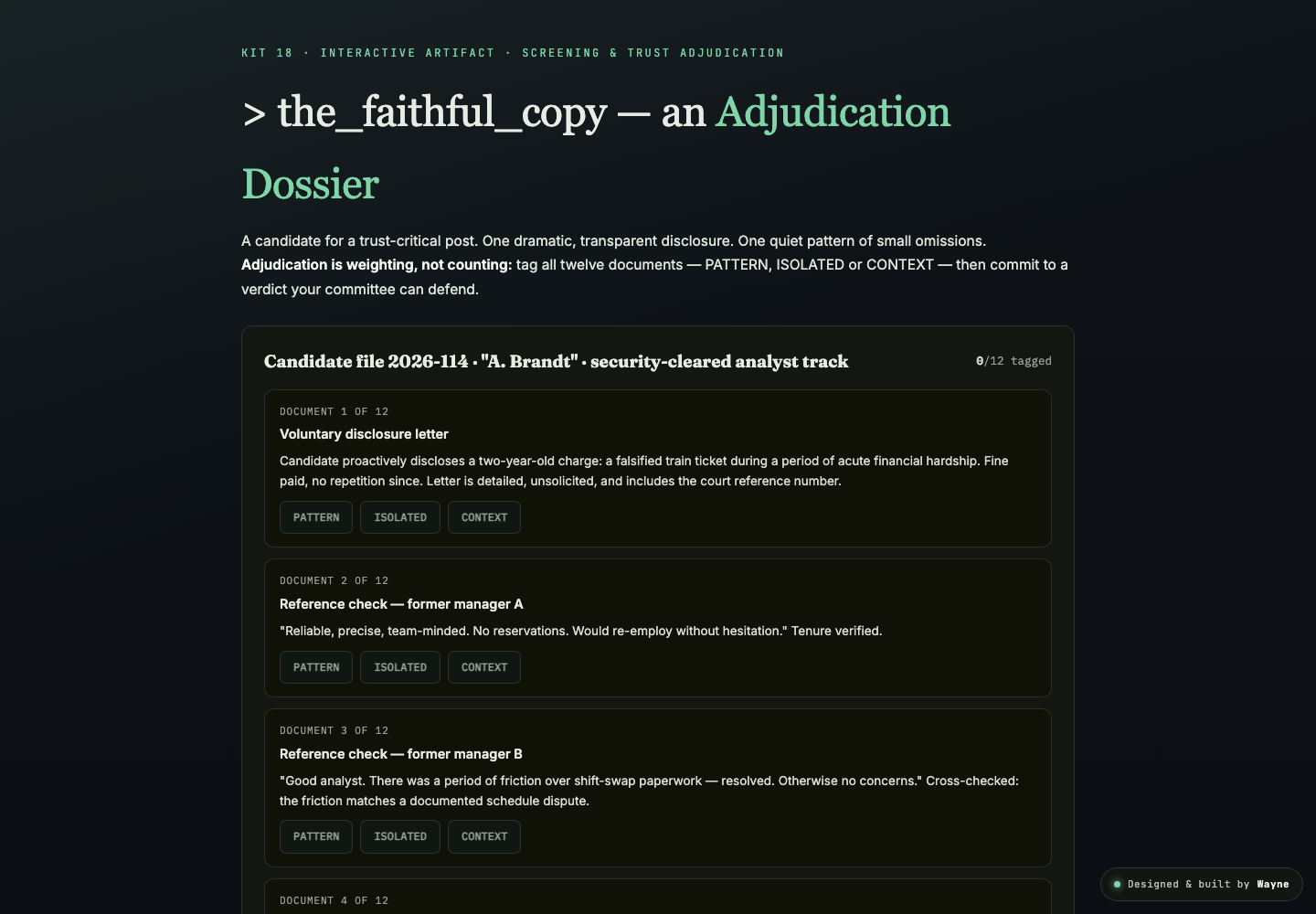
An evidence-weighting dossier: tag all twelve documents PATTERN / ISOLATED / CONTEXT with immediate contrast feedback, then commit — appointable with conditions or decline. The debrief scores your weight distribution against designed adjudication logic and names both failure modes by name.
The build itself, not a video about it — open it, make the calls, and read what each one costs.
From adjudication logic to an evidence-weighting dossier — the stages below are the actual production sequence.
Mapped from how screening files mislead in a predictable direction: vivid, disclosed events recruit certainty while quiet, repeated omissions hide in plain sight. Rules training produces rule-recall — adjudication demands weighting.
The instructional-design foundations that informed this build:
Action Mapping (Clark)
Every behavior the kit produces is traced back to a business goal and a specific practice activity. See the linked action map for the full chain.
Cognitive Load Theory
The Three.js scene reduces extraneous load by visualising abstract systems. Learners focus on the decision, not the interface.
Situated Cognition
The environment matches the real context. Practice happens where the skill will be performed.
Kirkpatrick L1-L4
Evaluation designed for all four levels: reaction, learning, behavior, results. See the linked evaluation plan.
Pre-committed targets (agreed with stakeholders before build, not retrofitted):
Adjudicators rate the file ≥4/5 for 'realistic tension'
L1 · Reaction
Adjudicators rate the file ≥4/5 for 'realistic tension'
L2 · Learning
≥70% correctly weight the pattern documents as PATTERN
L3 · Behavior
Case notes show weight language (pattern/isolated/context) within a month
L4 · Results
Verdict rationales survive committee review without rework
Screening files mislead in a predictable direction: one vivid, disclosed event recruits certainty while a quiet pattern of small omissions hides in plain sight. Rules training cannot fix that — the failure is weighting, not rule knowledge. The proposal was an evidence-weighting dossier: twelve documents tagged PATTERN / ISOLATED / CONTEXT, then a verdict — scored on the weight distribution against designed adjudication logic, so a defensible outcome reached on wrong reasoning still fails.
More screening-rules training considered · rejected
The standard response to every adjudication concern. Rejected because the officers knew the rules — the designed trap in the file (the vivid repaid ticket against the curated certificate pattern) defeats rule knowledge by definition: nothing in the file breaks a rule outright.
Panel-discussion training on real anonymized cases considered · rejected
Rich and honest. Rejected as the core format because panels distribute judgment — each officer can hide inside the consensus. The dossier forces an individual weighting and verdict, which is what committees actually need each member to be able to defend.