Fictional client — portfolio build · targets, not field results
E-Learning Scene Budgeting: Teach or Decorate?
A classroom day becomes e-learning on a Friday deadline — and the easy path is polished click-next.
The Audience
Government academy course teams converting classroom days to e-learning — plus ID teams calibrating what 'engaging' means.
Responsibilities
Interaction-type analysis · effort-budget design · brief-specific rule engine · debrief writing — a conversion philosophy made playable.
The Build
Scenario design · budget mechanics · branching feedback · AI-assisted drafting (disclosed)
How I used AI in this case
AI drafted scene-placement commentary variants and brief wording; the interaction-type analysis, the per-brief rule engine and the verdict design were authored by me. Edited, verified and disclosed.
LO1 · Apply
Spend an effort budget on interactions that teach rather than decorate — click-next costs nothing, and that is the trap.
LO2 · Discriminate
Judge any scene plan with the teaches-vs-decorates lens before a build starts.
LO3 · Perform
Meet a module brief's behaviour goal within the effort budget, not despite it.
By the end of this experience a learner can do the three things above — assessed by the STRONG BUILD / MIXED / SLIDESHOW quality check in-build. Every interaction in the build exists to create the evidence for one of them.
Conversion projects fail in a predictable way: the source day is well-rated, the deadline is Friday, and the module ships as presentation with clicks. Completion looks fine — nothing was asked of anyone:
Training had taught what e-learning tools exist. It never practiced the judgment call on every single screen — does this interaction make learners think, or just keep them busy?
0
learner effort spent by click-next polish — cost: free
1st
place the knowledge check opens — a pre-test, not a quiz at the end
The problem was the client's. These were mine — the design and build constraints that shaped the solution.
Effort must mean something
Eight scene types priced 0-3 points: the budget only teaches if the prices reflect real production effort, so the rule engine encodes actual conversion economics.
Every brief fails differently
Video-heavy refreshers, scenarios buried after theory, hotspot repetition: each module brief needed its own failure rules, not a generic quality score.
Verdicts, not vibes
Every placement gets an instant TEACHES or DECORATES verdict with a reason — the debrief names the conversion philosophy behind the rules.
A lesson-scene builder with a budget: eight scene types cost 0–3 effort points, three module briefs each have a required scene and their own failure rules — video-heavy refreshers, scenarios buried after theory, hotspot repetition — and every placement gets an instant TEACHES or DECORATES verdict.
The build itself, not a video about it — open it, make the calls, and read what each one costs.
From interaction-type analysis to a playable builder — the stages below are the actual production sequence.
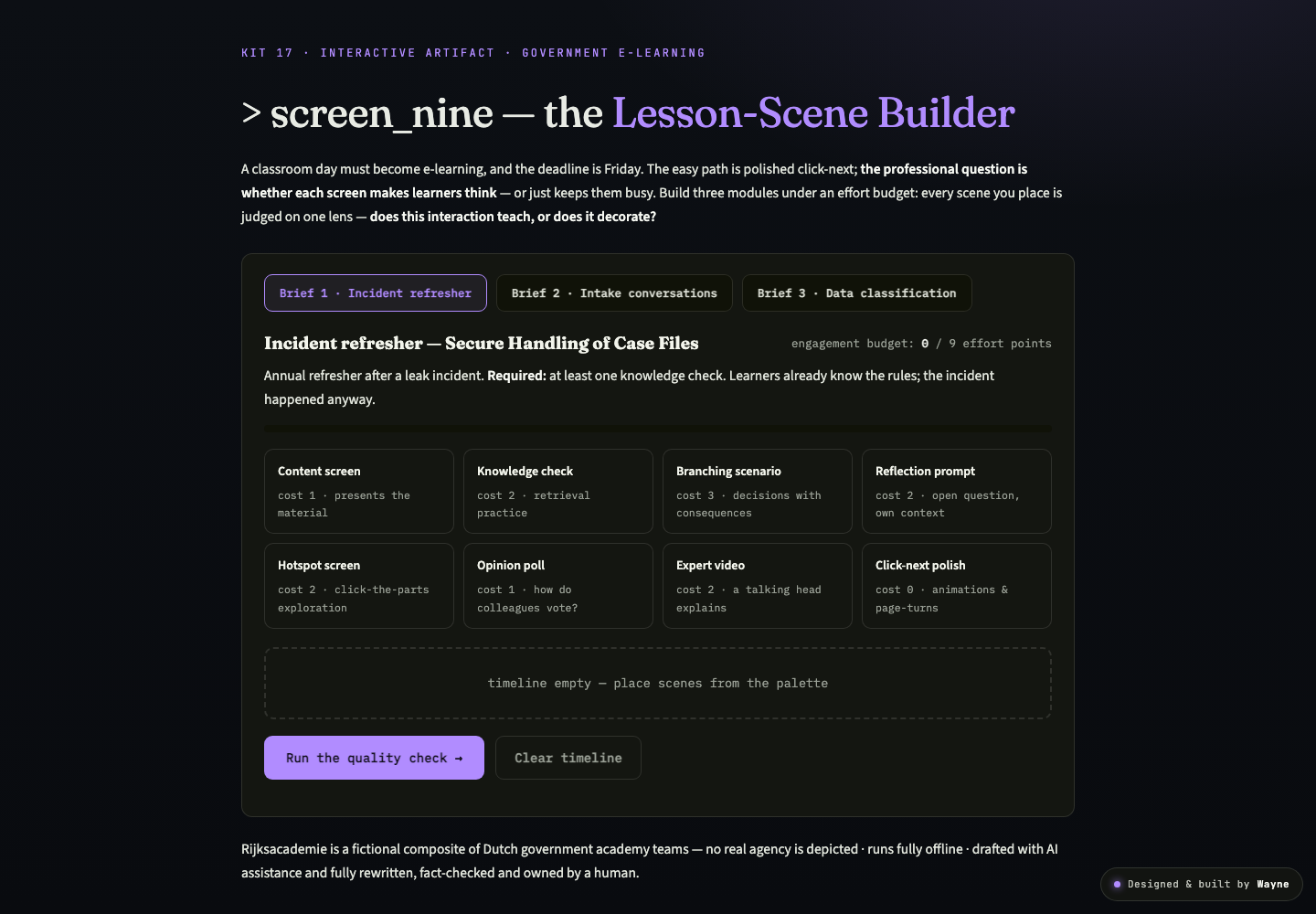
Mapped from the predictable conversion failure: the source day is well-rated, the deadline is Friday, and the module ships as presentation with clicks. The map is a budget — decoration is cheap and teaching is expensive, on purpose.
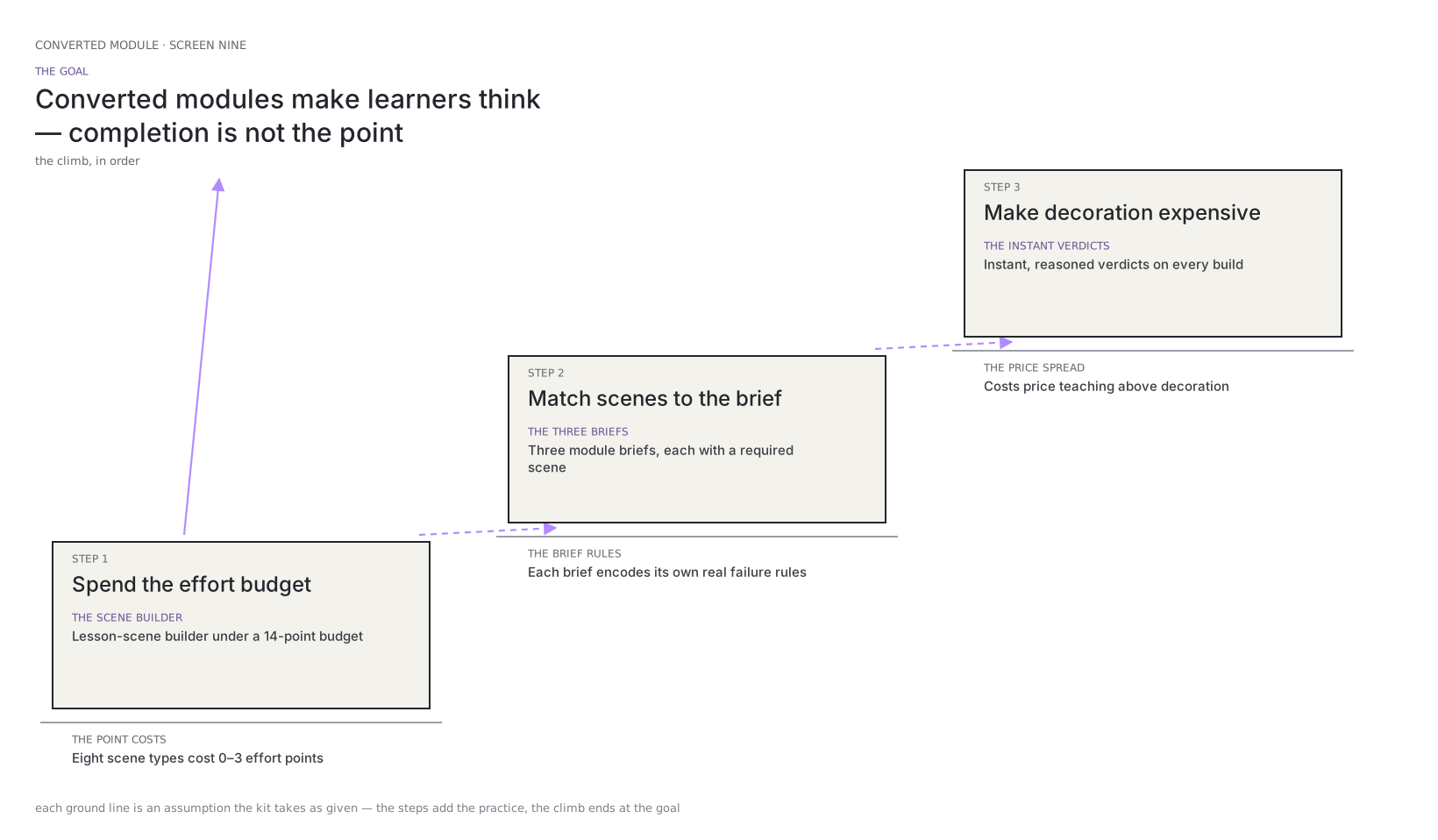
The instructional-design foundations that informed this build:
Action Mapping (Clark)
Every behavior the kit produces is traced back to a business goal and a specific practice activity. See the linked action map for the full chain.
Cognitive Load Theory
The Three.js scene reduces extraneous load by visualising abstract systems. Learners focus on the decision, not the interface.
Situated Cognition
The environment matches the real context. Practice happens where the skill will be performed.
Kirkpatrick L1-L4
Evaluation designed for all four levels: reaction, learning, behavior, results. See the linked evaluation plan.
Pre-committed targets (agreed with stakeholders before build, not retrofitted):
Course teams rate the builder ≥4/5 as 'a fair mirror of our deadline debates'
L1 · Reaction
Course teams rate the builder ≥4/5 as 'a fair mirror of our deadline debates'
L2 · Learning
≥80% of rebuilt modules include at least one required teaching scene
L3 · Behavior
Conversion briefs submitted to the desk carry scene plans, not slide dumps
L4 · Results
Fewer 'nobody finished it' complaints on converted modules within two quarters
Government academies convert classroom days under deadline, and the standing answer is a polished click-next module — completion looks fine, nothing was asked of anyone. The proposal was a lesson-scene builder with an engagement budget: eight scene types priced by learner effort, three module briefs with their own failure rules, and every placement scored on one lens — does this interaction teach, or decorate? The budget makes the design philosophy physical: decoration is free, teaching costs points.
A better click-next template considered · rejected
What the deadline always produces. Rejected because the template IS the failure: it optimizes polish per hour, and polish per hour is exactly what the converted modules already have too much of. A shinier version of the wrong form is still the wrong form.
Authoring-tool training (Storyline, Rise) considered · rejected
Useful skills, honestly. Rejected as the fix because tool skill does not make the teach-or-decorate call — the converted modules were already built by people who knew the tools. The judgment layer above the toolbar was the gap.