Fictional client — portfolio build · targets, not field results
Wellbeing Signal Triage: Diagnose Before the Fix
Absence is up, mood is flat — and everyone has a favourite fix. Read the wall first.
The Audience
HR advisors, team leads and prevention/occupational-health staff facing rising absence and flat mood.
Responsibilities
Signal-family design · root-cause architecture · wellbeing-wash traps · advisory debrief — the Monday curve as evidence.
The Build
Diagnostic design · intervention scoring · advisory writing · AI-assisted drafting (disclosed)
How I used AI in this case
AI drafted signal-card variants and advisory wording; signal-family design, root-cause architecture and trap calibration were authored by me. Edited, verified and disclosed.
LO1 · Apply
Read nine wellbeing signals against three root causes before proposing a single fix.
LO2 · Discriminate
Choose the two interventions that address the diagnosed cause — and reject the wellbeing-washing option outright.
LO3 · Perform
Defend a zero-score for the yoga programme with the Monday-curve evidence.
By the end of this experience a learner can do the three things above — assessed by the advisory debrief tiers in-build. Every interaction in the build exists to create the evidence for one of them.
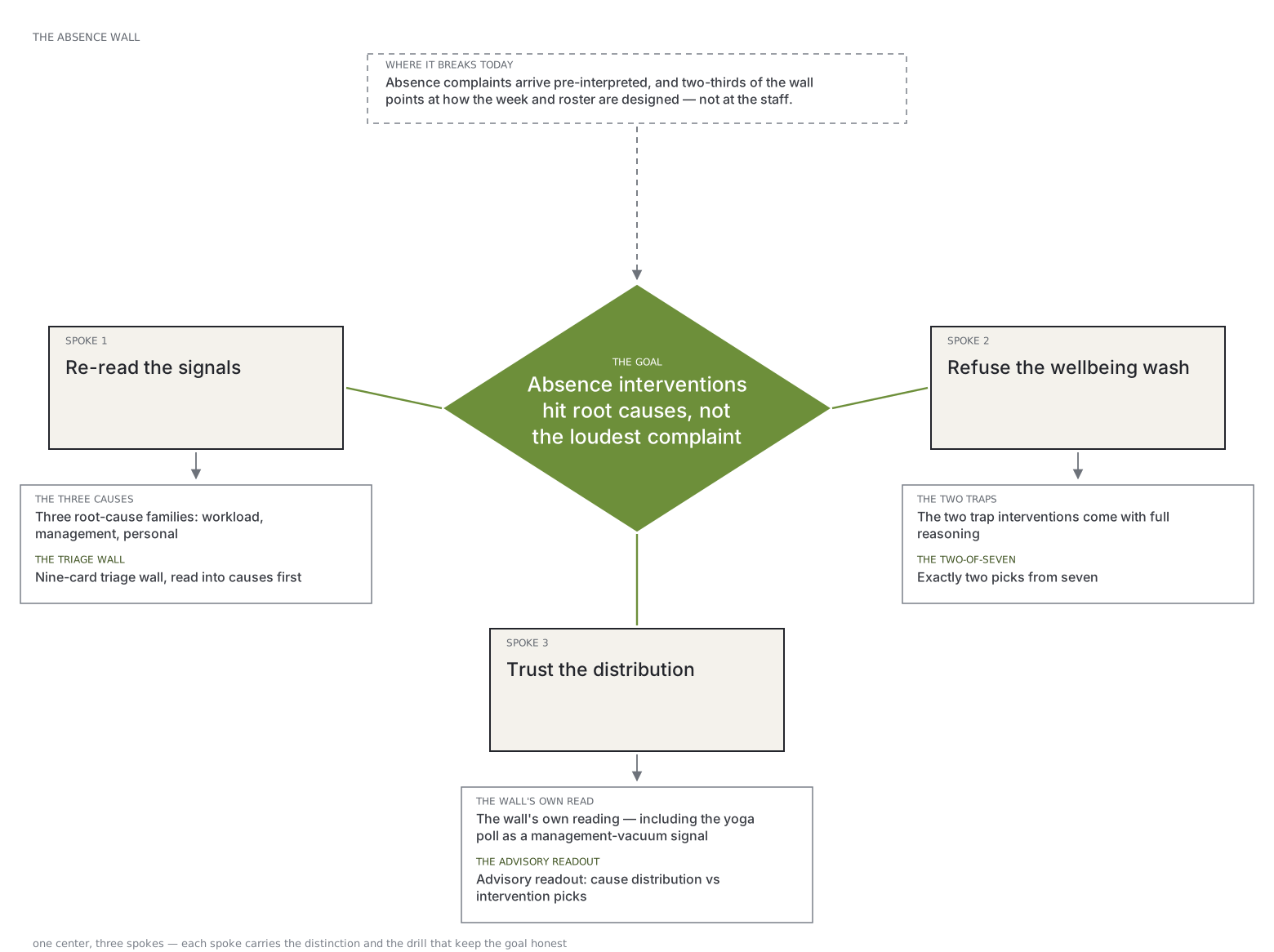
Absence complaints arrive pre-interpreted. The wall is built to re-anchor the reading:
Two-thirds of the wall points at how the week and the roster are designed. The third family — personal circumstance — exists honestly, and is worsened by a management practice that refuses adjustments.
44%
of absence lands on Mondays — a load-shape signature; lives do not know it is Monday
23h
weekly meeting load on dock planners, 11 without a decision output
78%
want a yoga programme — the popular fix that scores zero as an intervention
The problem was the client's. These were mine — the design and build constraints that shaped the solution.
Signals that argue
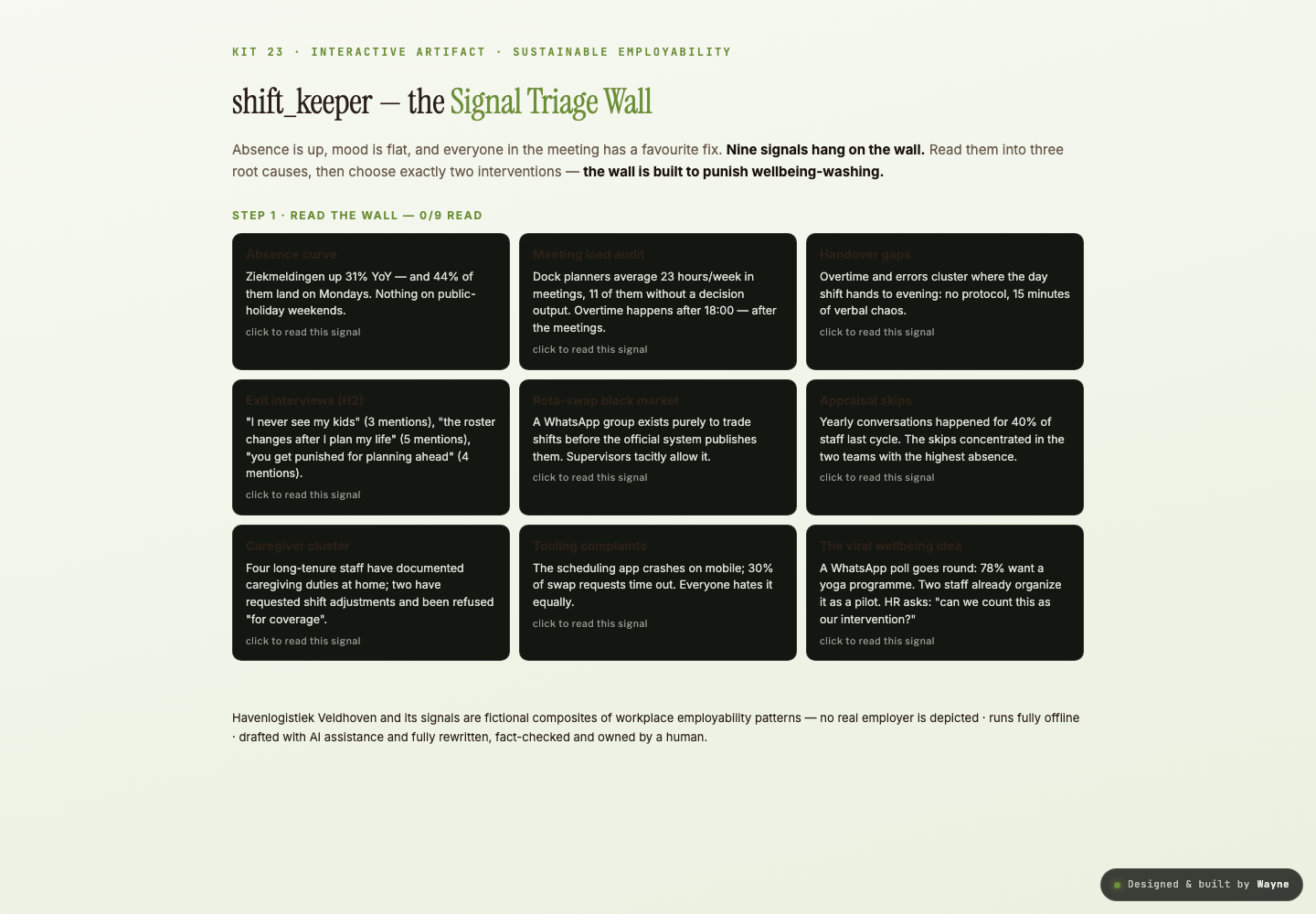
Nine cards must support three root causes — including the yoga poll as a management-vacuum signal — so the evidence genuinely competes for the reader's story.
Wellbeing-wash traps
Resilience training for structural overload and the visible quick win must be tempting AND named as traps in the debrief — the wash is the failure mode.
Two of seven is the advice
The intervention cap makes the debrief read like a real advisory: prioritized, reasoned and honest about trade-offs.
A signal triage wall: nine cards read into three root causes (each with the wall's own reading — including the yoga poll as a management-vacuum signal), then exactly two interventions from seven. The wellbeing-wash traps — resilience training for structural overload, the visible quick win — get named debrief entries.
The build itself, not a video about it — open it, make the calls, and read what each one costs.
From absence data to a signal-triage wall — the stages below are the actual production sequence.
Mapped from the reading problem: absence complaints arrive pre-interpreted, and two-thirds of the wall points at how the week and roster are designed — not at the staff. The map re-anchors the reading before any intervention is chosen.
The instructional-design foundations that informed this build:
Action Mapping (Clark)
Every behavior the kit produces is traced back to a business goal and a specific practice activity. See the linked action map for the full chain.
Cognitive Load Theory
The Three.js scene reduces extraneous load by visualising abstract systems. Learners focus on the decision, not the interface.
Situated Cognition
The environment matches the real context. Practice happens where the skill will be performed.
Kirkpatrick L1-L4
Evaluation designed for all four levels: reaction, learning, behavior, results. See the linked evaluation plan.
Pre-committed targets (agreed with stakeholders before build, not retrofitted):
Advisors rate the wall ≥4/5 for 'a real meeting, minus the meeting'
L1 · Reaction
Advisors rate the wall ≥4/5 for 'a real meeting, minus the meeting'
L2 · Learning
≥70% map the workload signals correctly before intervening
L3 · Behavior
Advisory reports open with the root-cause reading, not the fix menu
L4 · Results
Structural interventions (roster, policy) outnumber resilience spending in adopted plans
Absence was up, mood was flat, and every meeting produced a favourite fix — usually the most visible one. The advisory reality: two-thirds of the signals pointed at workload design and management practice, and the popular fixes were structurally irrelevant. The proposal was a signal triage wall: nine team signals read into three root causes, then exactly two interventions from seven — built so the wellbeing-wash traps (resilience training for structural overload, the yoga programme) get named debrief entries of their own.
A wellbeing-programme menu to choose from considered · rejected
Friendly, fast, and what HR usually ships. Rejected because menus presuppose the diagnosis — picking yoga off a menu while the Monday absence curve screams roster design is wellbeing-washing, and the wall exists to make that failure visible before the budget is spent.
An absence-data report with recommendations considered · rejected
Rigorous and defensible. Rejected because reading numbers and interpreting them under social pressure are different skills — a report tells the advisor what the analyst concluded; the wall trains the advisor to conclude. Reports inform; the wall rehearses the reading.