Fictional client — portfolio build · targets, not field results
Student Wellbeing Conversations: Join, Refer, Follow Up
Every student opens with one problem and is really carrying another.
The Audience
Student advisors, tutors and wellbeing staff — first conversation training before shadowing hours.
Responsibilities
Decoy-ask writing · defensible-wrong calibration · referral-dial mechanics · safe-scope design — sequence as the trained unit.
The Build
Dialogue design · referral pathways · scoring design · AI-assisted drafting (disclosed)
How I used AI in this case
AI drafted decoy-ask variants and dialogue phrasings; the reply-dial mechanics, defensible-wrong calibration and safe-scope design were authored by me. Edited, verified and disclosed.
LO1 · Apply
Join the thing under the thing in a student's opening ask — before answering the decoy.
LO2 · Discriminate
Refer within scope and agree a check-back: the full sequence, not a warm handoff to nobody.
LO3 · Perform
Recognise 'correct service behind a closed door' as a failure mode, not a success.
By the end of this experience a learner can do the three things above — assessed by the full-sequence score (join + refer + check-back) across the four rooms. Every interaction in the build exists to create the evidence for one of them.
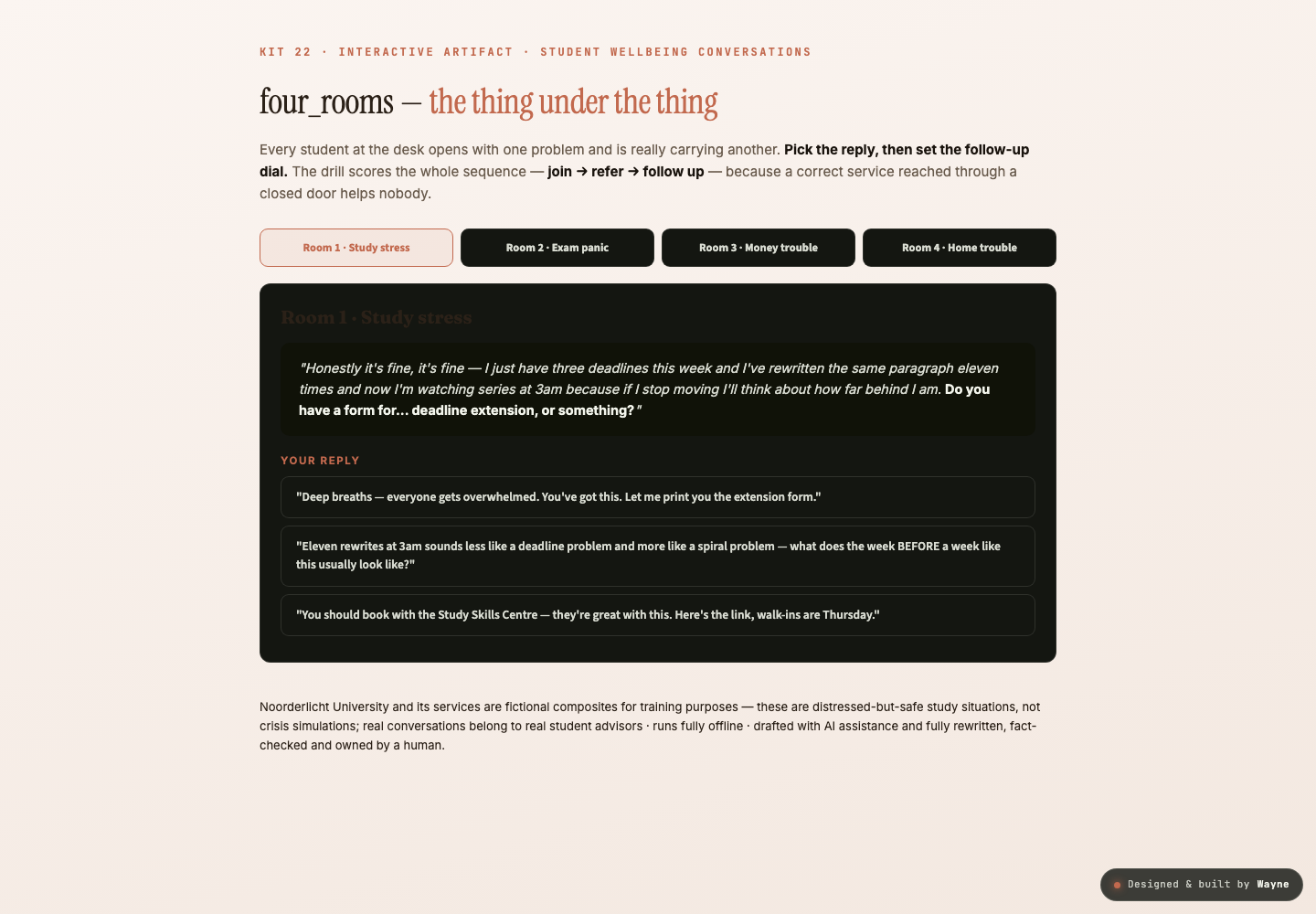
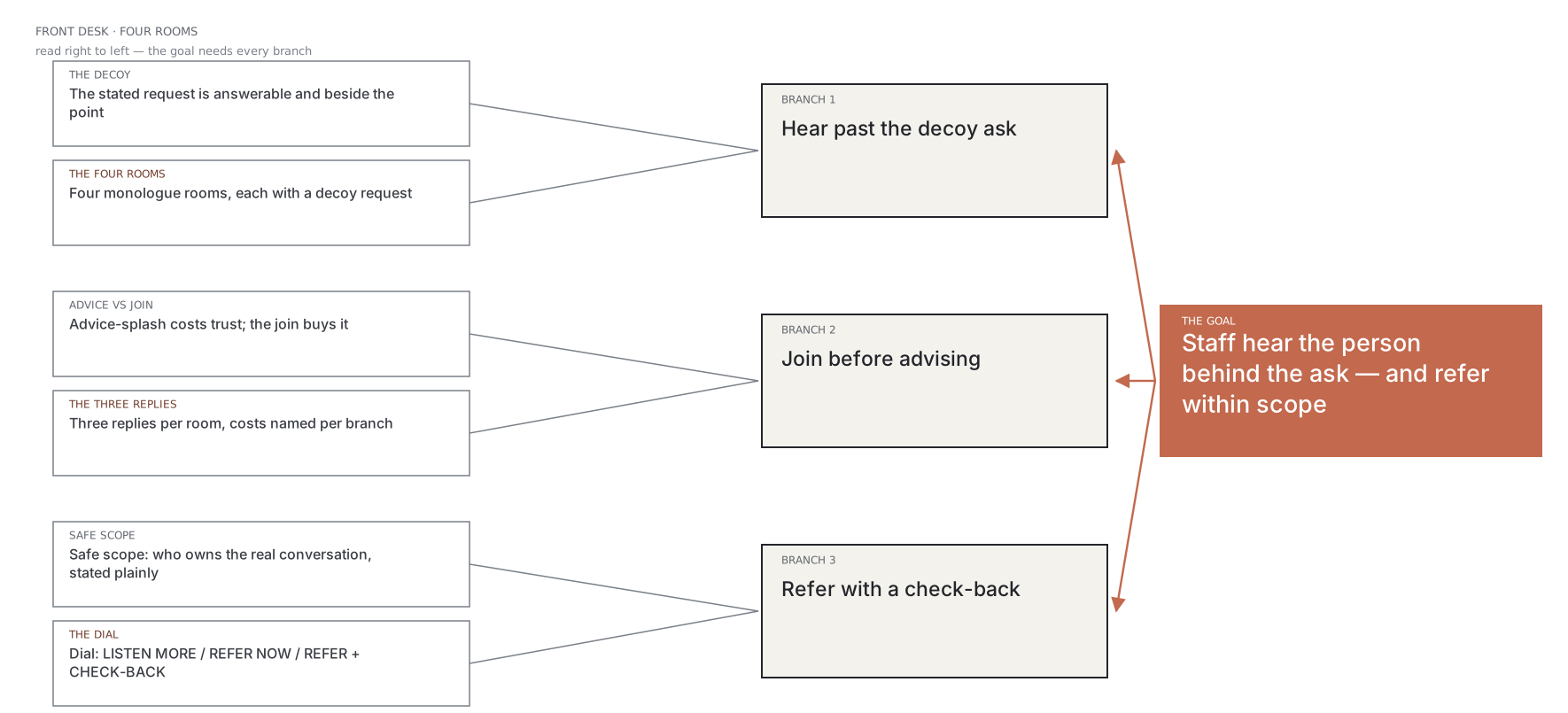
Each room opens with a decoy: the stated ask is real, answerable — and not the point.
Answer the question, miss the person. The drill scores the sequence because every partial sequence fails differently.
3am
the study-stress student asks for a form; the case is the spiral the form lives inside
40%
the exam-panic student knows the material — panic is a performance condition, not a knowledge gap
The problem was the client's. These were mine — the design and build constraints that shaped the solution.
Advice-splash is the enemy
The tempting failure is helping too much, too fast. Each room's advice-splash reply had to be genuinely kind — and genuinely out of scope.
Defensible wrong answers
Distractors must be wrong for named reasons a supervisor would endorse, not strawmen. The defensible-wrong calibration took the longest.
Sequences over moments
Scoring full sequences — join, listen, refer, check-back — instead of single choices makes the trained unit the conversation, not the click.
Dialogue forks with a referral dial: three replies per room (the join, advice-splash, and the correct-service-closed-door), then LISTEN MORE / REFER NOW / REFER + CHECK-BACK. Feedback names what each choice cost; the debrief scores full sequences and explains why partial sequences fail.
The build itself, not a video about it — open it, make the calls, and read what each one costs.
From safe-scope analysis to a four-room conversation trainer — the stages below are the actual production sequence.
Mapped from the decoy structure: each room opens with a stated ask that is real, answerable — and not the point. Answer the question, miss the person. The map scores the referral sequence because every partial sequence fails differently.
The instructional-design foundations that informed this build:
Action Mapping (Clark)
Every behavior the kit produces is traced back to a business goal and a specific practice activity. See the linked action map for the full chain.
Cognitive Load Theory
The Three.js scene reduces extraneous load by visualising abstract systems. Learners focus on the decision, not the interface.
Situated Cognition
The environment matches the real context. Practice happens where the skill will be performed.
Kirkpatrick L1-L4
Evaluation designed for all four levels: reaction, learning, behavior, results. See the linked evaluation plan.
Pre-committed targets (agreed with stakeholders before build, not retrofitted):
Staff rate the rooms ≥4/5 for realism without distress
L1 · Reaction
Staff rate the rooms ≥4/5 for realism without distress
L2 · Learning
≥75% complete full sequences across all four rooms
L3 · Behavior
Referrals logged with a check-back date, not just a handoff
L4 · Results
Service uptake after referral rises; fewer dropped first contacts
Student wellbeing training named every service on campus; the conversations still failed — because a correct referral through a closed door helps nobody. The failure is sequence: join the thing under the thing, then refer, then follow up. The proposal was a dialogue-fork trainer with a referral dial: four distressed-but-safe rooms where the stated ask is always a decoy, three replies each, and a follow-up dial scored as part of the same unit.
A service-directory training session considered · rejected
Accurate and easy to deliver. Rejected because the staff could already name every service — the scored failures were sequence failures: correct destination, zero join, no check-back. A directory maps the roads; it doesn't teach crossing them with someone.
Professional role-play with trained actors considered · rejected
The gold standard for conversation practice. Rejected as the baseline on cost and consistency: actor hours are finite and session quality varies. The trainer gives every staff member unlimited consistent practice first; actors remain the advanced calibration layer.