Fictional client — portfolio build · targets, not field results
Async Process Handover: Built for the 22:00 Reader
She cannot ask you anything. She runs the process at 22:00 tonight.
The Audience
Anyone handing over a process — across teams, timezones, or out the door.
Responsibilities
Element-taxonomy design · structure-matching logic · minute-by-minute simulation — documentation as an empathy test.
The Build
Document design · simulation narrative · scoring logic · AI-assisted drafting (disclosed)
How I used AI in this case
AI drafted handover-document fragments and simulation narrative variants; the element taxonomy, the structure-matching logic and the minute-by-minute scoring were designed by me. Edited, verified and disclosed.
LO1 · Apply
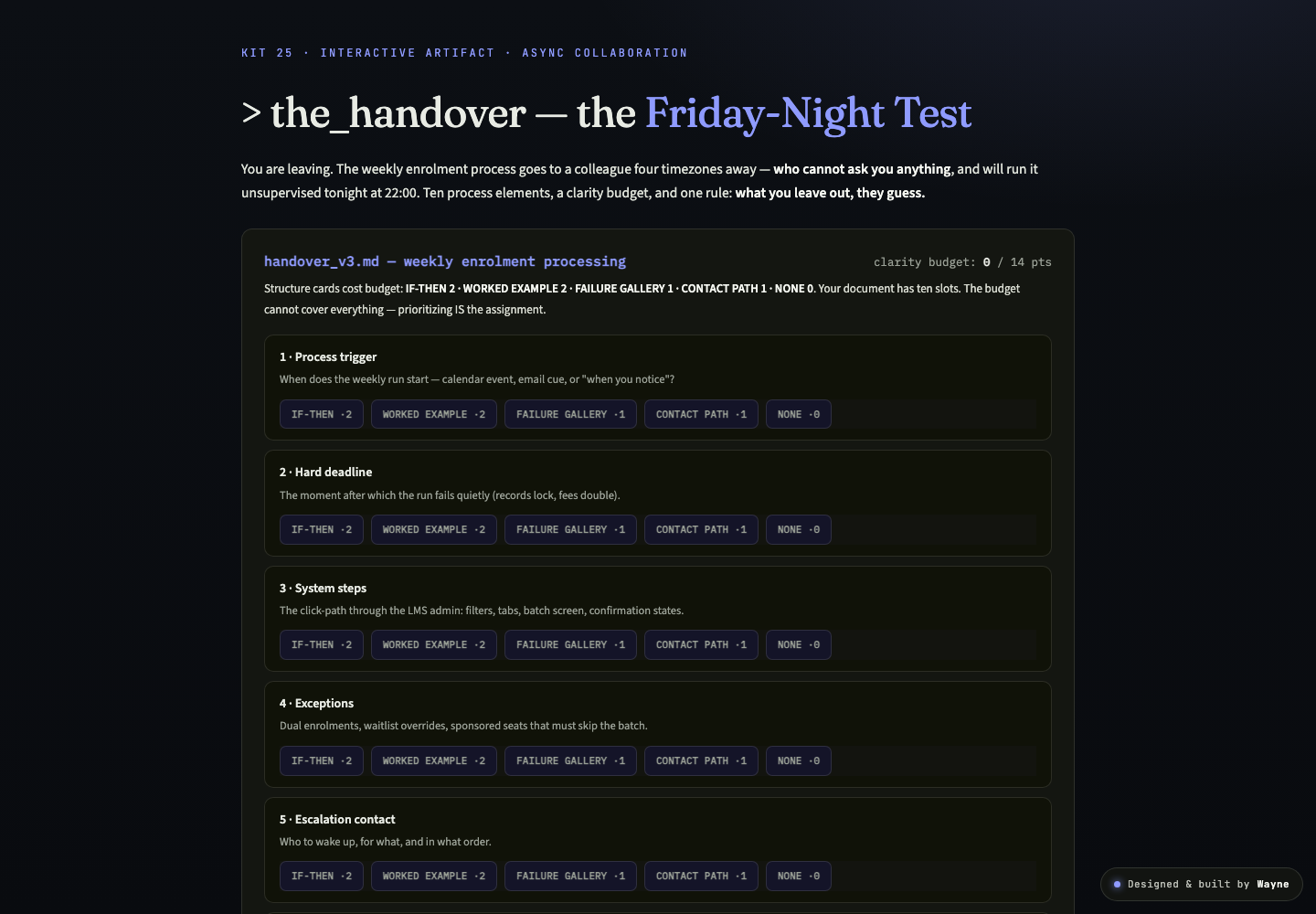
Allocate a 14-point clarity budget across ten process elements for a reader who cannot ask you anything.
LO2 · Discriminate
Apply the five structure cards (if-then, worked example, failure gallery, contact path) where they pay off most.
LO3 · Perform
Run the Friday-night test and close every guess it itemises.
By the end of this experience a learner can do the three things above — assessed by the handover score (hits/10) and the itemised guesses at 22:00. Every interaction in the build exists to create the evidence for one of them.
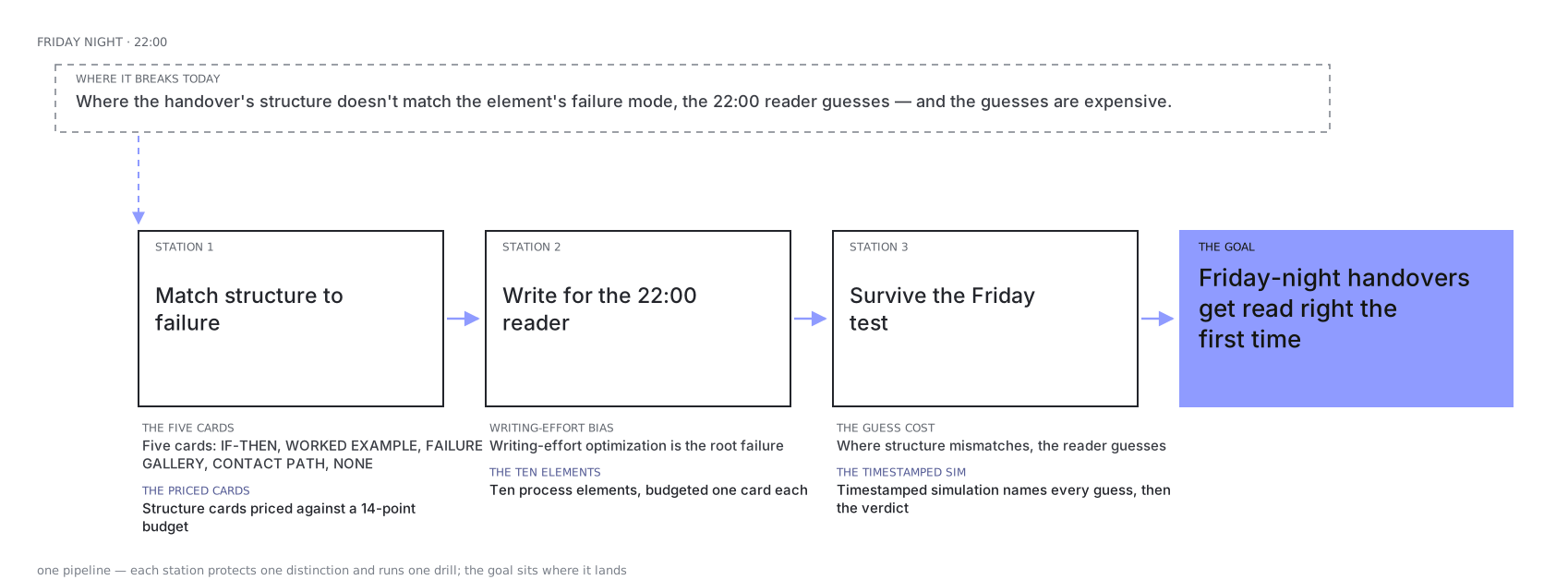
The Friday-night test is merciless because it is realistic. Where the document's structure matches the element's failure mode, the reader proceeds; where it doesn't, she guesses — and the guesses are itemized:
Both failure modes come from the same root: optimizing for writing effort instead of the reader's 22:00.
22:04
Priya opens the doc. No one in the Netherlands is reachable for nine hours.
NONE
elements left unstructured become guesses logged with low confidence
The problem was the client's. These were mine — the design and build constraints that shaped the solution.
Documentation as empathy
The Friday-night test runs minute-by-minute and itemizes every guess your gaps produced — the scoring had to narrate confusion fairly, not punish abstractly.
Five structures, priced honestly
IF-THEN, WORKED EXAMPLE, FAILURE GALLERY, CONTACT PATH, NONE: pricing each against the 14-point budget encodes the real maintenance cost of documentation.
The test must sting precisely
Every gap in the doc maps to a specific wrong turn in the simulation — no generic failure messages, only consequences you authored by omission.
A handover-doc builder with a simulation ending: ten process elements, five structure cards (IF-THEN, WORKED EXAMPLE, FAILURE GALLERY, CONTACT PATH, NONE) priced against a 14-point budget — then the Friday-night test runs minute-by-minute, itemizing every guess your gaps produced.
The build itself, not a video about it — open it, make the calls, and read what each one costs.
From handover failures to a doc builder with a simulation ending — the stages below are the actual production sequence.
Mapped from the Friday-night test: where the document's structure matches the element's failure mode, the reader proceeds — where it doesn't, she guesses, and the guesses are expensive. Both failure modes optimize for writing effort, not the reader's 22:00.
The instructional-design foundations that informed this build:
Action Mapping (Clark)
Every behavior the kit produces is traced back to a business goal and a specific practice activity. See the linked action map for the full chain.
Cognitive Load Theory
The Three.js scene reduces extraneous load by visualising abstract systems. Learners focus on the decision, not the interface.
Situated Cognition
The environment matches the real context. Practice happens where the skill will be performed.
Kirkpatrick L1-L4
Evaluation designed for all four levels: reaction, learning, behavior, results. See the linked evaluation plan.
Pre-committed targets (agreed with stakeholders before build, not retrofitted):
Leavers rate the builder ≥4/5 for 'painfully realistic'
L1 · Reaction
Leavers rate the builder ≥4/5 for 'painfully realistic'
L2 · Learning
≥75% pass ≥8/10 Friday-night checks by second attempt
L3 · Behavior
Handover docs in the team carry if-then exception logic
L4 · Results
First-month errors in handed-over processes drop measurably
The handover failed the moment the leaver's calendar emptied: documents were either comprehensive walls of text (everything rich, nothing prioritized) or bullets plus 'ask me if unclear'. The proposal was a handover-doc builder with a Friday-night test: ten process elements, five structure cards priced against a clarity budget — then a minute-by-minute simulation of a colleague executing the process at 22:00, well outside Netherlands office hours, who cannot ask you anything.
A handover meeting and a shared doc considered · rejected
What every team does. Rejected because the meeting dies with the leaver's last day and the doc survives it — the async reality is that the colleague in Bengaluru executes at 22:00 against the document alone. The simulation reproduces exactly that condition.
A mandated handover-document template considered · rejected
Consistent and auditable. Rejected because a fixed template lets writers fill every box with equal weight — the wall-of-text in compliance form. The budget forces the prioritization: deadline logic and exceptions get the rich structures; the glossary gets pointers.