Fictional client — portfolio build · targets, not field results
Executive Briefing: Twelve Data Cards, One Decision
Twelve numbers. Fifteen minutes. One decision — the brief is a decision, not a report.
The Audience
Analysts and ops leads reporting to executives — plus anyone whose one-pager gets read for fifteen minutes.
Responsibilities
Mechanism-triad design · claim-register scoring · trade-off ethics — advisory as a decision, delivered.
The Build
Executive-communication design · claim calibration · scoring logic · AI-assisted drafting (disclosed)
How I used AI in this case
AI stress-tested claim formulations and drafted variant card texts for the register; the mechanism-triad design, scoring logic and trade-off framing were authored by me. Final copy edited by hand, use disclosed.
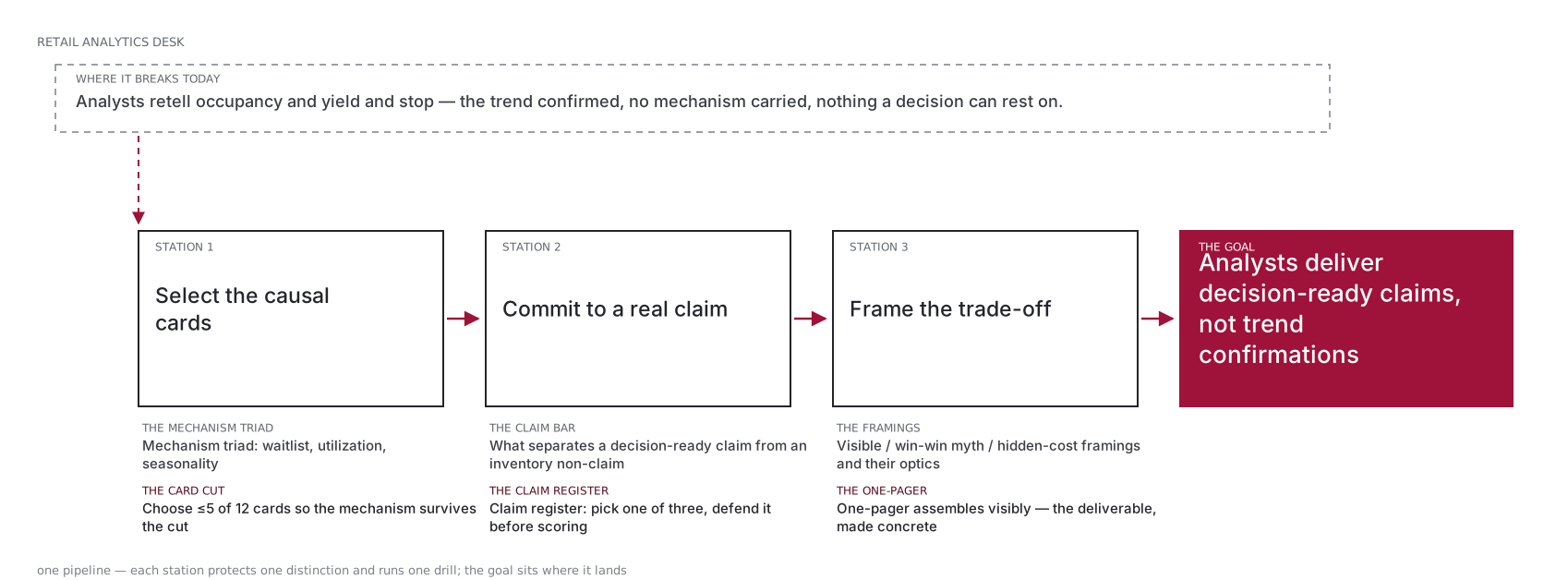
LO1 · Apply
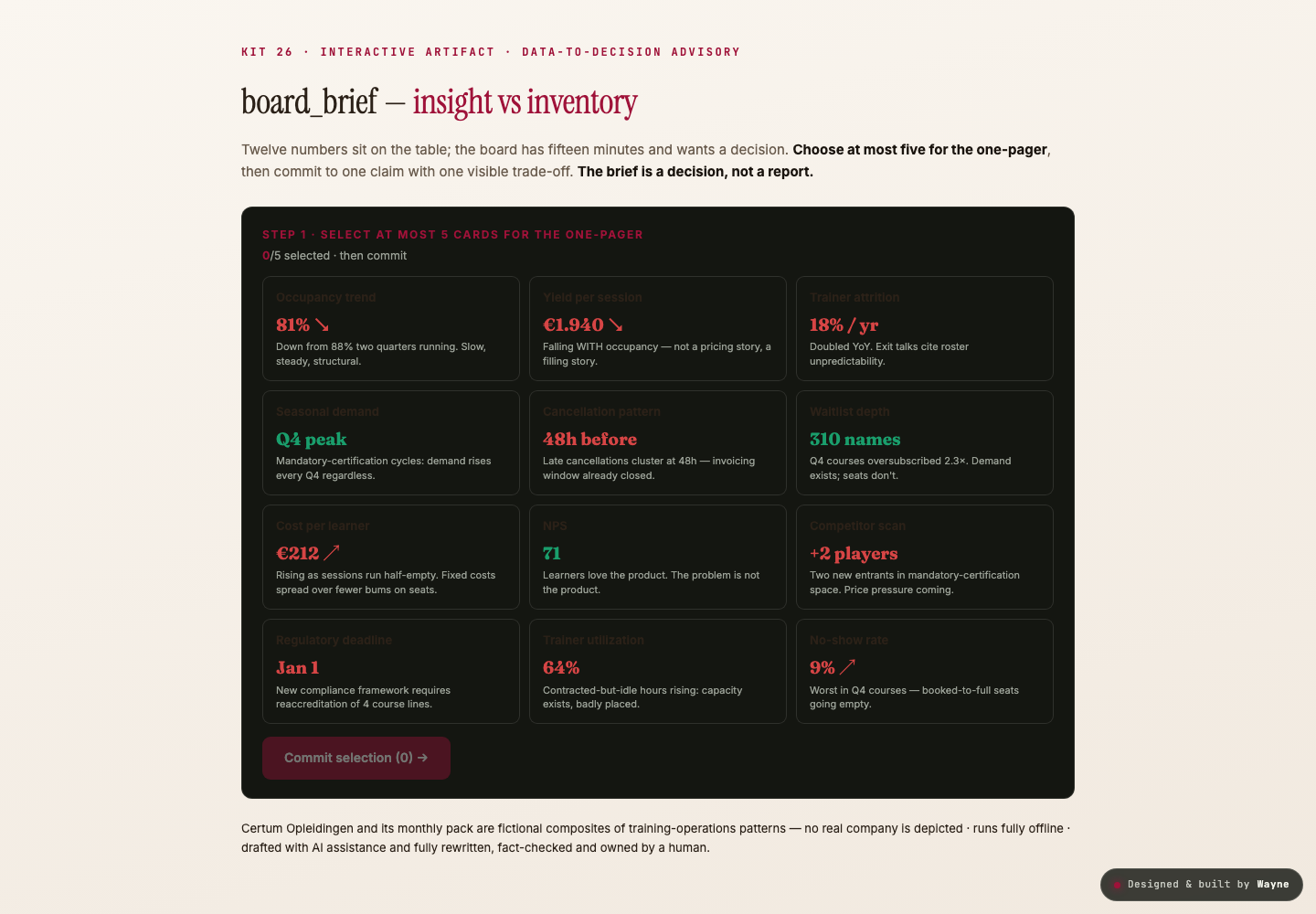
Select the five data cards that carry the decision mechanism — waitlist, utilisation, seasonality.
LO2 · Discriminate
Commit to one causal claim instead of the inventory non-claim.
LO3 · Perform
State the trade-off with its visible cost, not as win-win framing.
By the end of this experience a learner can do the three things above — assessed by the board-ready verdict on claim + trade-off + mechanism triad. Every interaction in the build exists to create the evidence for one of them.
The monthly pack carries a story most analysts never tell:
Occupancy and yield merely confirm the trend. The mechanism triad — waitlist, utilization, seasonality — is what a decision-ready claim must carry.
310
names on the waitlist — 2.3× oversubscribed. Demand is not the problem.
64%
trainer utilization — capacity exists, badly placed
The problem was the client's. These were mine — the design and build constraints that shaped the solution.
Scoring judgment honestly
A brief is not right or wrong. The claim register had to reward decision-ready calibration — not confidence, not hedging — which meant scoring the mechanism behind each claim.
Constraint as the teacher
Five of twelve cards is the lesson. Making the limit feel like the executive's fifteen minutes — not an arbitrary rule — drove the card design and the debrief.
Trade-offs without cynicism
The three frames — visible, win-win myth, appendix-hidden — had to be ethically distinct without caricaturing any of them.
A brief assembler with three registers: select ≤5 of 12 cards, commit to one claim (wrong mechanism / decision-ready / inventory non-claim), then frame one of three trade-offs (visible / win-win myth / appendix-hidden). Your one-pager renders before scoring — and the debrief names the rewarded mechanism triad.
The build itself, not a video about it — open it, make the calls, and read what each one costs.
From executive-communication analysis to a brief assembler — the stages below are the actual production sequence.
Mapped from the story analysts never tell: occupancy and yield merely confirm the trend. The mechanism triad — waitlist, utilization, seasonality — is what a decision-ready claim must carry, so it anchors every branch.
The instructional-design foundations that informed this build:
Action Mapping (Clark)
Every behavior the kit produces is traced back to a business goal and a specific practice activity. See the linked action map for the full chain.
Cognitive Load Theory
The Three.js scene reduces extraneous load by visualising abstract systems. Learners focus on the decision, not the interface.
Situated Cognition
The environment matches the real context. Practice happens where the skill will be performed.
Kirkpatrick L1-L4
Evaluation designed for all four levels: reaction, learning, behavior, results. See the linked evaluation plan.
Pre-committed targets (agreed with stakeholders before build, not retrofitted):
Analysts rate the assembler ≥4/5 for 'brutally close to the real meeting'
L1 · Reaction
Analysts rate the assembler ≥4/5 for 'brutally close to the real meeting'
L2 · Learning
≥70% land claim and trade-off both on first full run
L3 · Behavior
Monthly briefs open with a claim + named trade-off
L4 · Results
Board decisions land in-meeting instead of next-quarter
The monthly pack was complete and unread: twelve numbers, no decision, and four executives redoing the analysis with worse data. The analyst's real skill is selection and claim-making, not comprehensiveness. The proposal was a brief assembler: twelve data cards, at most five for the one-pager, one claim, one visible trade-off — with the debrief naming the mechanism triad (waitlist depth, trainer utilization, seasonal demand) the claim must carry.
A data-visualization course considered · rejected
The professional-development default. Rejected because the charts were already fine — the failure was selecting which numbers earn a place and committing to a claim with its cost visible. A prettier version of the twelve-card dump is still a dump.
A longer monthly report with an executive summary considered · rejected
Thorough and defensible. Rejected because the board's constraint is attention, not information — 'longer, with a summary' adds a layer to the exact artifact that already fails. The brief is a decision; the report remains in the appendix where it belongs.