Fictional client — portfolio build · targets, not field results
Wind-Turbine Alarm Calls: Restart or Hold?
The alarm is cleared, the SCADA is green, and production is screaming for megawatts. Restart or hold?
The Audience
Offshore wind control-room technicians and onshore O&M staff making remote restart decisions — plus shift leads calibrating the escalation boundary with the production desk.
Responsibilities
Alarm-pattern analysis · scenario economics (making the wrong call tempting) · feedback design · pressure simulation — decision discipline made playable.
The Build
Pattern-based scenario design · HUD instrumentation · economic tension crafting · AI-assisted drafting (disclosed)
How I used AI in this case
AI drafted alarm-log and production-desk dialogue variants; the pattern taxonomy, scenario economics and scoring logic were authored by me. Edited, verified and disclosed.
LO1 · Apply
Call restart or keep-stopped on each of the four alarm patterns — with inspection priced in as the cost of safety.
LO2 · Discriminate
Recognise recurrence-after-reset as a pattern, never an isolated event.
LO3 · Perform
Defend a megawatts-costing safe call to a production manager demanding output.
By the end of this experience a learner can do the three things above — assessed by full-pattern recognition on first run (4/4). Every interaction in the build exists to create the evidence for one of them.
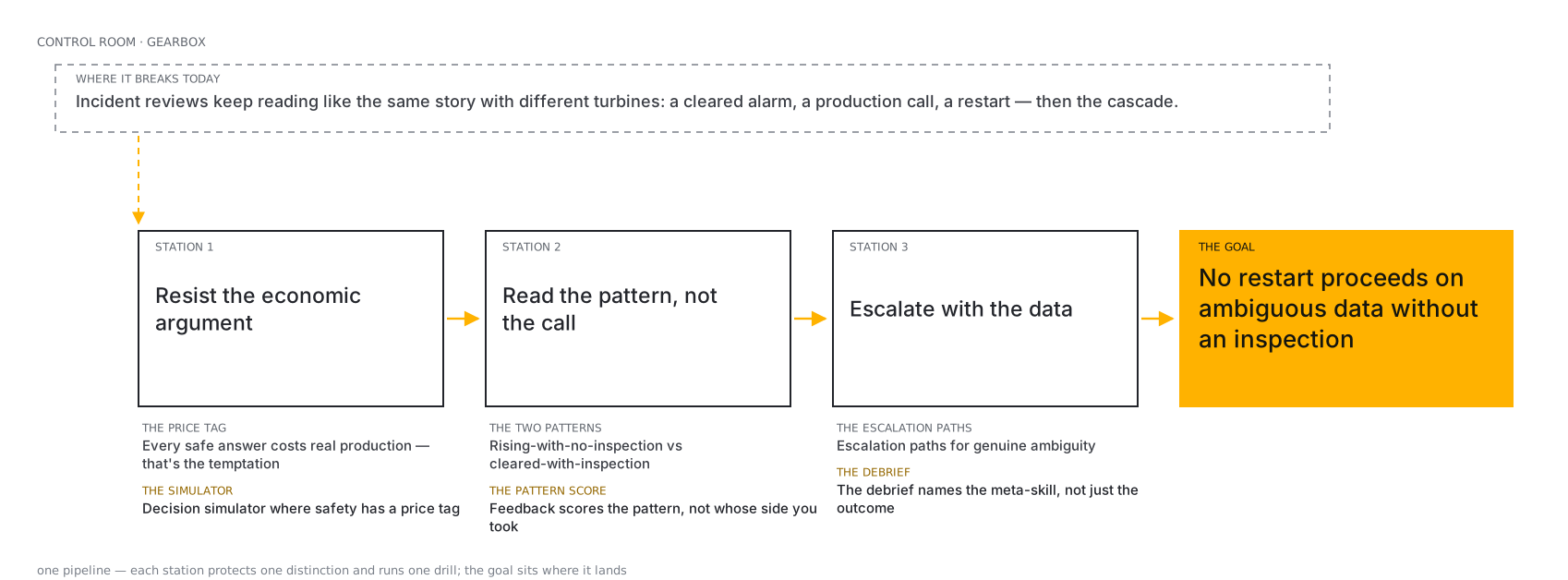
The incident reviews read like the same story with different turbines: a cleared alarm, a production call, a restart — and then the gearbox cascade nobody ordered:
Training taught alarm thresholds. It didn't practice resisting the economic argument when the data is genuinely ambiguous — which is the actual job.
8–12 wks
main-gearbox replacement — crane lead time dominates the bill
60%
of major-component failures showed rising vibration before the run
1 call
is all it takes: production pressure converted a trend into a restart
The problem was the client's. These were mine — the design and build constraints that shaped the solution.
Make safe expensive
Every scenario prices the safe answer in lost megawatts. If the temptation is not real, the discipline is not either — scenario economics was the core design problem.
Score the pattern, not the outcome
Rising-with-no-inspection vs cleared-with-inspection: the scoring rewards the decision pattern even when production suffers, because luck is not a skill.
The HUD is the desk
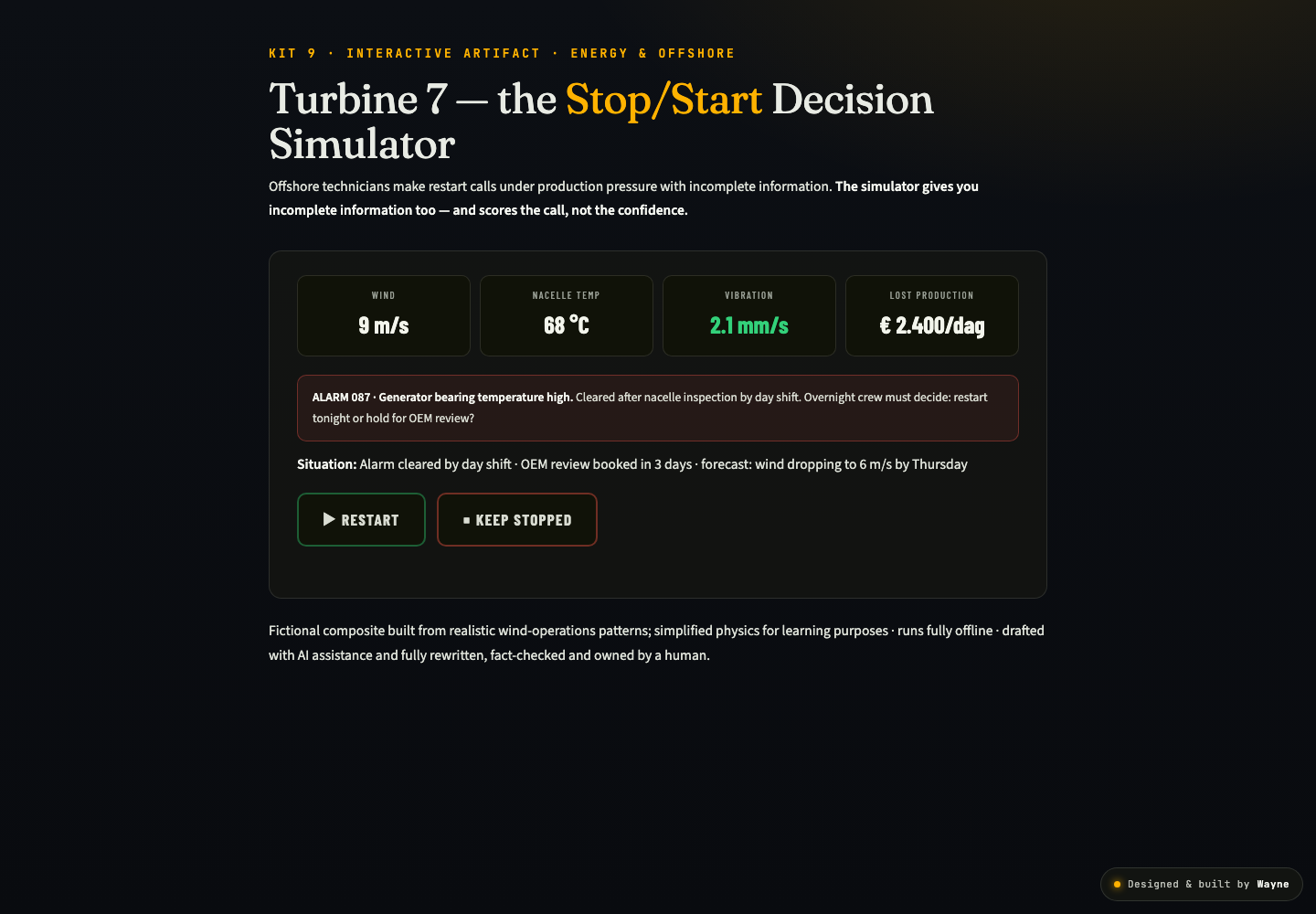
Wind, temperature, vibration and lost production stay visible because that is the real decision surface. Removing them would fake the job the trainer exists to build.
A decision simulator where every scenario has a real economic cost to the safe answer — and the feedback scores the pattern (rising-with-no-inspection vs cleared-with-inspection), not whether production got its megawatts. The HUD keeps wind, temperature, vibration and lost production visible, because that's the desk.
The build itself, not a video about it — open it, make the calls, and read what each one costs.
From incident reviews to a shipped simulator — the stages below are the actual production sequence.
Mapped from incident reviews that read like the same story with different turbines: a cleared alarm, a production call, a restart — then the gearbox cascade nobody ordered. Training taught thresholds; the map practices resisting the economic argument.
The instructional-design foundations that informed this build:
Action Mapping (Clark)
Every behavior the kit produces is traced back to a business goal and a specific practice activity. See the linked action map for the full chain.
Cognitive Load Theory
The Three.js scene reduces extraneous load by visualising abstract systems. Learners focus on the decision, not the interface.
Situated Cognition
The environment matches the real context. Practice happens where the skill will be performed.
Kirkpatrick L1-L4
Evaluation designed for all four levels: reaction, learning, behavior, results. See the linked evaluation plan.
Pre-committed targets (agreed with stakeholders before build, not retrofitted):
"The pressure felt real" — O&M team debrief, ≥4/5
L1 · Reaction
"The pressure felt real" — O&M team debrief, ≥4/5
L2 · Learning
Full-pattern recognition on first run: 4/4
L3 · Behavior
Documented inspection-before-restart rate on rising trends: 100%
L4 · Results
Major-component failure rate ↓ year-over-year; lost-production per avoidable stop ↓
Incident reviews kept telling the same story: a cleared alarm, a production manager pushing for megawatts, a restart, a gearbox cascade. The technicians knew every threshold. What they had never practiced was resisting the economic argument under genuine ambiguity. The proposal was a SCADA-style restart/hold simulator: live wind, temperature, vibration and lost-production readouts, four alarm patterns — cleared, rising, recurring, external-cause — and a production desk voice that argues, convincingly, for the wrong call.
Alarm-threshold e-learning considered · rejected
Cheap, trackable, familiar. Rejected because thresholds were never the failure — every technician in the incidents could recite them. The module would re-teach what the control room already knows and leave the decision moment untouched.
Case-review sessions on past incidents considered · rejected
Valuable and honest. Rejected as the core format because hindsight flattens pressure: everyone knows how the story ends, so nobody practices the ambiguity. The simulator restores the uncertainty and the production-desk voice; the reviews remain as the debrief material.