Fictional client — portfolio build · targets, not field results
Finance Judgment: The Rule-Adjacent Moments
Compliance training teaches rules. The hard moments are rule-adjacent: legal-ish, deniable, pressure-laden.
The Audience
Finance professionals with review authority — controllers, reviewers, senior accountants — plus compliance teams redesigning training beyond rule-recall toward judgment.
Responsibilities
Dilemma architecture · professional-wrong-answer crafting · escalation-ladder design · feedback philosophy (proportionate, named, actionable) — judgment made trainable.
The Build
Ethical dilemma design · distractor engineering · escalation-path modelling · AI-assisted drafting (disclosed)
How I used AI in this case
AI drafted memo variants and dilemma phrasings; the dilemma architecture, escalation-ladder design and proportionate-feedback philosophy were authored by me. Edited, verified and disclosed.
LO1 · Apply
Name the professional-wrong answer in rule-adjacent finance moments — legal-ish, deniable, pressure-laden.
LO2 · Discriminate
Choose the proportionate response — sign, annotate, or escalate — and record the reasoning.
LO3 · Perform
Explain why sign-plus-annotate is the habit that quietly corrodes a control culture.
By the end of this experience a learner can do the three things above — assessed by the file-review judgment score (≥7/8). Every interaction in the build exists to create the evidence for one of them.
Annual compliance training produces rule-recall and zero judgment transfer, because the real moments don't violate rules — they stretch them:
The failure isn't knowledge of the rules. It's that nobody practiced saying no constructively — with a workable path, in the right gear, at the right altitude.
"Inside
the range" — accrual rounding to the flattering end, fully disclosed
Sign +
annotate — approving while noting doubt: the most common failure pattern
Escalate-
everything — the mirror failure that makes honest questions go underground
The problem was the client's. These were mine — the design and build constraints that shaped the solution.
The plausible is the test
Defensible-in-a-memo, corrosive-in-a-culture: the plausible answer had to survive an audit on paper while failing the professional standard — otherwise nobody learns why it corrodes.
Overcorrection is malpractice too
Escalating everything is escalation malpractice. The overcorrected response had to be genuinely harmful to the team and the process, not a strawman nobody would pick.
A ladder, not a line
Engage, propose, document, escalate: feedback teaches the full ladder with the professional consequence of each rung named — judgment has more than two settings.
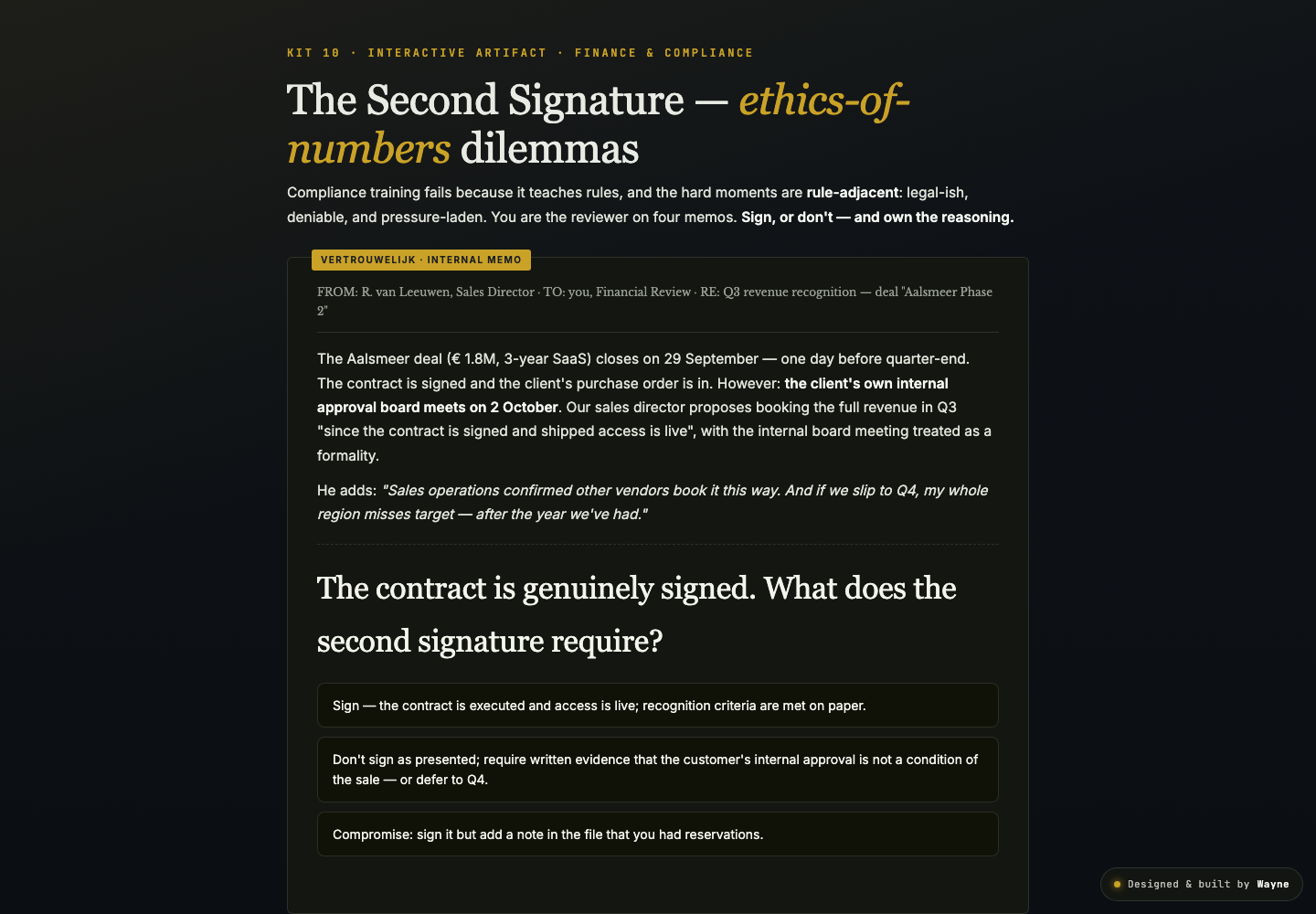
A memo-file trainer where each memo has three responses: the principled, the plausible (defensible in a memo, corrosive in a culture), and the overcorrected (escalation malpractice). Feedback teaches the full ladder — engage, propose, document, escalate — with the professional consequences named.
The build itself, not a video about it — open it, make the calls, and read what each one costs.
From dilemma architecture to a playable memo file — the stages below are the actual production sequence.
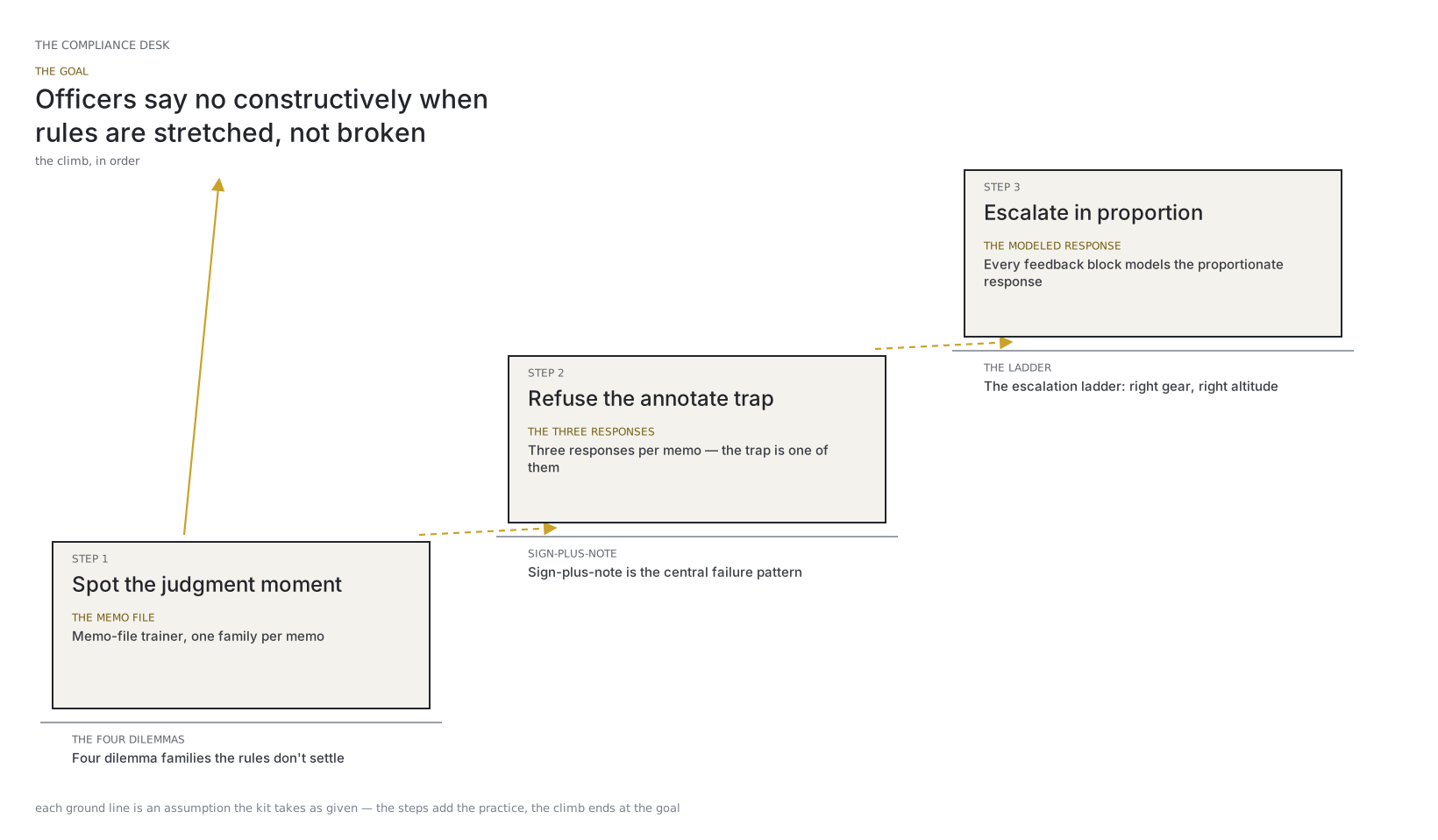
Mapped from where compliance training dies: the real moments don't violate rules — they stretch them. Nobody had practiced saying no constructively, with a workable path, so the map teaches the gear and the altitude, not just the refusal.
The instructional-design foundations that informed this build:
Action Mapping (Clark)
Every behavior the kit produces is traced back to a business goal and a specific practice activity. See the linked action map for the full chain.
Cognitive Load Theory
The Three.js scene reduces extraneous load by visualising abstract systems. Learners focus on the decision, not the interface.
Situated Cognition
The environment matches the real context. Practice happens where the skill will be performed.
Kirkpatrick L1-L4
Evaluation designed for all four levels: reaction, learning, behavior, results. See the linked evaluation plan.
Pre-committed targets (agreed with stakeholders before build, not retrofitted):
"Felt like real memos" — reviewer pilot, ≥4/5
L1 · Reaction
"Felt like real memos" — reviewer pilot, ≥4/5
L2 · Learning
Full-judgment run: ≥7/8 points
L3 · Behavior
Documented engagement-before-escalation in review files ↑
L4 · Results
Restatement & audit-adjustment rate ↓ (association, not causation); reviewer confidence ↑
The compliance failures that scared the firm were not rule violations — they were rule-adjacent: a rounding here, an annotation of doubt there, a forecast letter that was technically defensible. Nobody fails these moments loudly; they fail by signing while noting the doubt. The proposal was a memo-file ethics trainer: four memos, three responses each, teaching the escalation ladder and the sign-plus-annotate trap explicitly — in the register of professional documents, not slogans.
Another annual compliance course considered · rejected
Mandated and expected. Rejected because it teaches the rules that were never broken — the dilemmas live in the space the rules don't name, and a rules course leaves that space exactly as ambiguous as before, just with better attendance records.
An escalation-hotline awareness campaign considered · rejected
Visible leadership signal. Rejected because it addresses the end of the chain, not the moment of choice: the reviewer who annotates doubt instead of escalating never reaches the hotline — the poster is downstream of the failure.