Fictional client — portfolio build · targets, not field results
Docent Conversation Training: Four Visitor Types
Docents memorise the catalogue and still freeze when a child asks if the painter used a photo.
The Audience
New museum docents (volunteers, mixed ages) at a mid-size art museum — plus education staff redesigning their volunteer training around conversation rather than content delivery.
Responsibilities
Visitor-archetype research · conversation design · distractor crafting (the plausible-but-wrong docent move) · scoring rubric — joining behavior made visible and trainable.
The Build
Branching scenario design · archetype modelling · feedback writing with behavioral rationale · AI-assisted drafting (disclosed)
How I used AI in this case
AI drafted visitor-dialogue variants for the four archetypes; archetype research, distractor crafting and the behavioral-rubric feedback were authored by me. Edited, verified and disclosed.
LO1 · Apply
Join a visitor's move — curiosity, expertise, project or grief — before redirecting it.
LO2 · Discriminate
Choose responses that open the conversation rather than manage the visitor.
LO3 · Perform
Stay with the grieving visitor without retreating into catalogue facts.
By the end of this experience a learner can do the three things above — assessed by the join-rate score in-build (trainer join-rate ≥6/8). Every interaction in the build exists to create the evidence for one of them.
Docent training covers the collection thoroughly and the visitors not at all. The gaps show up in the galleries:
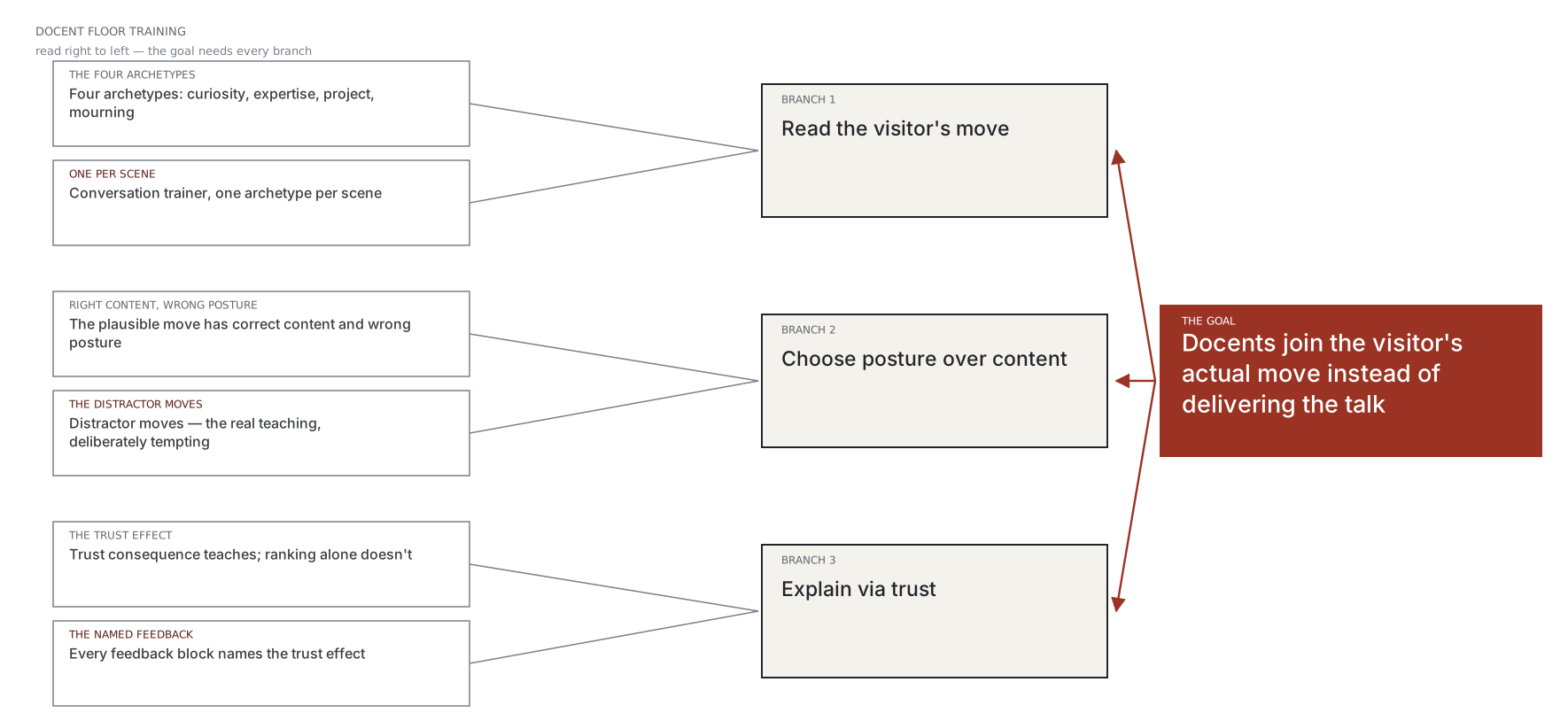
The training gap isn't knowledge; it's a lens: seeing what move the visitor is making (curiosity, expertise, project, mourning) and joining it — instead of delivering the memorised talk.
Kids
questions get corrected instead of answered — the family leaves
Experts
get managed as threats instead of recruited as allies
Grief
gets deflected — the moment the visit was actually for
The problem was the client's. These were mine — the design and build constraints that shaped the solution.
Correct content, wrong posture
The plausible move knows the painting and misses the visitor. Writing content-accurate distractors was harder than writing failures — they must be genuinely good docenting, one posture away.
Archetypes without caricature
Four visitor types must feel like Saturday visitors, not demographics; each needs a genuine motivation the docent can join rather than manage.
Feedback names the principle
Ranking moves teaches obedience; naming the behavioral principle — meet before manage — teaches judgment that transfers to the next visitor.
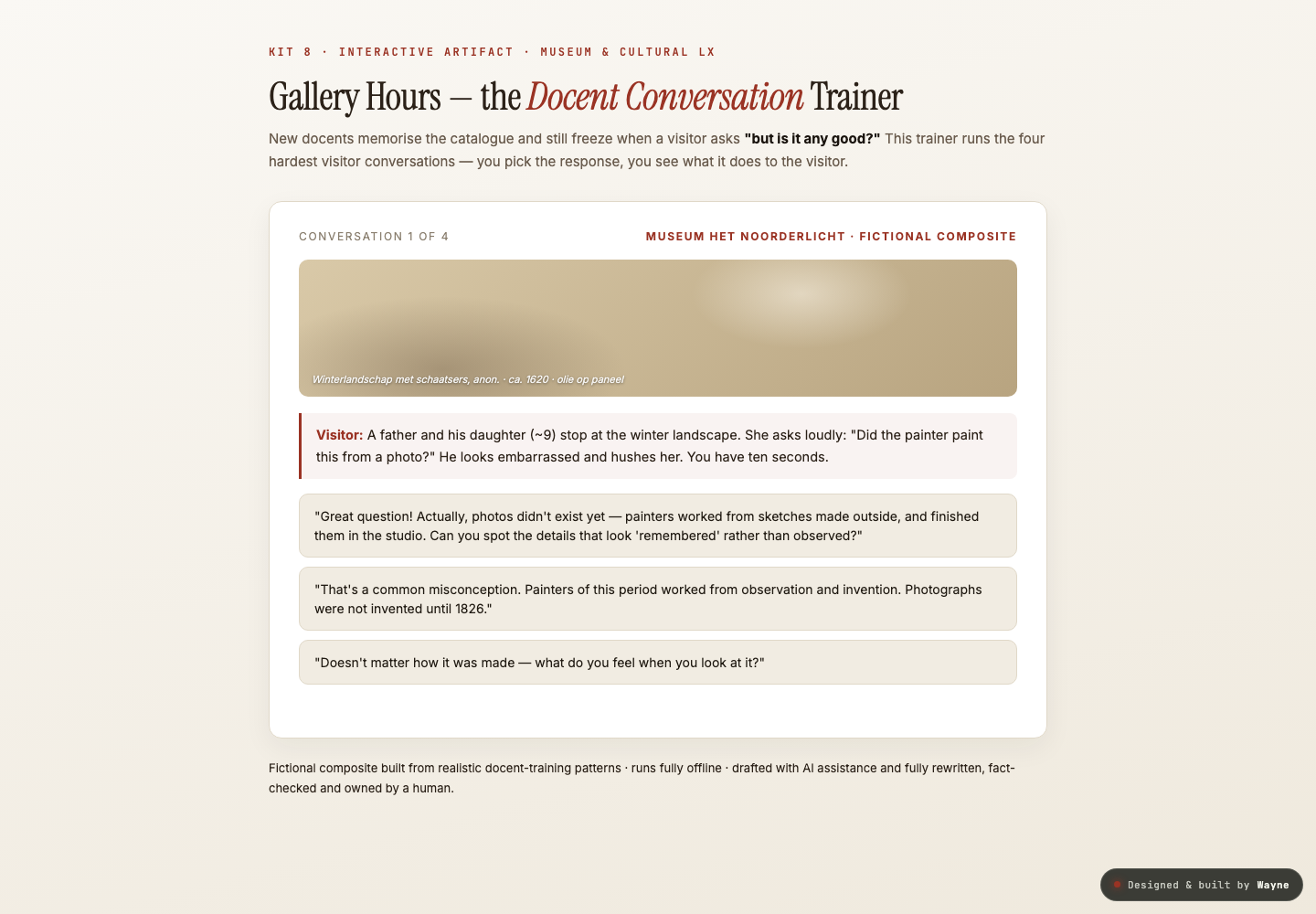
A conversation trainer built on four visitor archetypes, each with three docent moves: the best (joins the visitor's actual move), the plausible (correct content, wrong posture), and the tempting failure (manages instead of meets). Feedback names the behavioral principle, never just the ranking.
The build itself, not a video about it — open it, make the calls, and read what each one costs.
From visitor research to a conversation trainer — the stages below are the actual production sequence.
Mapped from the training gap: docent training covers the collection thoroughly and the visitors not at all. The missing piece is a lens — seeing which move the visitor is making — so the map is organized around the four archetypes.
The instructional-design foundations that informed this build:
Action Mapping (Clark)
Every behavior the kit produces is traced back to a business goal and a specific practice activity. See the linked action map for the full chain.
Cognitive Load Theory
The Three.js scene reduces extraneous load by visualising abstract systems. Learners focus on the decision, not the interface.
Situated Cognition
The environment matches the real context. Practice happens where the skill will be performed.
Kirkpatrick L1-L4
Evaluation designed for all four levels: reaction, learning, behavior, results. See the linked evaluation plan.
Pre-committed targets (agreed with stakeholders before build, not retrofitted):
Docent-council pilot: "harder than the real thing" ≥4/5
L1 · Reaction
Docent-council pilot: "harder than the real thing" ≥4/5
L2 · Learning
Trainer join-rate ≥6/8 on first run
L3 · Behavior
Mystery-visitor conversation scores +20% next season
L4 · Results
Docent-led visit satisfaction ↑; volunteer first-year retention ↑
Docents aced the collection training and still struggled with the collection's visitors — the child's question, the visiting expert's challenge, the mourner in front of one painting. The gap was conversational: joining a visitor's move rather than managing them. The proposal was a branching conversation trainer: four visitor archetypes, three docent moves each, scored on one lens — did you join, or manage? — with the grieving visitor as the deliberate emotional center.
More collection-knowledge training considered · rejected
The department's reflex request. Rejected because the pain points in the data were all interpersonal, not factual — and more art history gives the docent more material to lecture with, which is the failure mode itself.
A mystery-visitor program alone considered · rejected
Real measurement, real stakes. Rejected as a standalone because it scores the failure without building the skill — docents would be measured on moments they were never safe to practice. The trainer becomes the practice surface; the mystery program stays as the L3/L4 instrument.