Fictional client — portfolio build · targets, not field results
AI Adoption Program: From Curious to Governed Weekly Use
300 desk workers, 60 days: from "AI is a chatbot I've heard of" to "AI is a governed habit in my week" — without a single policy-breach incident.
The Audience
300 desk employees across Finance, HR and Ops-planning at Helios Facilities Group — general employees with Monday-morning workloads and no AI background; managers get their own enablement layer.
Responsibilities
Adoption-stage architecture · persona-driven curriculum · prompt-pattern trainer build · manager enablement pack · GDPR-aware governance design — the Curious→Capable→Confident→Governed arc.
The Build
Adoption-stage design · interactive prompt-pattern trainer (HTML) · traffic-light data classification · manager huddle scripts · AI-assisted drafting (disclosed)
How I used AI in this case
AI drafted first-pass persona task lists and huddle-script variants; the adoption arc, traffic-light classification and trainer scoring were designed by hand. All output edited, verified and disclosed.
LO1 · Apply
Rewrite a vague request into a structured prompt using the four taught patterns (RTF, few-shot, decompose, critic-loop).
LO2 · Discriminate
Choose the right prompt pattern for a real task in your own desk role (finance, HR or ops-planning persona).
LO3 · Perform
Apply the governance guardrails — which data may and may not go into a prompt — before hitting send.
By the end of this experience a learner can do the three things above — assessed by the /12 pattern check in-build and the 60-day weekly-use adoption metric. Every interaction in the build exists to create the evidence for one of them.
Abstract adoption programs produce abstract adoption (zero). The honest baseline at Helios:
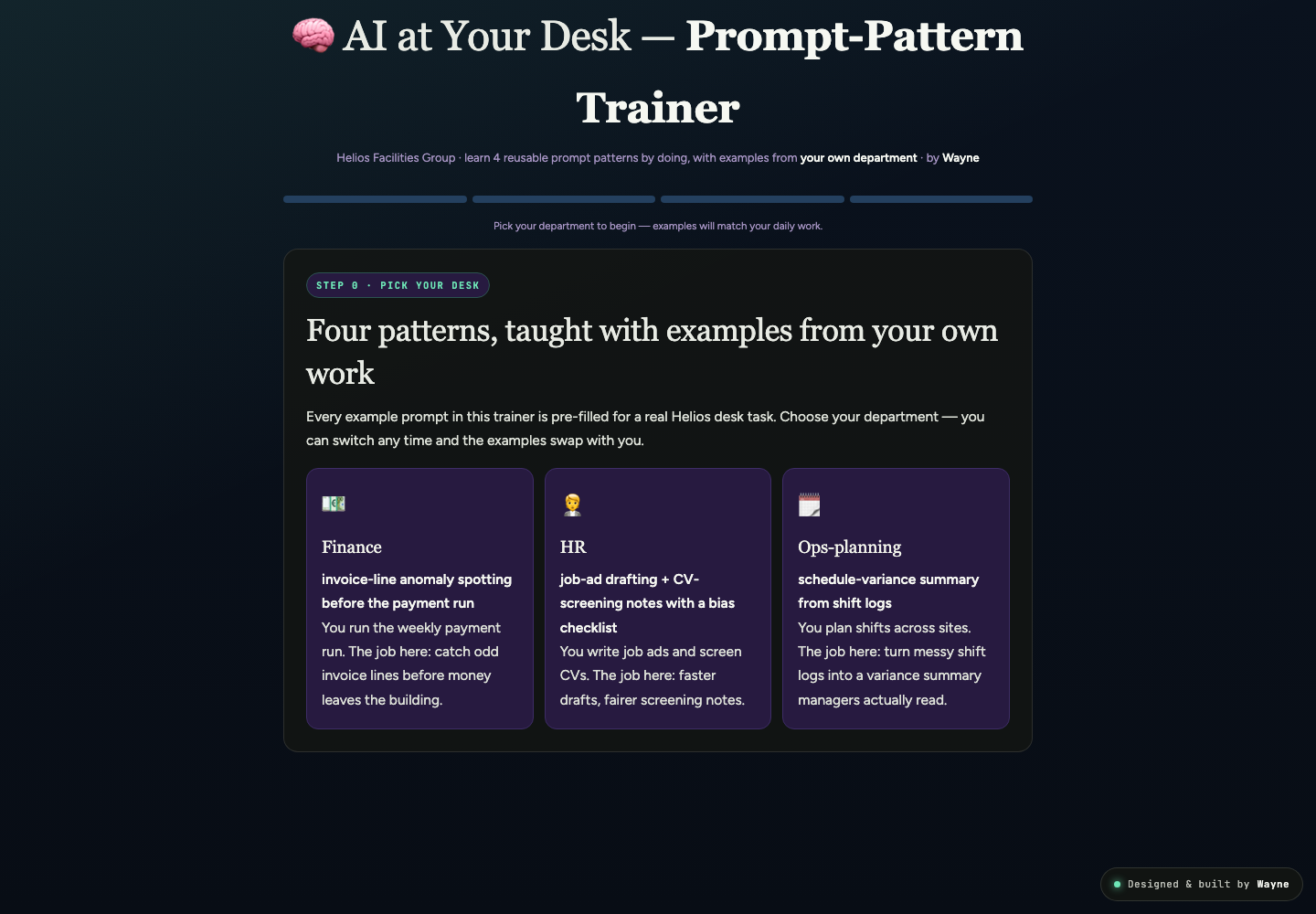
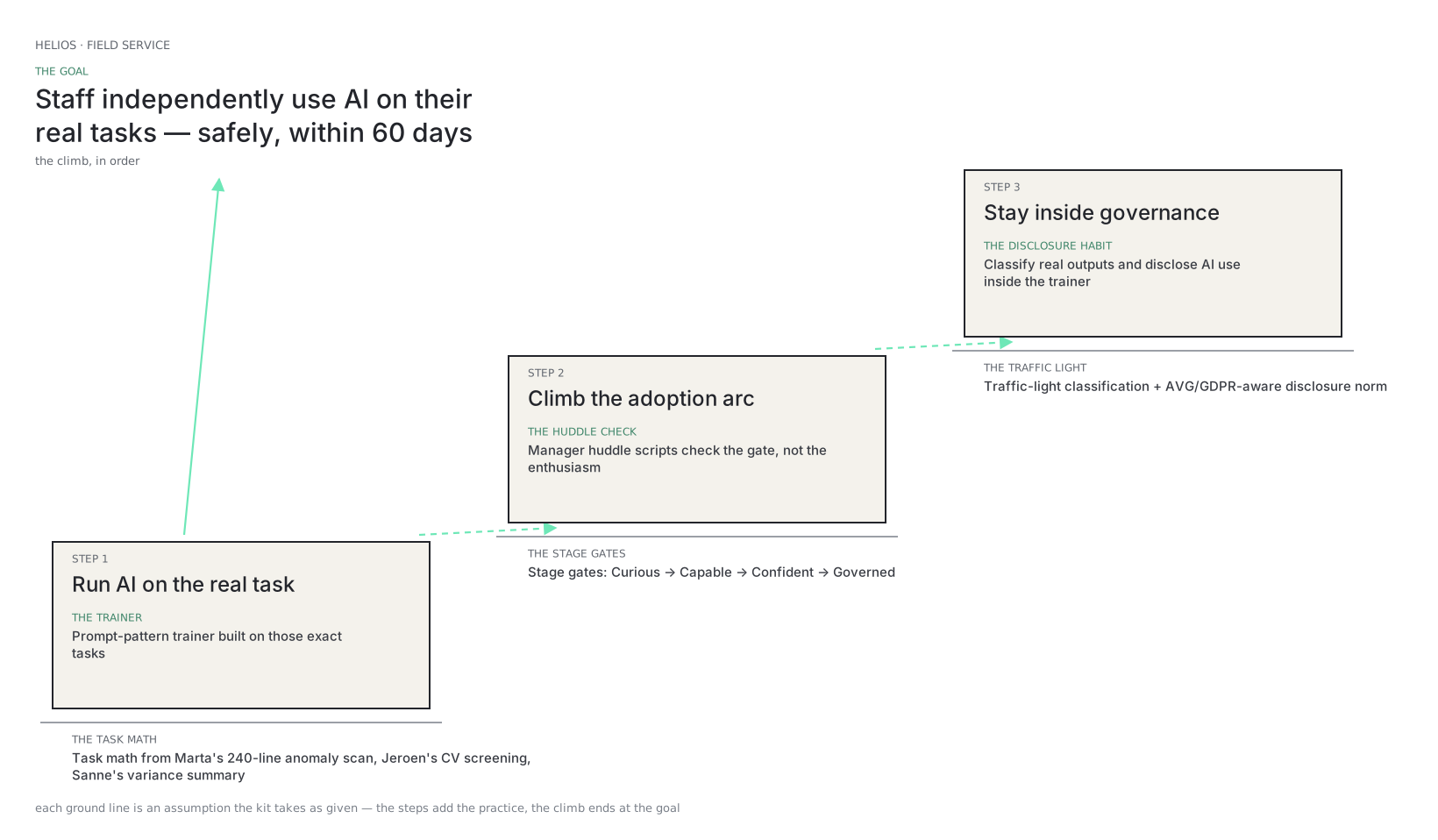
Every task here is real: Marta's 240-line anomaly scan, Jeroen's 38-CV screening, Sanne's 90-minute variance summary. If a training example doesn't map to one of their tasks, it gets cut.
300
desk employees — most have tried a chatbot once, none have a governed habit
3.5h
Marta's weekly invoice-line scan — fatigue errors after hour 2
15min
per CV for Jeroen — style drifts by CV #20, bias risk rises
The problem was the client's. These were mine — the design and build constraints that shaped the solution.
Adoption is not a course
A 60-day arc with managers as co-deliverers cannot live in one module. The design had to produce artifacts managers actually use — huddle scripts, one-page guardrails — or the training would evaporate by week two.
Governance with teeth
Most AI guidance is vibes. Translating GDPR-aware rules into a traffic-light data table an employee can apply in five seconds — and a manager can enforce — took more iterations than any training content.
Personas without stereotypes
Finance, HR and Ops-planning work differently. Each persona needed real Monday-morning tasks inside the trainer, or the prompt patterns would teach nothing transferable.
A 60-day, four-stage adoption arc — Curious → Capable → Confident → Governed — taught through an interactive prompt-pattern trainer on the personas' real tasks, wrapped in manager huddle scripts and one-page guardrails with enforcement teeth (the traffic-light table).
The build itself, not a video about it — open it, make the calls, and read what each one costs.
From persona research to a 60-day adoption arc — the stages below link the working documents.
More design docs
Mapped backwards from the honest baseline at Helios: adoption was zero because training was abstract. Every branch below is anchored to one of the three personas' real tasks — if it didn't map to Marta's, Jeroen's or Sanne's work, it got cut.
The foundations that shaped this design — mapped to the specific decisions made in the build:
Diffusion of Innovation (Rogers)
The 60-day arc maps onto the adoption curve: Innovators to Early Adopters to Early Majority to Late Majority to Laggards. The motion graphics funnel makes this visible so managers see the gap their huddles must close.
Adult Learning Theory (Andragogy)
Managers as co-deliverers require immediately applicable content. The toolkit provides templates and scripts for 6-huddle conversations — no theory without practice.
Action Mapping
Business goal: safe AI adoption. Behavior change: managers run structured huddles. Skills: prompt evaluation, output verification, bias detection. Practice: the adoption tour with gap radar.
Kirkpatrick L1-L4
L1: >=4/5 usefulness on manager confidence surveys. L2: >=85% correct gap identification. L3: 4.2/5 average huddle rating. L4: 60-day AI usage metrics improvement.
Pre-committed targets (agreed with stakeholders before build, not retrofitted):
Session usefulness ≥4/5 per stage; manager pulse
L1 · Reaction
Session usefulness ≥4/5 per stage; manager pulse
L2 · Learning
Trainer pattern checks passed; guardrail two-second test ≥90%
L3 · Behavior
≥60% of desk staff with a named weekly AI use case by day 60
L4 · Results
Persona task hours (3.5h→1h class); zero policy-breach incidents
'Run AI training' was the request; the needs analysis reframed it. Three hundred desk workers did not need to know what AI is — they needed specific, governed AI habits inside their actual weekly tasks. The proposal was a 60-day adoption program built on three personas with task math: each persona gets named tasks (hours reclaimed, drafts accelerated, errors caught), stage gates, and a governed toolset — so adoption is measured in task-level behavior, not course completions.
A generic AI-awareness e-learning course considered · rejected
Cheap, fast, and the default across the market. Rejected because awareness is not adoption: everyone completing it would still open the same three tools on Monday and use two of them badly. The unit of change is the task, not the awareness.
Deep training on one specific AI tool considered · rejected
Concrete and demo-able. Rejected because tools churn — a year of tool-specific skill evaporates with the next vendor pivot. The program teaches persona-level patterns (draft-and-verify, summarize-and-check) that survive tool turnover.