Fictional client — portfolio build · targets, not field results
New-Hire Onboarding Program: Days to Solo, 41 → 26
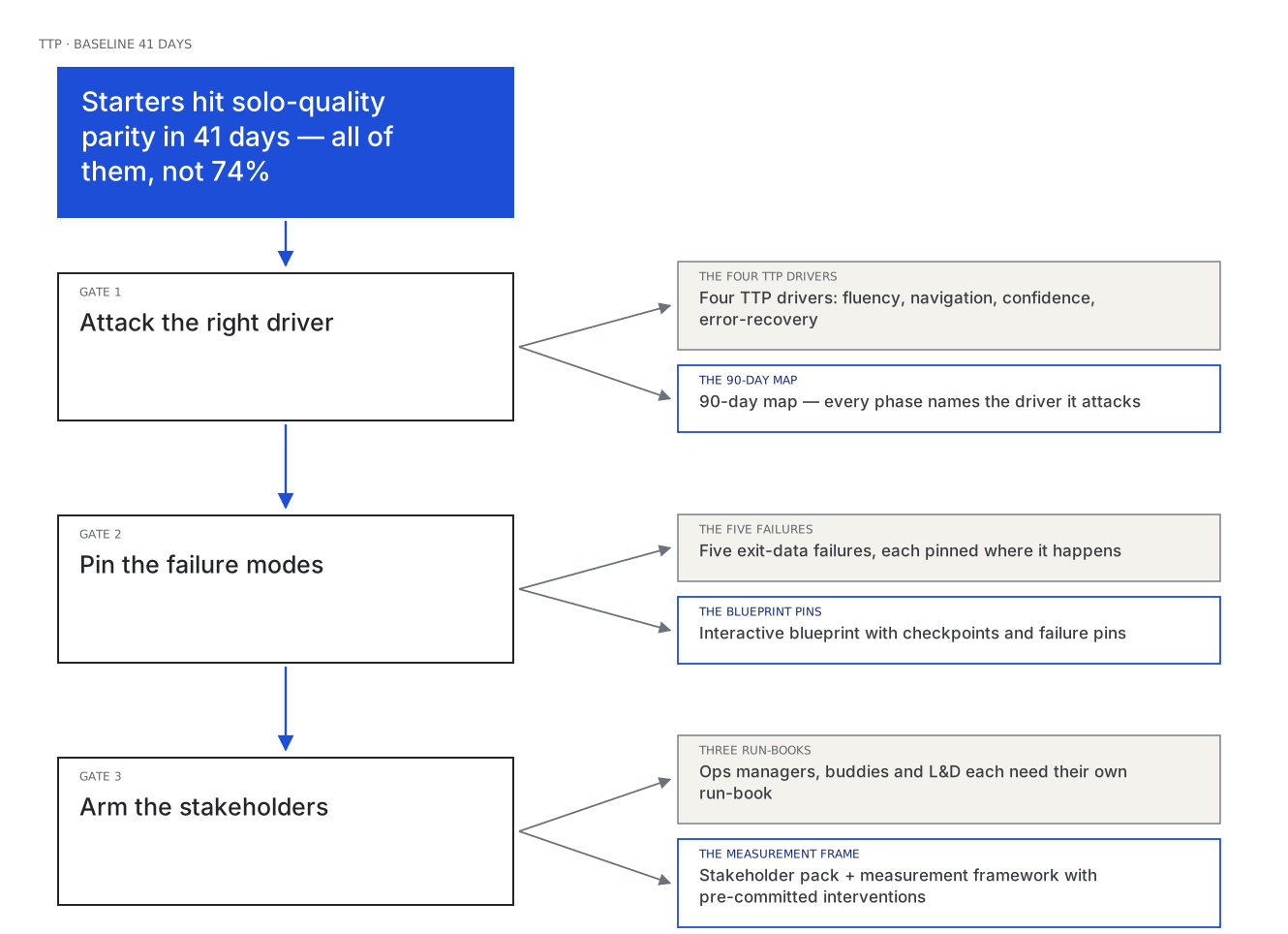
One metric runs this program: days until a new receiver handles chilled loads solo at quality parity. Baseline 41. Target 26.
The Audience
New chilled-goods receivers at VanDijk Logistics — seasonal hires and career switchers; buddies and shift leads are the program's co-deliverers, coached through their role.
Responsibilities
Program architecture around TTP · failure-mode analysis from exit data · phase design with named drivers · checkpoint instruments · intervention triggers — evidence-driven, not calendar-driven.
The Build
Curriculum architecture · interactive blueprint (HTML) · measurement framework · reuse of Kit 1 module as a named component · AI-assisted drafting (disclosed)
How I used AI in this case
AI drafted phase-summary and stakeholder-pack wording variants; the TTP phase architecture, failure-mode counters and measurement framework were designed by hand. Edited, verified and disclosed.
LO1 · Apply
Explain the days-to-solo-parity metric and how each phase of the blueprint moves it from 41 toward 26.
LO2 · Discriminate
Match the five exit-data failure modes to their scheduled risk moments and named countermeasures.
LO3 · Perform
Judge whether a new receiver is on track using the d30/d60/d90 checkpoint gates.
By the end of this experience a learner can do the three things above — assessed by the checkpoint gates in the curriculum blueprint; programme metric is days to solo quality parity. Every interaction in the build exists to create the evidence for one of them.
Baseline reconstruction from scan-log and error data: 41 days to solo quality parity (median of survivors) — and 26% of starters never got there at all. The five failure modes from exit data, each pinned to its risk moment:
FM1
quit-in-week-2 dock-shock — the cold, noise and pace
FM2
certified-but-frozen — passed the module, can't run a live dock
FM3
goes quiet on errors — mistakes hide, then compound
FM4
paperwork drift — records slip once solo
FM5
post-parity coasting — parity reached, growth stops
The problem was the client's. These were mine — the design and build constraints that shaped the solution.
Every phase attacks a driver
Knowledge fluency, environment navigation, confidence, error-recovery: each of the five phases must name which driver it attacks, or it is a calendar, not a curriculum.
Failure modes from exit data
Counter-measures are pinned to risk moments taken from exit interviews — designing against evidence, not against onboarding folklore.
Reuse with honesty
Kit 1's certification module re-enters this program as a named component with its own measurement hooks — reused deliberately, not recycled silently.
A TTP-driven 90-day curriculum in five phases, where every phase names which of the four TTP drivers it attacks (knowledge fluency · environment navigation · confidence · error-recovery), every failure mode gets a designed counter-measure pinned to its risk moment, and Kit 1's certification module returns as a named, scheduled component — not a link in an appendix.
The build itself, not a video about it — open it, make the calls, and read what each one costs.
From exit-data failure modes to a 90-day TTP curriculum — the stages below link the working documents.
More design docs
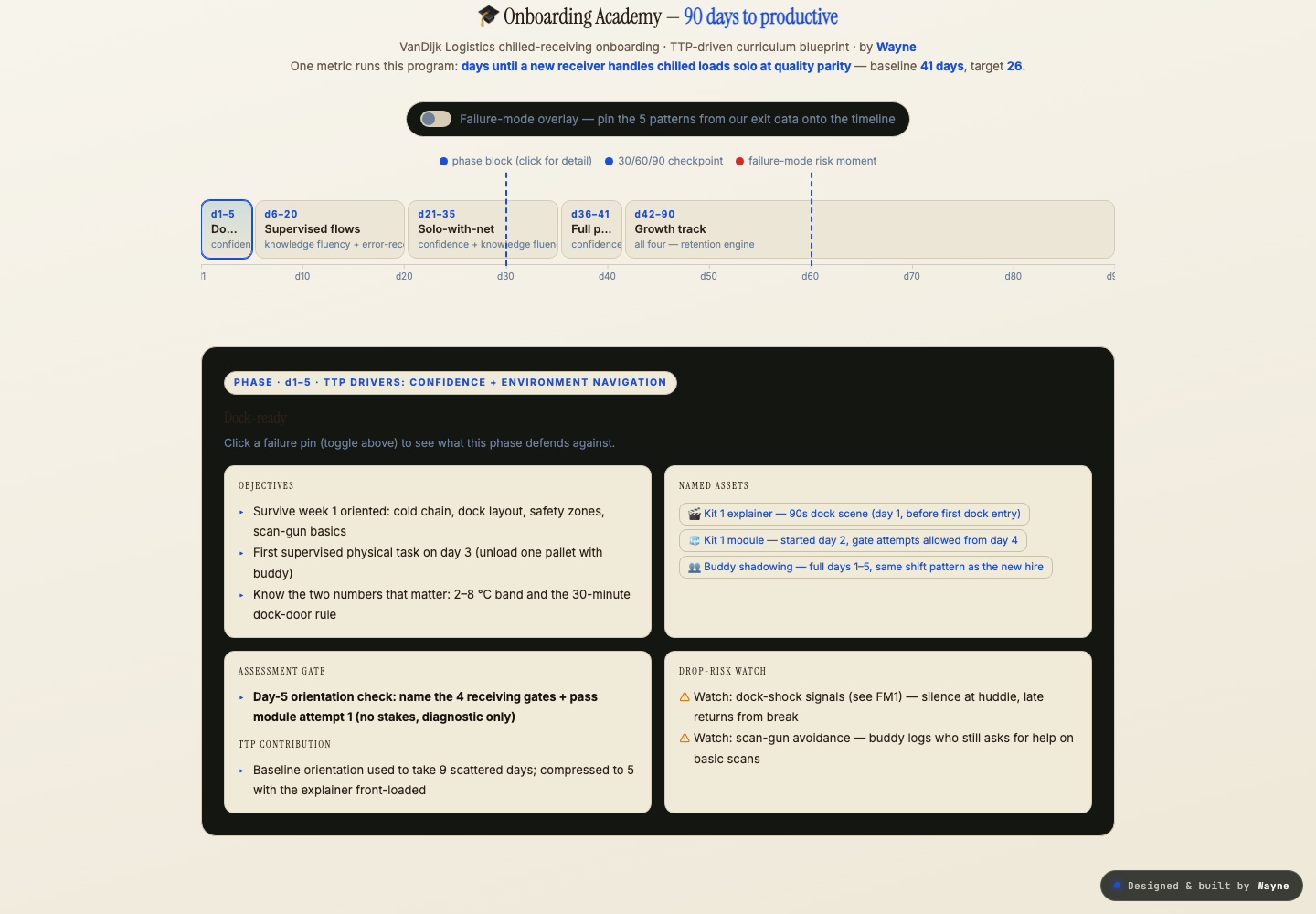
Mapped from baseline reconstruction: 41 days to solo-quality parity (median of survivors) — and 26% of starters never got there at all. The five failure modes from exit data are pinned to the phases that must attack them.
The instructional-design foundations that informed this build:
Action Mapping (Clark)
Every behavior the kit produces is traced back to a business goal and a specific practice activity. See the linked action map for the full chain.
Cognitive Load Theory
The Three.js scene reduces extraneous load by visualising abstract systems. Learners focus on the decision, not the interface.
Situated Cognition
The environment matches the real context. Practice happens where the skill will be performed.
Kirkpatrick L1-L4
Evaluation designed for all four levels: reaction, learning, behavior, results. See the linked evaluation plan.
Pre-committed targets (agreed with stakeholders before build, not retrofitted):
Day-5 pulse: new hires feel oriented, not overwhelmed
L1 · Reaction
Day-5 pulse: new hires feel oriented, not overwhelmed
L2 · Learning
d30 skills gate cohort pass-rate ≥80%, rubric-scored
L3 · Behavior
d35 solo error rate ≤2.1/100 lines; recovery plans dated
L4 · Results
TTP 41 → 26 days; starter drop-out below the 26% baseline
The program had one number as its spine: days until a new receiver handles chilled loads solo at quality parity — baseline 41, target 26. Nothing generic could own that number, so the proposal was a 90-day phased program map: five phases, four time-to-productivity drivers per phase, and the five known failure modes overlaid exactly where they bite — so a mentor can see not just what happens in week two, but what silently goes wrong there.
Sink-or-swim with a buddy considered · rejected
How it worked before, and how the 41-day baseline was produced. Rejected because variance was the problem: some new hires got a great buddy and thrived, others got a busy one and drifted. The metric needs a designed path, not luck in mentor allocation.
A one-week classroom bootcamp considered · rejected
Efficient on paper. Rejected because the knowledge decays before the real workload arrives — weeks three to six, where most failures actually cluster, would remain exactly as unstructured as before. Front-loading is not sequencing.