Fictional client — portfolio build · targets, not field results
Pharmacy Double-Check Training: Errors vs Over-Flags
Dispensing errors don't live in the scary prescriptions — they live in the routine ones.
The Audience
Hospital pharmacy technicians in their first dispensary year — plus experienced techs as a calibration exercise in team huddles.
Responsibilities
Error-family analysis · scenario writing (seeded errors + decoys) · scoring design · over-flag penalty logic — the audit's mental model, made playable.
The Build
Scenario design · free-text keyword scoring · distraction/decoy architecture · AI-assisted drafting (disclosed)
How I used AI in this case
AI drafted prescription-line variants and error-family brainstorming lists, all re-seeded by hand; scenario construction, decoy architecture and over-flag scoring were designed by me. Disclosed.
LO1 · Apply
Write a double-check annotation that catches seeded errors in routine-looking prescriptions.
LO2 · Discriminate
Discriminate true safety signals from correct-but-flaggable values — over-flagging costs the audit too.
LO3 · Perform
Hold a zero-miss checking pattern across a full four-prescription run.
By the end of this experience a learner can do the three things above — assessed by in-trainer catch rate on seeded families (≥4/4, zero over-flags). Every interaction in the build exists to create the evidence for one of them.
The audit data shows the paradox clearly: technicians know the high-alert drugs cold — the failures cluster in prescriptions that look routine:
Training had taught what to check. It hadn't practiced catching yourself not checking — the moment the routine lull replaces the audit lens.
2×
incident rate for therapeutic duplication vs. look-alike sound-alike errors
60%
of methotrexate dispensing incidents involve weekly-dose confusion — a "known" rule
Low
verbal double-check catch rate — written annotation forces the second look
The problem was the client's. These were mine — the design and build constraints that shaped the solution.
Over-flagging must cost
Paranoid checking is its own error. The scoring penalizes flags on clean lines, teaching discrimination rather than fear — the audit's real mental model.
Seeded, not random
Error families are seeded per prescription with clean decoys mixed in; every flag has a truth value the debrief can prove, so no scoring feels arbitrary.
Confidence as a skill
Clearing a correct prescription with confidence is scored as success — first-year techs must learn to trust a clean check, not just suspect a dirty one.
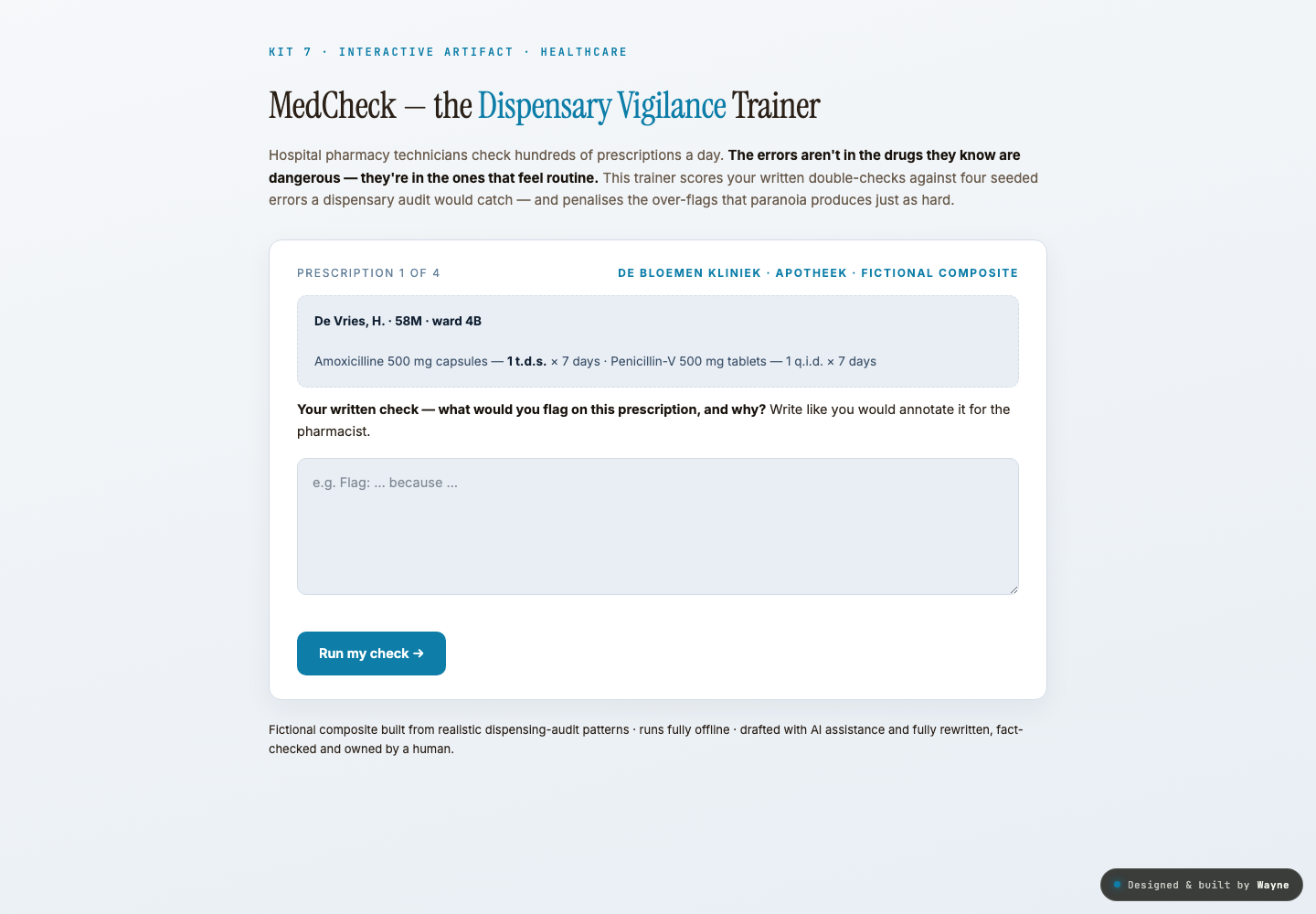
A written-check trainer with a twist: for every prescription, some error families are seeded, some are clean — and over-flagging a clean line costs you too. The scoring teaches discrimination, not paranoia: the audit rewards catching the real error AND clearing the correct prescription with confidence.
The build itself, not a video about it — open it, make the calls, and read what each one costs.
From error-family analysis to a playable vigilance trainer — the stages below are the actual production sequence.
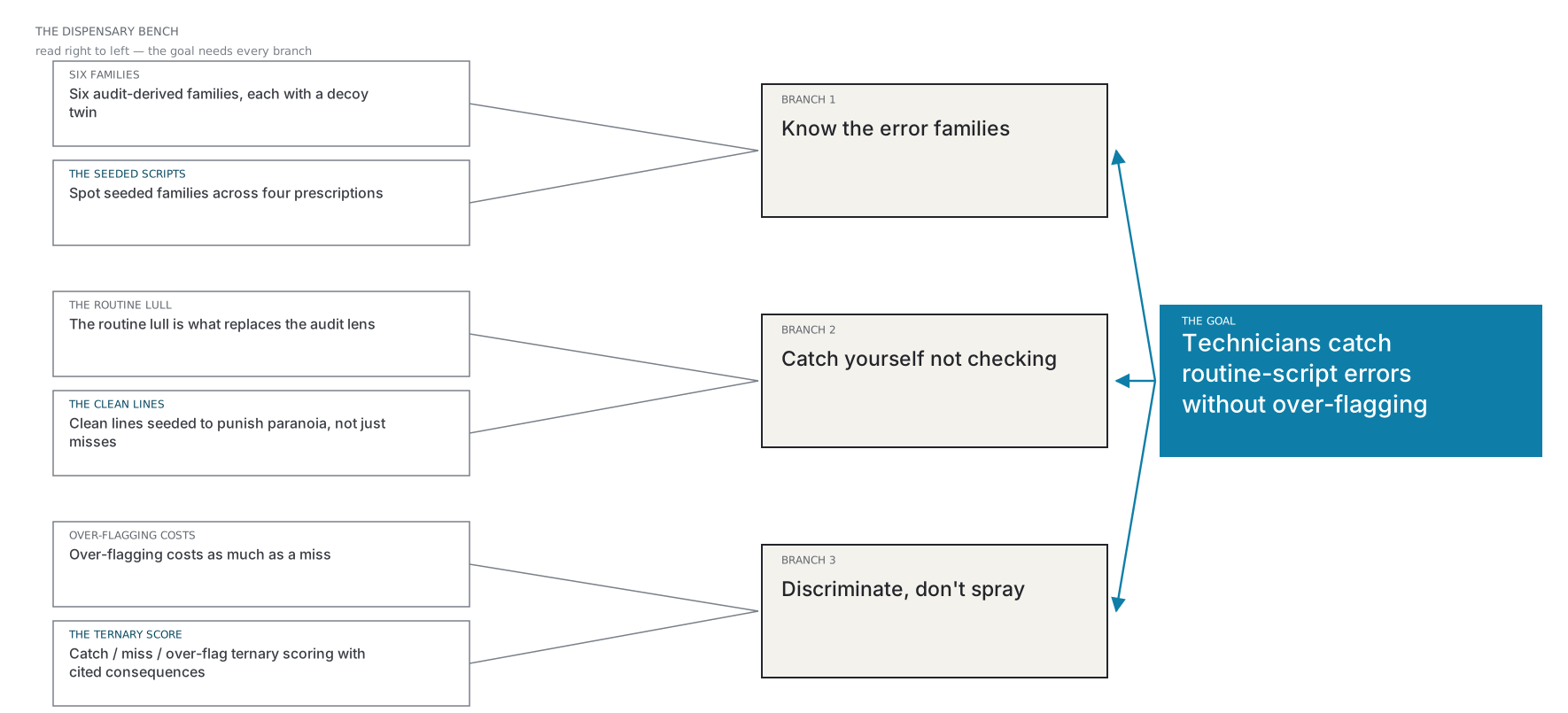
Mapped from the audit paradox: technicians know the high-alert drugs cold — failures cluster in prescriptions that look routine. Training taught what to check but never practiced catching yourself not checking, so the map prices over-flagging too.
The instructional-design foundations that informed this build:
Action Mapping (Clark)
Every behavior the kit produces is traced back to a business goal and a specific practice activity. See the linked action map for the full chain.
Cognitive Load Theory
The Three.js scene reduces extraneous load by visualising abstract systems. Learners focus on the decision, not the interface.
Situated Cognition
The environment matches the real context. Practice happens where the skill will be performed.
Kirkpatrick L1-L4
Evaluation designed for all four levels: reaction, learning, behavior, results. See the linked evaluation plan.
Pre-committed targets (agreed with stakeholders before build, not retrofitted):
"Felt like a real shift" — tech council debrief, ≥4/5
L1 · Reaction
"Felt like a real shift" — tech council debrief, ≥4/5
L2 · Learning
In-trainer catch rate on seeded families; ≥4/4 errors, zero over-flags
L3 · Behavior
Written annotation completeness on audited scripts, +30% in 6 weeks
L4 · Results
Duplication & dose-confusion incident rate ↓25% — target for a pilot quarter
Hospital pharmacy technicians pass the annual check-drug exam and still generate incident reports — clustered in prescriptions that look routine. The exam measures recall; the dispensary bench demands a written, attributable second look. So the proposal was a written-check vigilance trainer: four prescriptions with seeded error families and decoy-clean lines, scored on catches, misses AND over-flags — because paranoid flagging of correct prescriptions is also an audit failure.
Another knowledge quiz, harder this time considered · rejected
Fits the existing compliance rhythm. Rejected because the exam format is the problem: verbal or multiple-choice checking does not transfer to the written annotation the audit actually requires. Quizzes check knowledge; the bench practices vigilance.
More second-pharmacist supervision considered · rejected
The obvious safety answer. Rejected because it is unscalable, builds dependence instead of discrimination, and exactly the dependence the written check is meant to remove. Supervision remains for high-alert drugs; the trainer covers the routine prescriptions where incidents breed.