Fictional client — portfolio build · targets, not field results
Cabin-Crew Briefings: Rebuild the Sequence in SOP Order
Briefings fail in the order, not the content: safety items buried between chit-chat, the security question asked after the purser arrived.
The Audience
New cabin crew in type-rating or recurrent training — plus instructors who want the briefing sequence practiced interactively instead of lectured.
Responsibilities
SOP-sequence modelling · item-position rationale writing · position-level feedback design — the order made tactile.
The Build
Sequence-builder interaction design · SOP rationale writing · AI-assisted drafting (disclosed)
How I used AI in this case
AI drafted SOP-rationale sentence variants for the feedback layer; the sequence model, break-point logic and position-level feedback design were authored by me. Edited, verified and disclosed.
LO1 · Apply
Sequence the pre-flight briefing in SOP order: identity → picture → safety → care flows → service → close.
LO2 · Discriminate
Explain why safety content is never the flex block when time pressure hits.
LO3 · Perform
Rebuild a broken briefing from the first break-point, justifying both your item and the right one.
By the end of this experience a learner can do the three things above — assessed by position-level sequence feedback at the first break-point. Every interaction in the build exists to create the evidence for one of them.
Briefing quality is consistent in content and inconsistent in order — and order is where the failures live:
The sequence isn't bureaucratic preference: it encodes attention management (safety while fresh), flexibility (service as the compressible block), and recency (security question last-but-one). Training lectures it; nobody gets to feel the order break.
Buried
safety items between service chatter — attention decay is predictable
Late
security question after closing — loses its freshness advantage
Flexed
service over-runs safety blocks — the one direction SOP forbids
The problem was the client's. These were mine — the design and build constraints that shaped the solution.
Order as the skill
Cabin briefings are memorized as lists. The design had to make position meaningful — why punctuality anchors, why roll call precedes safety — or placement is just quiz trivia.
Feedback at the position, not the list
Saying wrong teaches nothing. Every check produces what belongs in that position and why, plus the rationale for what the learner placed there.
Two anchors, six free
Fixing punctuality and roll call mirrors the SOP, but the six remaining items needed orderings an instructor would defend in a classroom.
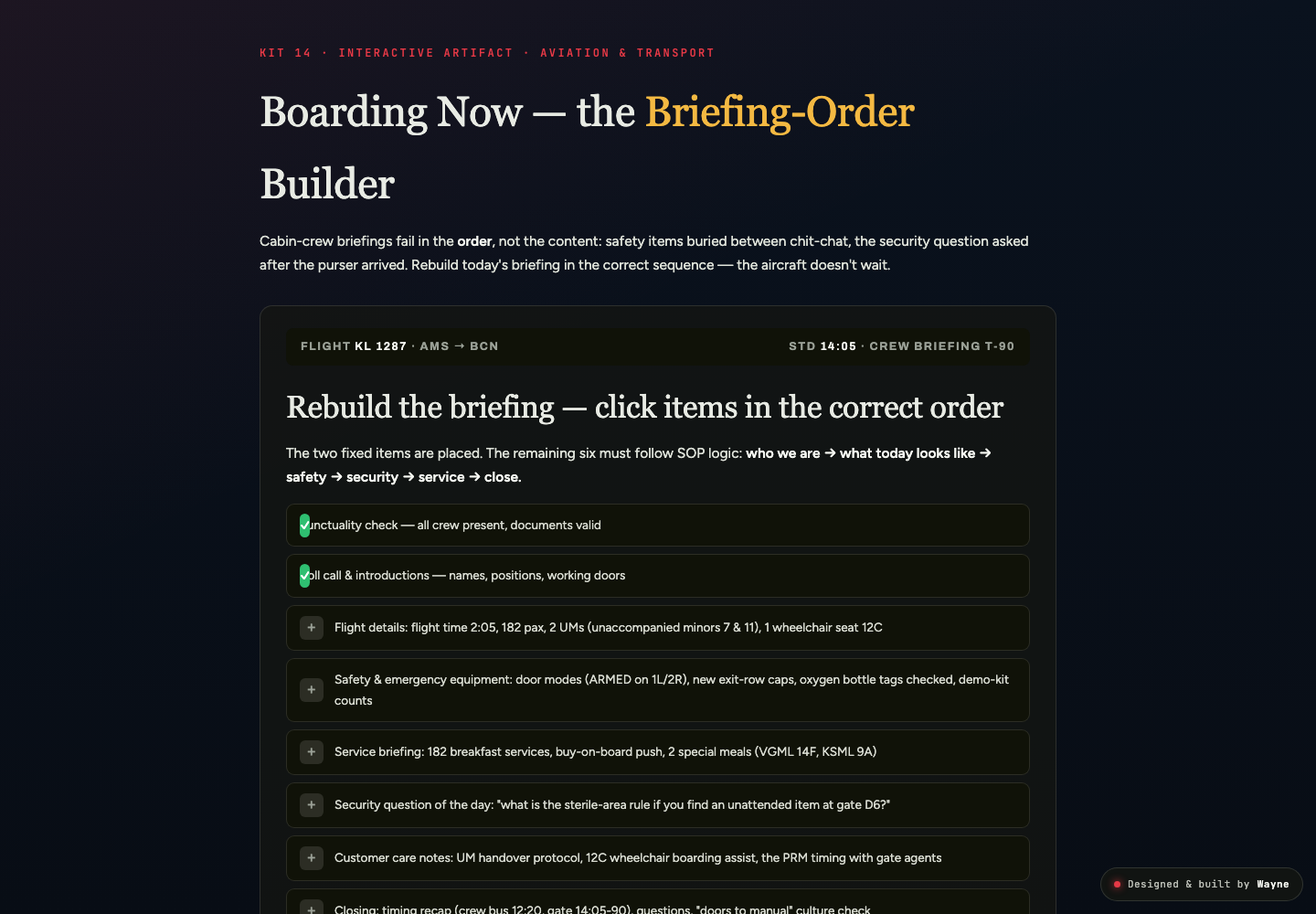
A sequence builder: two fixed items (punctuality, roll call) anchor the briefing; six more must be placed in SOP order. Checking produces position-level feedback — not "wrong", but "here's what belongs in position 4 and why, and here's the rationale for the item you placed there." Rebuild until fluent; the retry costs nothing.
The build itself, not a video about it — open it, make the calls, and read what each one costs.
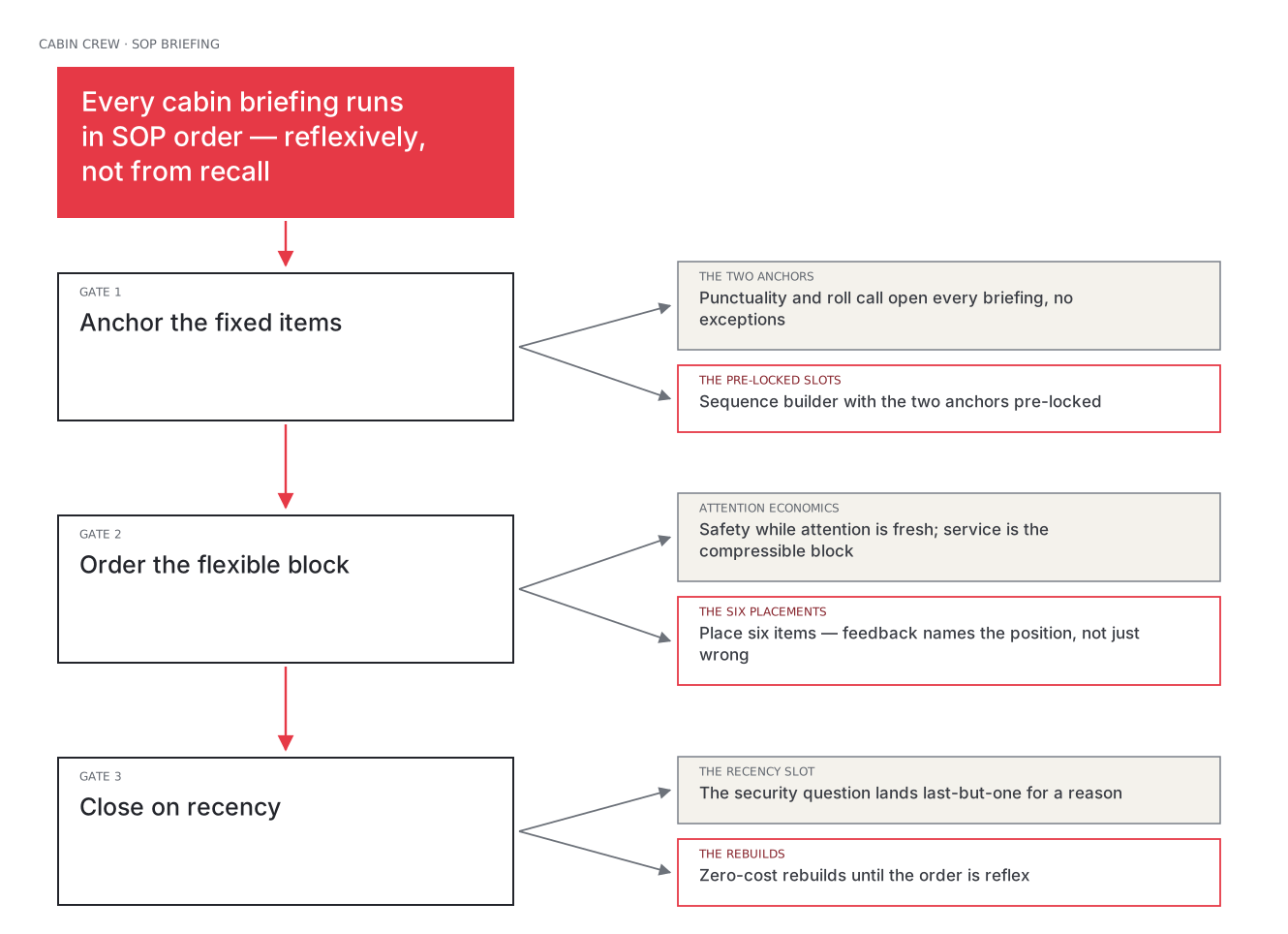
From SOP analysis to a tactile sequence builder — the stages below are the actual production sequence.
Mapped from the order problem: briefing quality is consistent in content and inconsistent in sequence — and order is where the failures live. The sequence encodes attention management, flexibility and recency, so the map teaches positions, not items.
The instructional-design foundations that informed this build:
Action Mapping (Clark)
Every behavior the kit produces is traced back to a business goal and a specific practice activity. See the linked action map for the full chain.
Cognitive Load Theory
The Three.js scene reduces extraneous load by visualising abstract systems. Learners focus on the decision, not the interface.
Situated Cognition
The environment matches the real context. Practice happens where the skill will be performed.
Kirkpatrick L1-L4
Evaluation designed for all four levels: reaction, learning, behavior, results. See the linked evaluation plan.
Pre-committed targets (agreed with stakeholders before build, not retrofitted):
"Finally practiced the ORDER" — crew pilot, ≥4/5
L1 · Reaction
"Finally practiced the ORDER" — crew pilot, ≥4/5
L2 · Learning
Perfect sequence on second attempt: target 80% of trainees
L3 · Behavior
Line-check briefing sequence compliance 100%
L4 · Results
Briefing-sequence findings in audits ↓≥70% for the cohort
New cabin crew knew every briefing item and still delivered broken briefings — safety buried in service chatter, the security question asked too late. The failure was order, and order is SOP: identity → picture → safety → care flows → service → security → close. The proposal was a briefing-order builder: two anchor items fixed, six to place, position-level feedback at the first break-point explaining both items — yours and the one that belongs there.
A slide-deck review of the briefing sequence considered · rejected
Fast to build, easy to schedule. Rejected because reading a sequence and producing one under pressure are different skills — the deck teaches recognition, and recognition is precisely what the failures already had.
A written SOP quiz considered · rejected
Trackable in the LMS. Rejected because '4/6 correct' teaches nothing about WHERE the order broke or why service sits where safety belongs. Position-level feedback is the design; a score is just a score.