Fictional client — portfolio build · targets, not field results
Dementia Communication: Join Her Reality
She asks for her mother every morning. The facts are gone; the feeling is the client.
The Audience
Care staff on dementia wards — new caregivers, activity coordinators, ward hosts — plus family caregivers in informal-care training programs.
Responsibilities
Moment taxonomy · response design (validation vs correction vs deflection) · feedback philosophy (the feeling is the client) — presence made discussable.
The Build
Validation-approach (informed) scenario design · grief-modeling · ethical-dilemma feedback · AI-assisted drafting (disclosed)
How I used AI in this case
AI drafted moment variants and response phrasings for review against validation-approach literature; the moment taxonomy, the response anatomy and the ethical framing were authored by me. Edited, verified and disclosed.
LO1 · Apply
Join her reality — validation over correction — across the four care moments.
LO2 · Discriminate
Recognise truth-as-wall as the anti-pattern: being factually right can still abandon her.
LO3 · Perform
Debrief the gentlest lie honestly: why it scores mid, and when it helps or harms.
By the end of this experience a learner can do the three things above — assessed by the scored response pattern across the four moments (learner artifact in Dutch). Every interaction in the build exists to create the evidence for one of them.
Dementia-communication training fails at the same four moments, every ward, every shift:
The gap: staff are trained in facts, safety and tasks. Nobody practices the feeling-first reflex — honoring the emotion while skipping the false fact — because it contradicts every correctness instinct the rest of life rewards.
Truth
used as a wall — "your children are adults now" is accurate and cruel
Self-defence
against theft accusations — technically right, relationally fatal
Re-killing
the dead — reminding her of the death is breaking news every time
The problem was the client's. These were mine — the design and build constraints that shaped the solution.
The feeling is the client
Scoring joins-her-reality vs corrects-her-facts required a feedback philosophy that honours the emotion without endorsing the false fact — the single lens every moment is scored on.
Give the feeling somewhere to go
Every right answer needs an exit: a walk, a story, a joint search, a window. Writing four endings that redirect without lying took the most drafts.
Honesty about the debate
Validation-informed care is contested. The debrief names the disagreement instead of pretending consensus — care staff deserve the real picture.
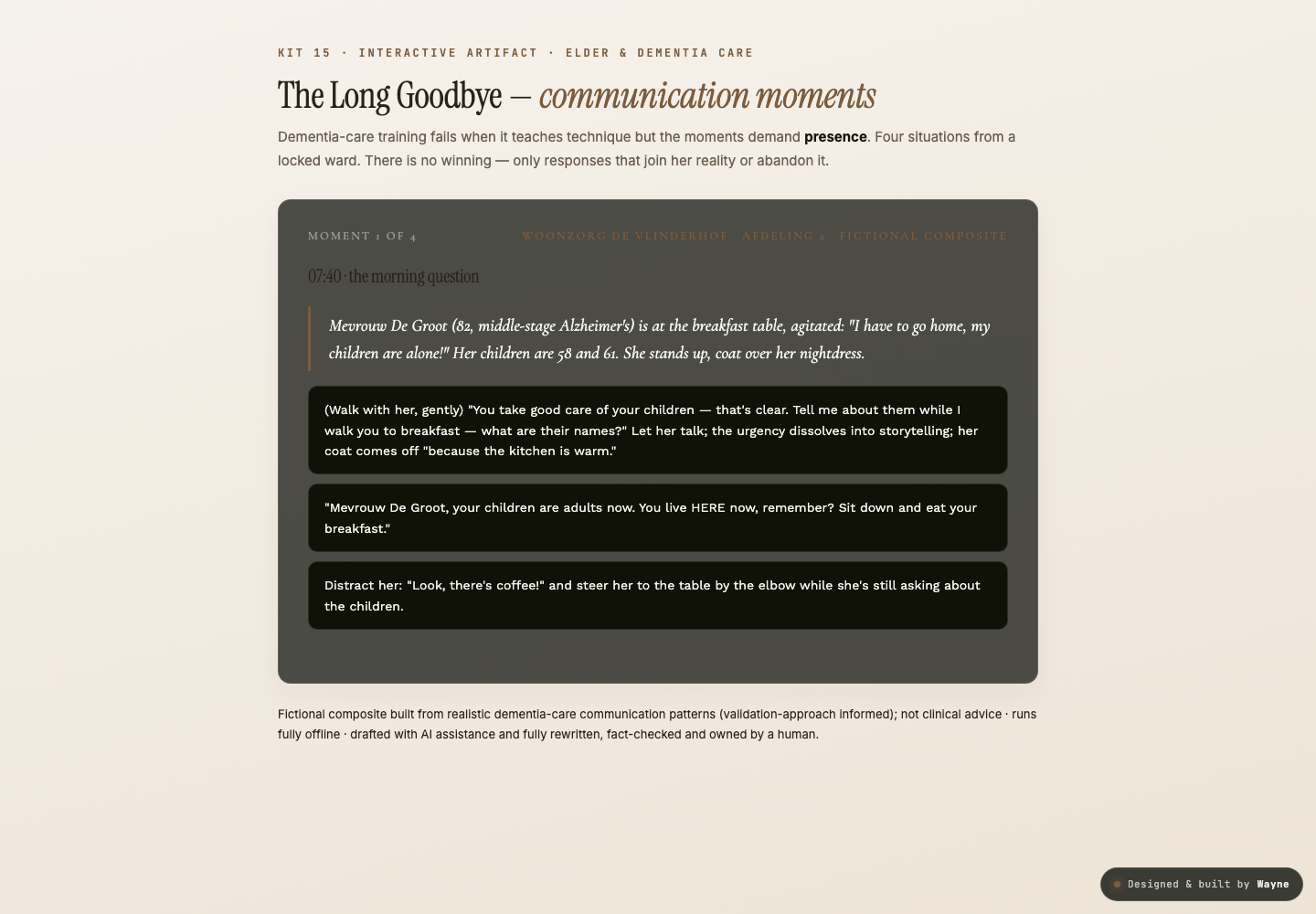
A reaction trainer with four moments, each scored on a single lens: did you join her reality or abandon it? The feedback explicitly teaches the anatomy — honour the emotion, skip the false fact, give the feeling somewhere to go (a walk, a story, a joint search, a window) — and names the therapeutic-fib debate honestly rather than pretending clean answers exist.
The build itself, not a video about it — open it, make the calls, and read what each one costs.
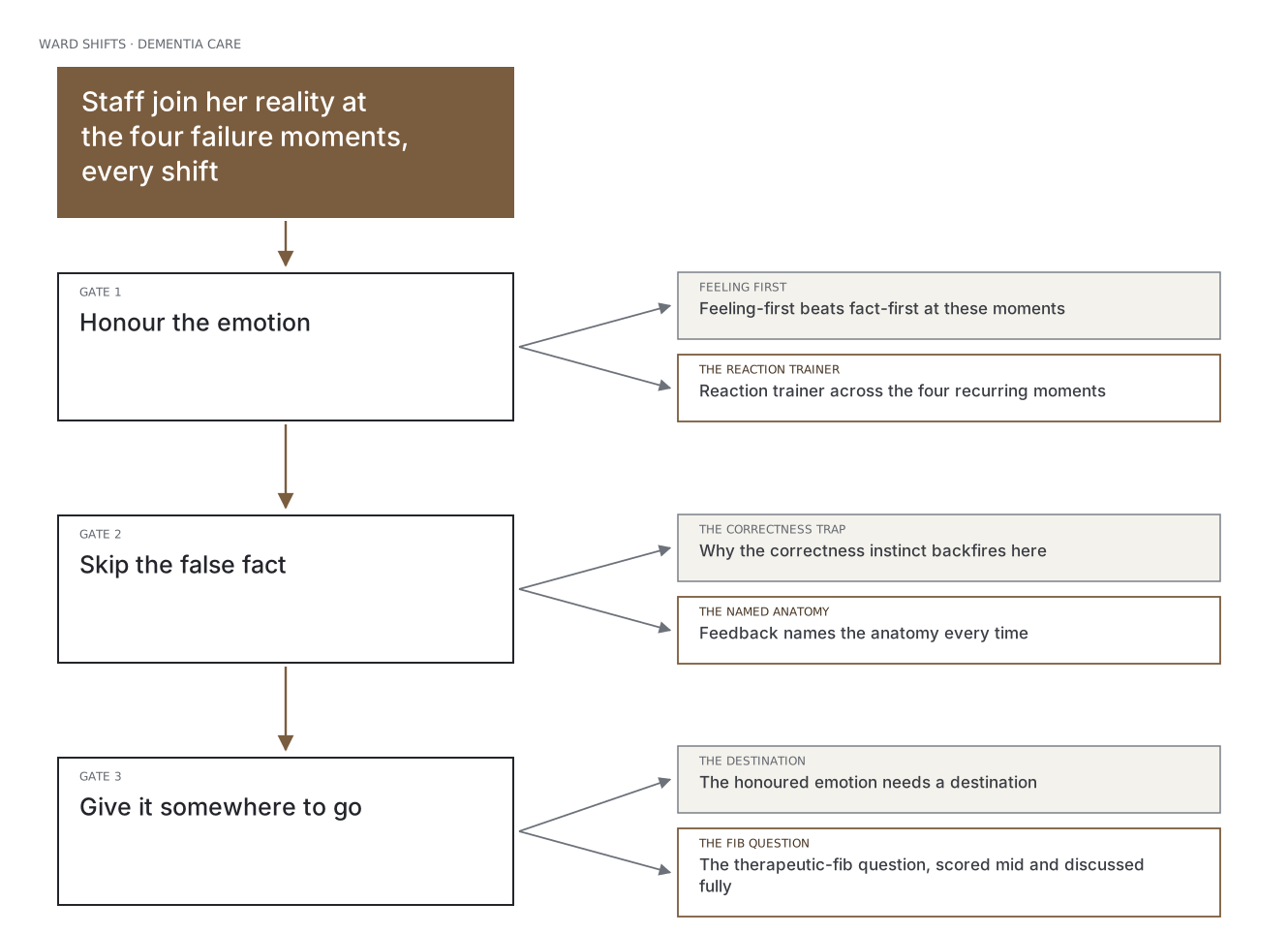
From ward moments to a reaction trainer — the stages below are the actual production sequence.
Mapped from the four moments where dementia-communication training fails — every ward, every shift. Staff are trained in facts, safety and tasks; the feeling-first reflex contradicts every correctness instinct, so the map makes the anatomy explicit.
The instructional-design foundations that informed this build:
Action Mapping (Clark)
Every behavior the kit produces is traced back to a business goal and a specific practice activity. See the linked action map for the full chain.
Cognitive Load Theory
The Three.js scene reduces extraneous load by visualising abstract systems. Learners focus on the decision, not the interface.
Situated Cognition
The environment matches the real context. Practice happens where the skill will be performed.
Kirkpatrick L1-L4
Evaluation designed for all four levels: reaction, learning, behavior, results. See the linked evaluation plan.
Pre-committed targets (agreed with stakeholders before build, not retrofitted):
"Everyone should do this before their first shift" — caregiver pilot, ≥4/5
L1 · Reaction
"Everyone should do this before their first shift" — caregiver pilot, ≥4/5
L2 · Learning
Full-run join score ≥7/8
L3 · Behavior
Observed validation-first responses in care moments ↑
L4 · Results
As-needed medication for agitation ↓; family satisfaction ↑
Dementia-ward incidents shared a signature: staff responding accurately and relationally fatally — using truth as a wall, self-defending against an accusation, re-announcing a death. Every correctness instinct life rewards is wrong in these moments, which is exactly why they must be practiced. The proposal was a reaction trainer with no winning moves: four moments scored only on join versus abandon, where even the gentlest therapeutic lie scores mid and gets discussed honestly.
A communication-facts e-learning module considered · rejected
Scales across the ward easily. Rejected because the moments demand presence, not information: staff already knew validation theory — the trainer exists because knowing it and doing it at the door are separated by forty years of correctness instinct.
Professional actor role-play considered · rejected
The gold standard, genuinely. Rejected as the baseline format on cost and consistency — actor hours are scarce and sessions vary. The trainer gives every staff member unlimited baseline practice; the actors remain the advanced layer when the budget allows.