Fictional client — portfolio build · targets, not field results
Craft-Dairy Process Training: Expert Interview to Floor-Ready Kit
One founder’s hands know the process. Twenty-four staff need it to survive a Friday — this kit traces every training decision back to her words.
The Audience
New production operators at a craft dairy scaling from 6 to 24 staff — mixed NL/EN, no desks, no PCs on the floor; the founder is the SME whose craft must become a system.
Responsibilities
Expert-interview capture · requirement extraction · CCP micro-module · print/digital enablement pack · test protocol · wording standard — the full SME-to-kit pipeline.
The Build
Interactive interview-capture explorer · 4-gate decision module with shuffled options · print-style floor manual + KB + FAQ + test plan · offline, login-free by constraint.
How I used AI in this case
AI helped draft interview-question variants and manual phrasings; the interview design, requirement extraction, traceability model and gating decisions were authored by me. Disclosed per artifact.
LO1 · Extract
Extract training requirements from an expert interview — critical tasks, misconceptions, vocabulary, constraints — and name the artifact each one feeds.
LO2 · Apply
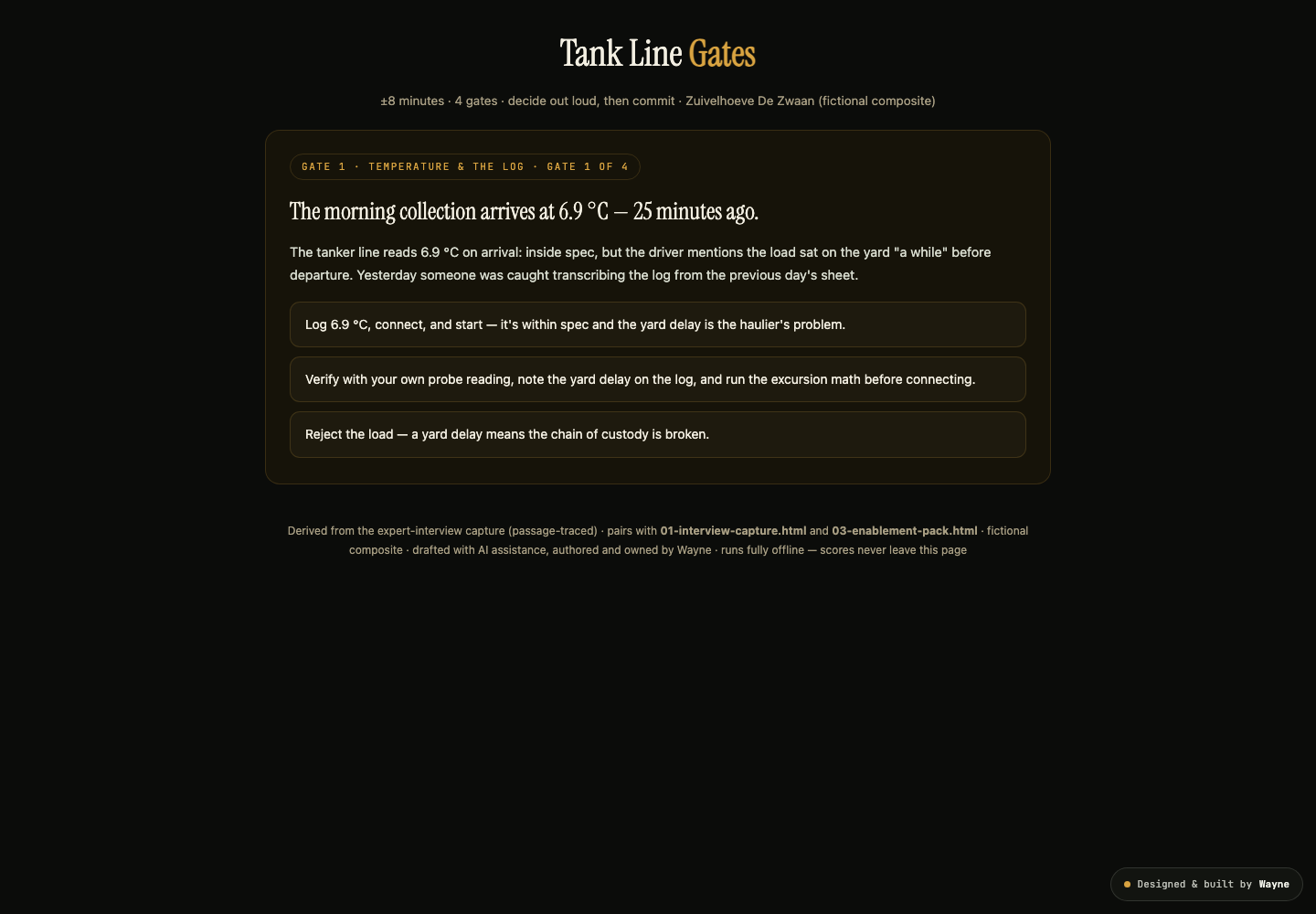
Run the tank-line gates: verify the record rather than the surface, and release with the note as part of the decision.
LO3 · Discriminate
Tell the difference between what the SME actually said and what training usually assumes — and choose the first, every time.
By the end of this experience a learner can do the three things above — assessed by the requirement-capture counter (10/10), the module score (≥7/8) and the transfer probe in the test plan. Every interaction in the build exists to create the evidence for one of them.
A craft dairy wins on process control nobody wrote down. Scaling quadruples the staff in one season, agency workers rotate faster than accounts can be created, and the two near-misses share one signature: routine steps performed from memory by people who were told once. The learning problem is not “teach the process” — it is convert one expert’s tacit craft into a system that survives a glance, one-handed, in boots.
6→24
staff in one season — the founder’s hands can no longer be everywhere at once
2
near-misses this spring in cleaning-in-place, both by people “told once, weeks earlier”
0
written protocols — the process lives as “what Sanne does before she opens that valve”
The problem was the client’s. These were mine — the design and build constraints that shaped the solution.
Tacit, not documented
The SME’s knowledge is real but unsayable in protocol form — “what I do before I open that valve” is expertise, not a procedure. The interview has to make it extractable without flattening it.
Two languages, one tablet, no logins
Half the floor reads Dutch only, half English only, nobody sits down. Print at the tank, a shared tablet in the break room, agency staff who rotate too fast for accounts. The format follows the constraint, not the tool list.
Familiarity disguised as competence
The near-misses came from routine that feels expert. Re-explaining everything insults the room; skipping verification recreates the near-miss. The gates had to target the habit, not the facts.
A three-artifact pipeline in which nothing exists “because training usually has one”: the interview produces requirements, the requirements produce the gates, the gates and the constraints produce the pack. Every artifact cites the passage it came from.
The written protocol the founder never had. She asked for her own words back, teachable — the manual says the same four sentences in the same order as the module and the KB, because one source beats three opinions on the floor.
A generic food-safety e-learning course considered · rejected
Cheap, standard, auditable. Rejected because it teaches the industry’s process, not hers — and the failure modes here are specific: her yard-window math, her aborted-CIP light, her worn line label, her excursion note. Off-the-shelf compliance training would have left every real near-miss untouched.
Filming the founder doing the process considered · rejected
Authentic and quick to shoot. Rejected as the primary artifact because a 40-minute video of an expert working is a recording, not a lesson: no decision points, no feedback, no way to check the habit transferred — and no good on a wet-gloved hand at the tank. The interview replaced it as the source; the video survives only as optional enrichment.
The build itself, not a video about it — the whole pipeline, from the raw interview to the pack on the tank wall. Start with the interview: it is where every other artifact comes from.
From a founder interview to a floor-ready pack — the stages below are the actual production sequence.
Mapped from the interview, not from a competency library: each column is a real moment on the tank line, and each action traces back to a passage the founder actually said. If it is on this map, she said it.
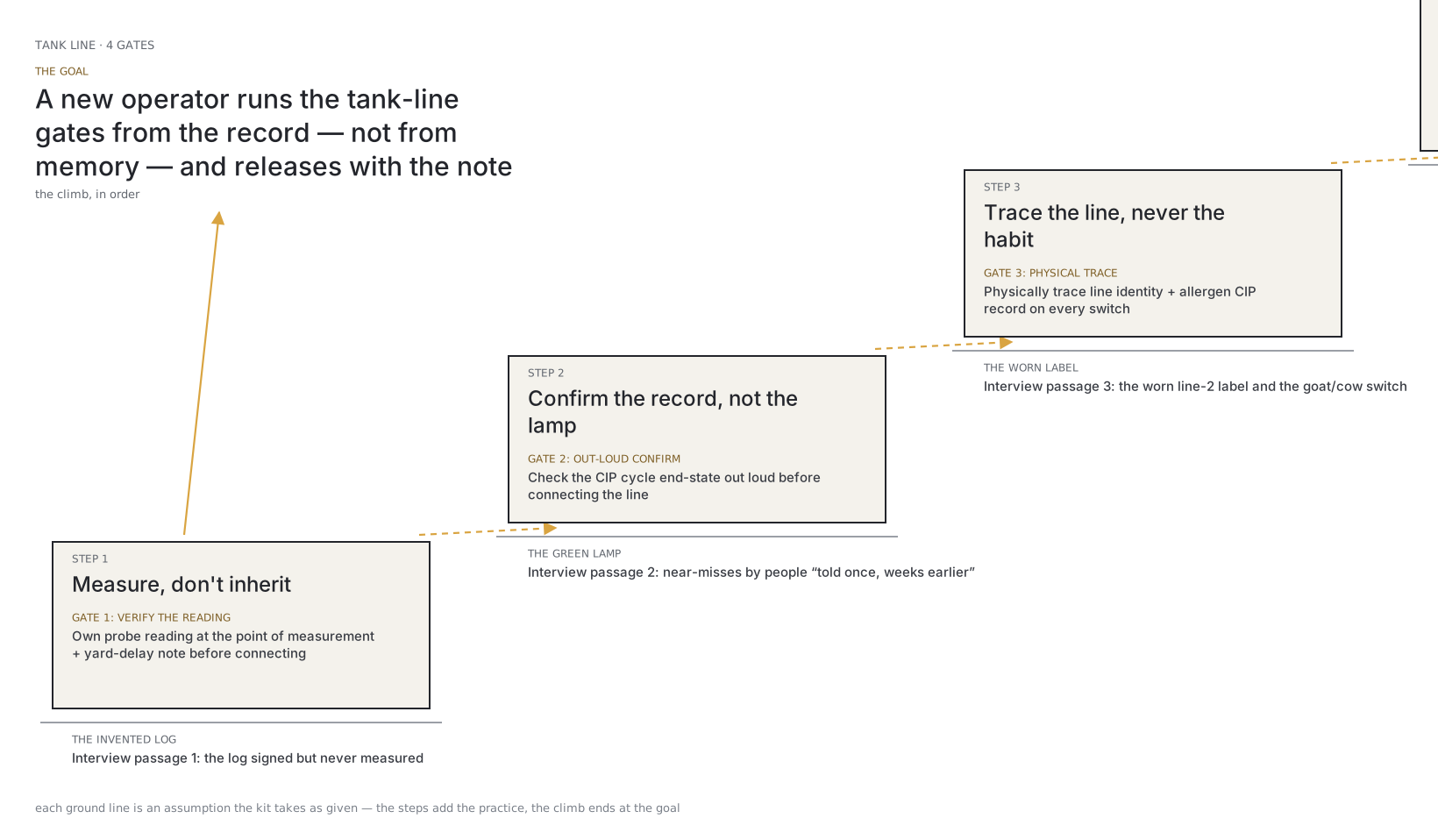
The instructional-design foundations that informed this build:
Action Mapping (Clark)
Every behavior the kit produces is traced back to a business goal and a specific practice activity. See the linked action map for the full chain.
Cognitive Load Theory
The Three.js scene reduces extraneous load by visualising abstract systems. Learners focus on the decision, not the interface.
Situated Cognition
The environment matches the real context. Practice happens where the skill will be performed.
Kirkpatrick L1-L4
Evaluation designed for all four levels: reaction, learning, behavior, results. See the linked evaluation plan.
Pre-committed targets (agreed with the client before build, not retrofitted):
L1 · Reaction
“Would you use this card on a real Friday?” — ≥2 of 3 testers yes
L2 · Learning
Module score ≥7/8 on first run, plus both release questions asked in the transfer probe
L3 · Behavior
Share of arrivals logged with a yard-delay note rises toward 100% in weekly sampling
L4 · Results
Excursion batches released without a deviation note trending to zero over two cycles
A single long procedure document considered · rejected
Rejected: nobody reads a 30-page SOP at the tank one-handed, and length is not the constraint — glanceability is. The four-gate card replaced it.
The founder as the only trainer considered · rejected
Rejected: that is the current system, and it is what broke at scale. The pack lets any shift lead deliver the same four gates in the same words.