Fictional client — portfolio build · targets, not field results
Feedback Conversations: Run-Sheet, Role-Play, Rubric
Team leads aren't avoiding feedback — they're delivering it in a form that triggers defensiveness.
The Audience
80 team leads at Helios Facilities Group (1,100 employees, post-restructure) — cohorts of max 14, volunteer-first pairing with an opt-out clause for psychological safety.
Responsibilities
Workshop design · run-sheet with recovery lines · digital rubric build · evaluation plan · transfer-device design — room-leadership craft, executable without the designer present.
The Build
Role-play design · SBI-C structure · digital observer rubric (HTML) · Kirkpatrick at event scale · AI-assisted drafting (disclosed)
How I used AI in this case
AI drafted role-play scenario variants and rubric wording options; the SBI-C structure, the run-sheet with recovery lines and the evaluation plan were authored by me. Edited, verified and disclosed.
LO1 · Apply
Deliver a corrective conversation using the run-sheet structure: situation → behaviour → impact → agreement.
LO2 · Discriminate
Recognise a defensiveness trigger mid-conversation and recover instead of escalating.
LO3 · Perform
Score a peer role-play on the observer rubric and name the Round-1 → Round-2 delta as the learning evidence.
By the end of this experience a learner can do the three things above — assessed by live role-plays scored on the digital rubric (Round-1 → Round-2 delta). Every interaction in the build exists to create the evidence for one of them.
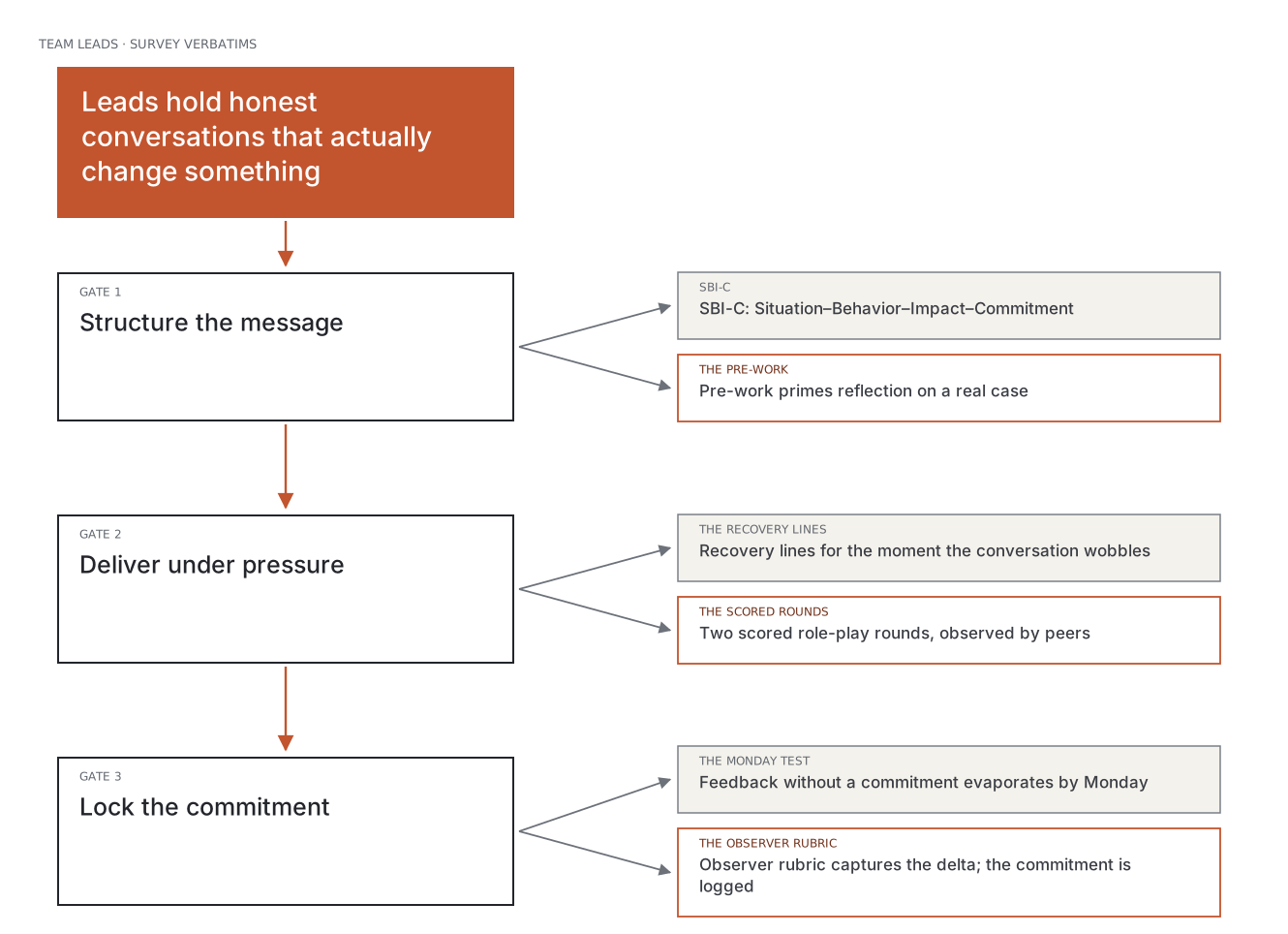
Survey verbatims clustered into one sentence: "I give feedback; nothing changes." Exit-interview mentions of "no honest conversations" doubled year-over-year. The leads are willing — their feedback just triggers defensiveness instead of change:
Not an awareness problem — a skill-under-pressure problem. The workshop is built so every lead delivers a real feedback conversation twice, scored by peers.
80
team leads to develop — calendar reality rules out half-day events
2×
YoY growth in "no honest conversations" exit mentions
#1
development ask in the engagement survey: feedback quality
The problem was the client's. These were mine — the design and build constraints that shaped the solution.
Practice needs safety
Volunteer-first pairing with an opt-out clause is not soft HR — it is the design condition for honest role-play. The run-sheet protects that condition explicitly, with recovery lines for the moments it wobbles.
A rubric observers can hold
Two scored rounds need live observation. The digital rubric tracks SBI-C behaviors, not impressions, so the feedback survives the room and reaches the debrief intact.
Transfer inside five days
The commitment card converts practice into a real conversation within five working days — that is the workshop's success metric, not attendance or satisfaction.
A 90-minute practice workshop around the SBI-C structure (Situation–Behavior–Impact–Commitment): pre-work primes reflection, two scored role-play rounds produce the learning evidence, and a commitment card converts practice into a real conversation within 5 working days.
The build itself, not a video about it — open it, make the calls, and read what each one costs.
From design brief to a workshop room-leaders can run without me — each stage links the working document.
More design docs
Mapped from the survey verbatims — 'I give feedback; nothing changes' — and exit interviews where 'no honest conversations' doubled year over year. Not an awareness problem: a skill-under-pressure problem, so the map is built around delivered practice.
The foundations that shaped this design — mapped to the specific decisions made in the build:
SBI-C Feedback Model
Situation-Behavior-Impact-Commitment provides the structure for every feedback moment. The observer rubric scores line-by-line against these four components — no holistic rating, just specific evidence.
Bandura's Observational Learning
Watch mode models the skill before practice. Two scored rounds build self-efficacy through graduated challenge — the delta between rounds is the proof of learning transfer.
Cognitive Load Theory
The 90-minute arc is time-boxed. The freeze mid-round and the derail in debrief are two deliberate cognitive-load peaks — each followed by recovery instruction.
Kirkpatrick L1-L4
L1: >=4/5 usefulness on observer rubrics. L2: SBI-C awareness pre/post survey. L3: 30-day follow-up on real feedback delivered. L4: team feedback quality scores improvement.
Pre-committed targets (agreed with stakeholders before build, not retrofitted):
Exit poll (40 seconds): ≥80% "worth my time" 4–5
L1 · Reaction
Exit poll (40 seconds): ≥80% "worth my time" 4–5
L2 · Learning
Rubric delta Round 2 − Round 1: +1.0 / 25 minimum
L3 · Behavior
70% of committed conversations held within 10 working days — the 5-day commitment, the 10-day audit
L4 · Results
One input to the quarterly survey item — association, never causation
Team leads were not avoiding feedback conversations — they were delivering them in a form that triggered defensiveness, then concluding 'feedback doesn't work here'. Knowing that, the gap was behavioral: the opening sentence, the framing, the composure when the other person pushes back. The proposal was a role-play workshop with live observers and a digital rubric, scored twice — round one against round two — so the delta between them is the evidence of learning.
A lecture on feedback models (SBI, radical candor, etc.) considered · rejected
Well-rated and easy to scale. Rejected because the failure is not conceptual — the leads could name every model; they still opened with 'don't take this the wrong way'. Frameworks without rehearsal change nothing in the first ten seconds of a real conversation.
An e-learning module with branching dialogue considered · rejected
Scalable practice. Rejected as the core format because the trigger here is live interpersonal discomfort — the flinch when a colleague pushes back — which a solo module rehearses with a mouse, not a face. Kept as pre-work to establish shared vocabulary.