Fictional client — portfolio build · targets, not field results
Kitchen Service Decisions: Allergens Under Pressure
New kitchen leavers don't quit over cooking. They quit over moments: the flooded pass, the allergy call, the correction that hits like weather.
The Audience
New kitchen staff (dishwashers moving up, culinary students, first-job cooks) — plus head chefs building a week-one onboarding that survives contact with a real service.
Responsibilities
Moment taxonomy · allergen-protocol dramatization · hierarchy dynamics without sanitization · closing-discipline design — early churn treated as a design problem.
The Build
Service-moment design · allergen-safety scenario writing · hierarchy dynamics · AI-assisted drafting (disclosed)
How I used AI in this case
AI drafted ticket-moment variants and blunt-correction phrasings; the moment taxonomy, the allergen protocol dramatization and the control-lens scoring were designed by hand. Edited, verified and disclosed.
LO1 · Apply
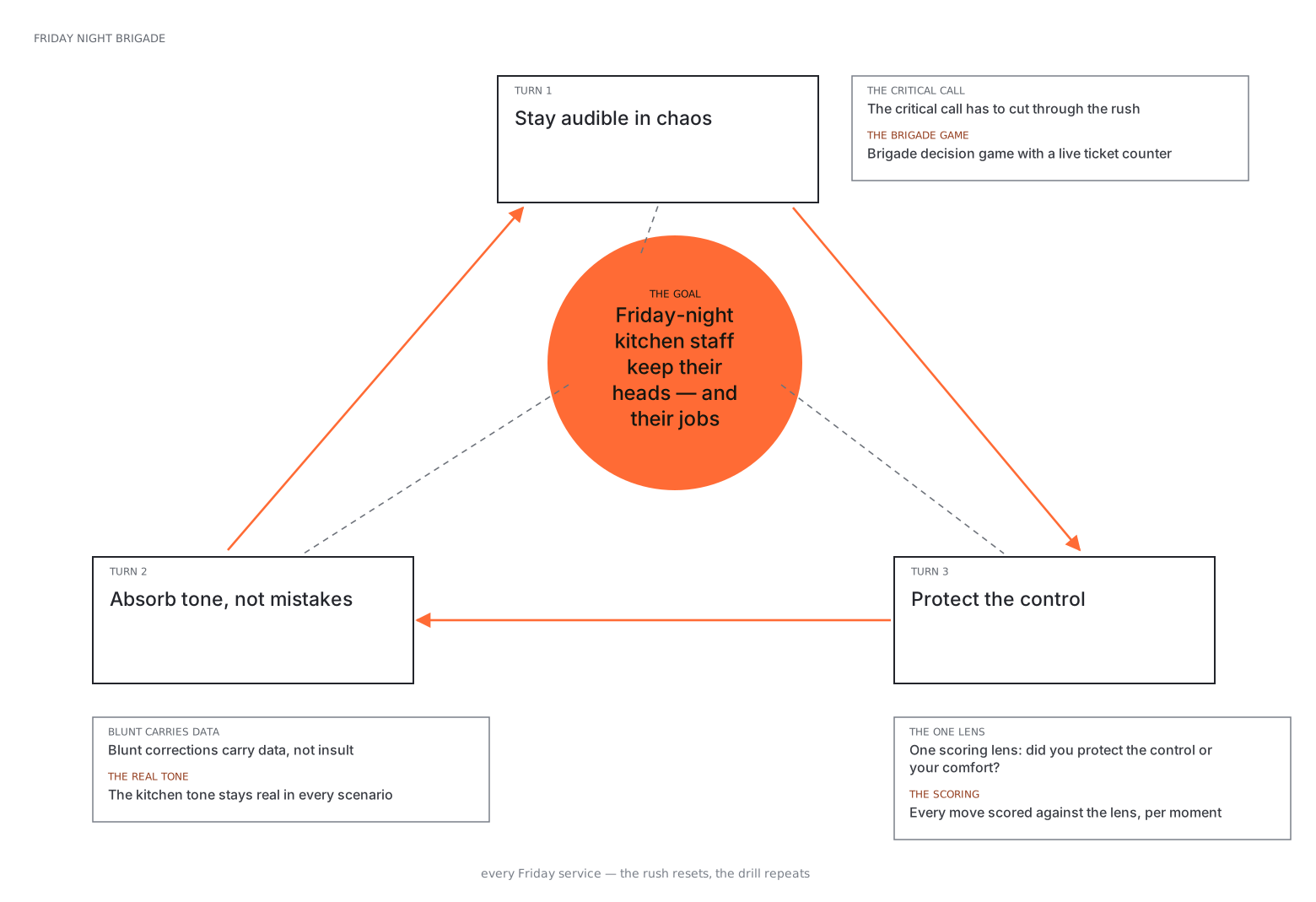
Make the allergen call audible mid-shout — and verify it came back.
LO2 · Discriminate
Correct a colleague harshly without costing the next question; keep the pass safe, not quiet.
LO3 · Perform
Close the shift with the list — owner behaviour, not survivor behaviour.
By the end of this experience a learner can do the three things above — assessed by the shift score across the four service moments. Every interaction in the build exists to create the evidence for one of them.
Kitchen exit interviews cluster on four moments that no onboarding covers:
Training covers recipes and food safety. It never practices making the critical thing audible during chaos — or absorbing tone without absorbing the mistake.
Celiac
ticket mid-shout — the allergy call that waits for a quiet moment
Public
corrections — the tone is weather; the data inside is not
Closing
lists rushed — grease fires and mislabels are born at 21:45
The problem was the client's. These were mine — the design and build constraints that shaped the solution.
Tone you cannot sanitize
Blunt corrections are part of kitchen weather. Sanitizing them would teach nothing; the design keeps the tone real while keeping the scoring fair.
One lens: control or comfort
Every moment scores on whether you protected the service's control or your own comfort — a single question that survives the rush.
Allergen moments cannot be soft
The allergen protocol dramatization had to feel like a near-miss, not a poster — the stakes are printed on the ticket.
A brigade decision game with a live ticket counter and four moments, scored on one lens: did you protect the control or your comfort? The kitchen tone stays real (blunt corrections included) because sanitizing it would teach nothing — the lesson is absorbing the weather while catching the data.
The build itself, not a video about it — open it, make the calls, and read what each one costs.
From early-churn analysis to a brigade decision game — the stages below are the actual production sequence.
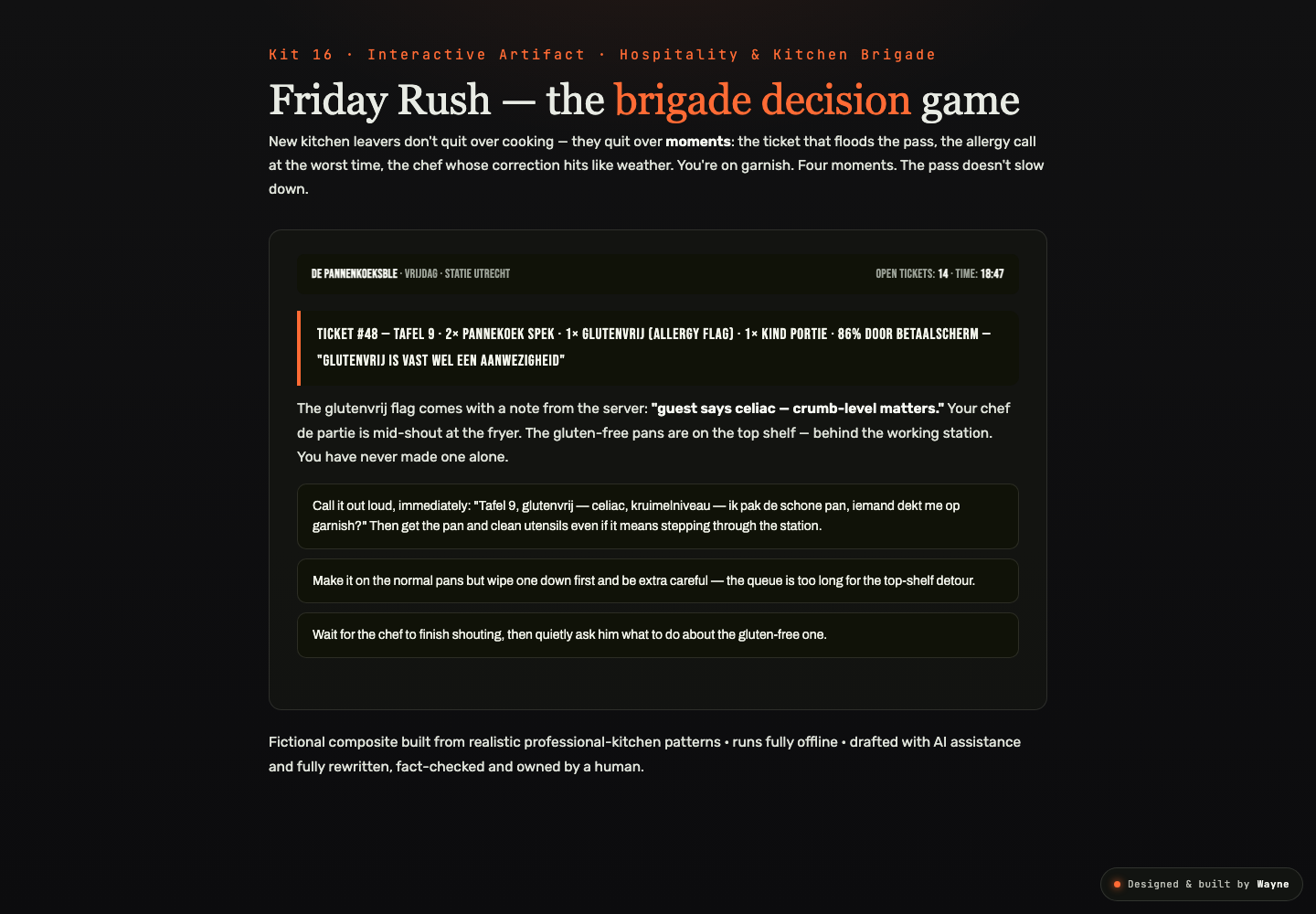
Mapped from kitchen exit interviews: the churn clusters on four moments no onboarding covers. Recipes and food safety were taught; making the critical thing audible during chaos was not — so tone realism stays in on purpose.
The instructional-design foundations that informed this build:
Action Mapping (Clark)
Every behavior the kit produces is traced back to a business goal and a specific practice activity. See the linked action map for the full chain.
Cognitive Load Theory
The Three.js scene reduces extraneous load by visualising abstract systems. Learners focus on the decision, not the interface.
Situated Cognition
The environment matches the real context. Practice happens where the skill will be performed.
Kirkpatrick L1-L4
Evaluation designed for all four levels: reaction, learning, behavior, results. See the linked evaluation plan.
Pre-committed targets (agreed with stakeholders before build, not retrofitted):
"That was my Friday" — kitchen pilot, ≥4/5
L1 · Reaction
"That was my Friday" — kitchen pilot, ≥4/5
L2 · Learning
Full-run control score ≥7/8
L3 · Behavior
Allergen call-outs on flagged tickets 100% observed post-training
L4 · Results
Week-4 kitchen retention ↑ (association, not causation); closing-checklist compliance ↑
Kitchen churn happened in week one over moments no recipe covers: the celiac ticket shouted mid-service, the harsh correction hiding an allergen question, the 9-minute wait with a parent watching the exit. Onboarding taught recipes and food safety; nothing taught making the critical thing audible during chaos. The proposal was a brigade decision game with a live ticket counter — the pressure on-screen and ticking, the tone kept deliberately real.
More recipe and food-safety training considered · rejected
Already in place and necessary. Rejected as the churn fix because the leavers could cook — they quit over moments of unhandled chaos, not over technique. More of the existing training would have been excellent and irrelevant.
Polished e-learning on kitchen communication considered · rejected
Trackable and calm. Rejected because calm is the lie: the whole failure happens when service is loud and the ticket counter is climbing. A calm module trains for a kitchen that does not exist — the tone in the game stays blunt on purpose.