Fictional client — portfolio build · targets, not field results
Implementation Governance: Compliance vs Custodianship
The pilot worked. Now it must land — and applause is not ownership.
The Audience
Programme and implementation managers in universities, government and public knowledge institutions.
Responsibilities
Faction modelling · move-economy design · sequence-dependent outcomes · governance debrief — implementation as a two-currency game.
The Build
Systems modelling · branching outcomes · governance design · AI-assisted drafting (disclosed)
How I used AI in this case
AI helped draft faction-dossier wording and outcome-sentence variants; the faction modelling, the move economy and the sequence-dependent outcome logic were designed by hand. Edited, verified and disclosed.
LO1 · Apply
Sequence governance moves so mandates follow co-ownership — mandates buy compliance, co-owning builds custodians.
LO2 · Discriminate
Spend willingness on the factions that can become custodians, and know which cannot.
LO3 · Perform
Plan a handover that survives because ownership — not the project team — carries it.
By the end of this experience a learner can do the three things above — assessed by the DURABLE / FRAGILE / THEATER faction readout at Q4. Every interaction in the build exists to create the evidence for one of them.
Programmes end and practices die, in one of two rational ways:
Both failure modes feel like leadership. Neither survives the twelve-month mark when the project funding stops.
Day 1
mandate — instant coverage, instant resistance, zero custodians
Q1–Q4
endless showcase — real applause, no structure, dies at funding end
The problem was the client's. These were mine — the design and build constraints that shaped the solution.
Hidden willingness without unfairness
Factions have hidden postures, but the board must stay solvable: every outcome had to be traceable to moves the player could have read — no gotchas.
Sequence is the lesson
MANDATE before CO-OWN must fail differently than after. Encoding that ordering logic — formalizing locks in only ownership that exists — was the core design work.
Two currencies, one board
Budget and legitimacy move differently. The debrief had to read both without reducing governance to arithmetic.
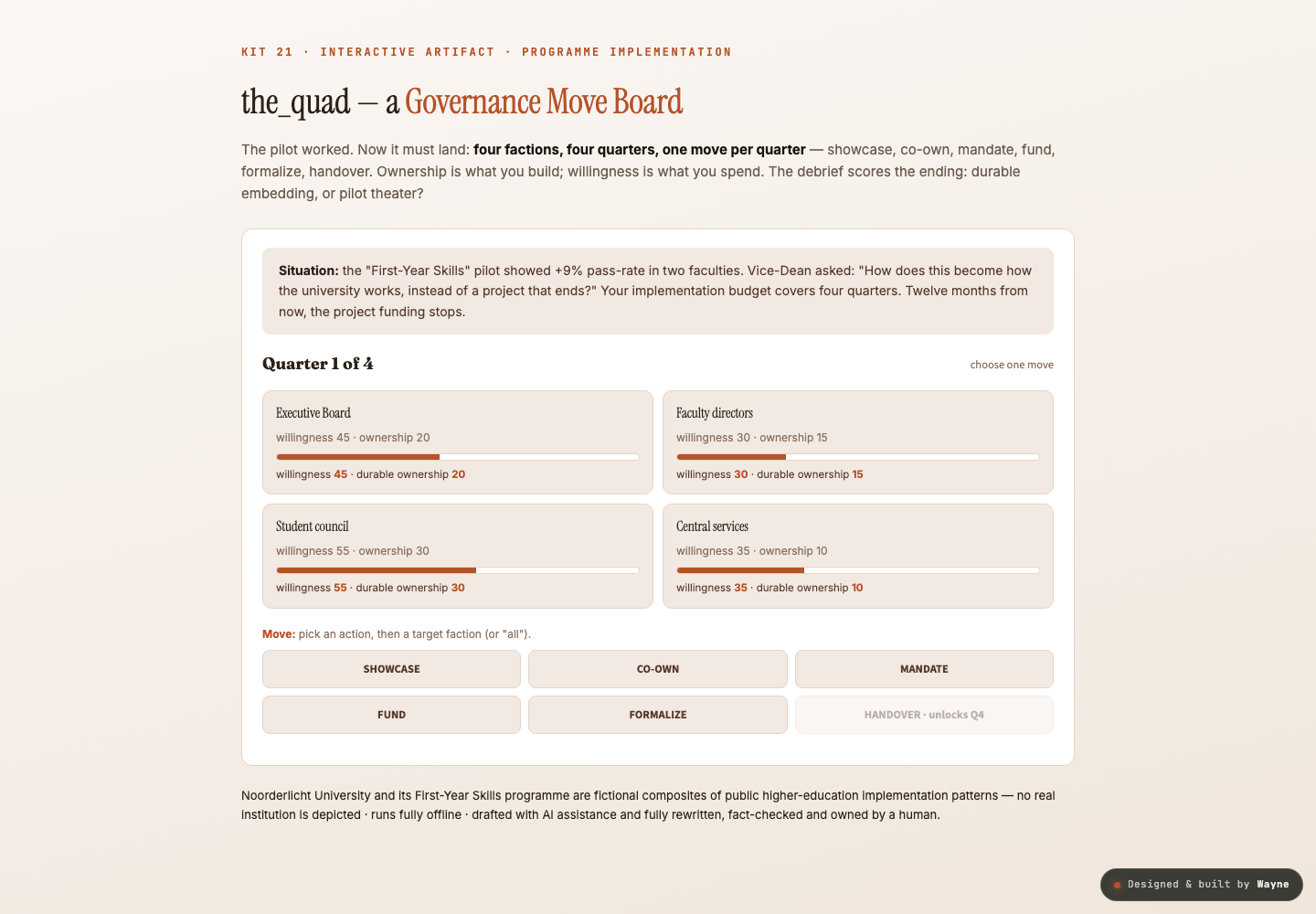
A governance move board: four factions with hidden willingness, six moves (SHOWCASE, CO-OWN, MANDATE, FUND, FORMALIZE, HANDOVER), four quarters, one move each. Outcomes are sequence-dependent — mandating after co-owning lands on prepared ground; formalizing locks in only ownership that exists. The debrief scores durable-ownership per faction and names the working sequence.
The build itself, not a video about it — open it, make the calls, and read what each one costs.
From implementation research to a governance move board — the stages below are the actual production sequence.
Mapped from the two rational ways practices die after programmes end. Both feel like leadership; neither survives the twelve-month mark. The map treats adoption as a sequence problem in two currencies.
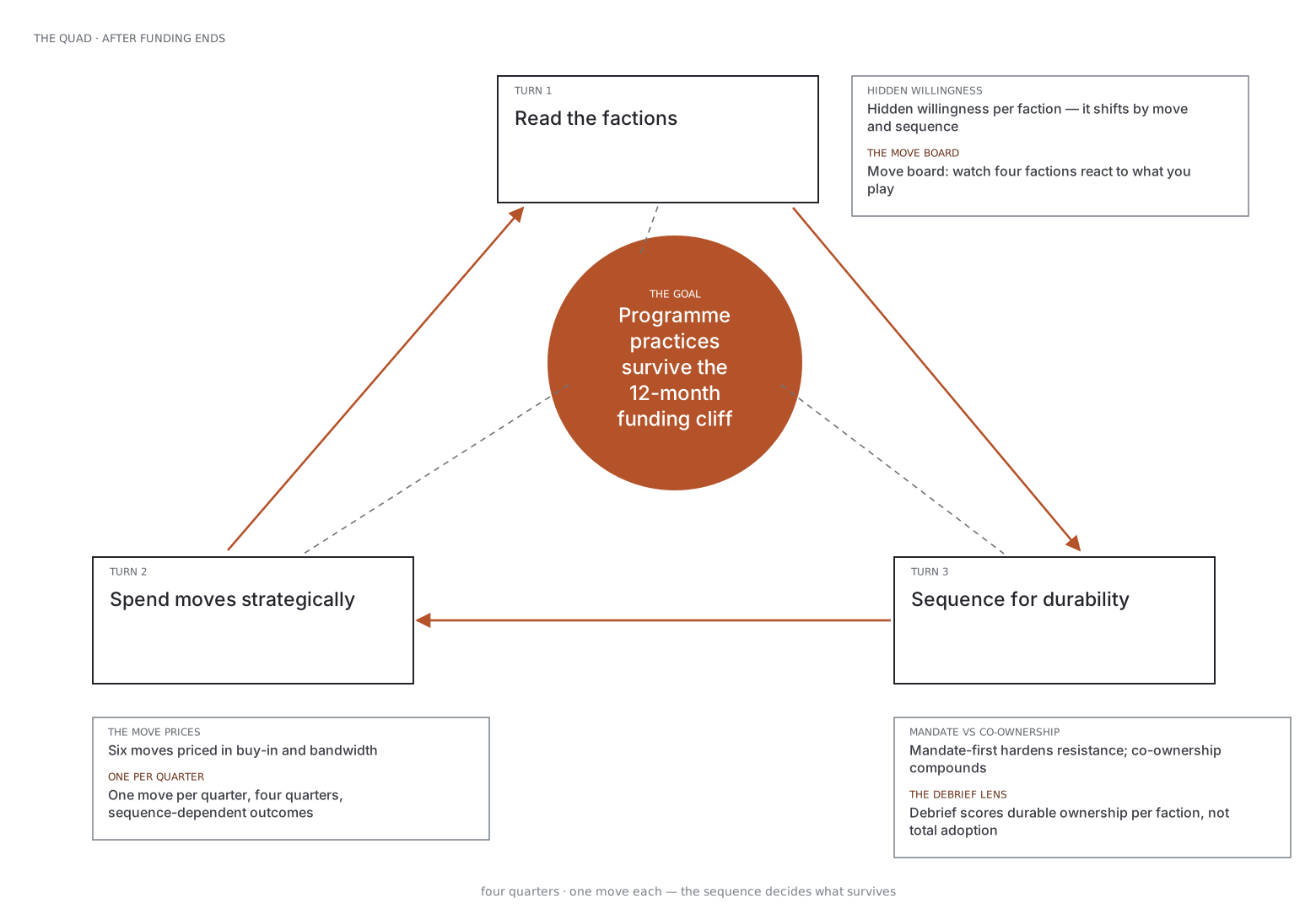
The instructional-design foundations that informed this build:
Action Mapping (Clark)
Every behavior the kit produces is traced back to a business goal and a specific practice activity. See the linked action map for the full chain.
Cognitive Load Theory
The Three.js scene reduces extraneous load by visualising abstract systems. Learners focus on the decision, not the interface.
Situated Cognition
The environment matches the real context. Practice happens where the skill will be performed.
Kirkpatrick L1-L4
Evaluation designed for all four levels: reaction, learning, behavior, results. See the linked evaluation plan.
Pre-committed targets (agreed with stakeholders before build, not retrofitted):
PMs rate the board ≥4/5 for 'honestly unfair in the right ways'
L1 · Reaction
PMs rate the board ≥4/5 for 'honestly unfair in the right ways'
L2 · Learning
≥70% reach embedded or mixed-landing endings by second play
L3 · Behavior
Programme plans name an owner per faction before launch
L4 · Results
Pilot practices survive funding end in subsequent evaluations
The pilot worked; the question was whether the practice would outlive the project funding. Implementation fails in two rational ways — day-one mandates that buy compliance without custodians, and endless showcasing that builds applause instead of structure. The proposal was a governance move board: four factions with hidden willingness, six move types, four quarters — making the two invisible currencies of implementation, willingness and ownership, visible and spendable.
A change-management framework course (Kotter, ADKAR) considered · rejected
The standard answer in every programme office. Rejected because the frameworks were already on the bookshelf — the failure is allocating four quarters of scarce moves between visibility and structure, which no framework slide makes you feel. The board makes the trade-off physical.
Launch-and-learn: run the scaling and adapt live considered · rejected
Agile and honest. Rejected because the currencies are invisible in live play — you discover in month nine that two quarters went to applause, and by then the funding calendar has decided for you. The board is where the allocation is rehearsed before the calendar enforces it.