Fictional client — portfolio build · targets, not field results
Week-One Cashier Training: Dignity Under Queue Pressure
The scanner knows prices. The queue doesn't forgive. Week-one cashiers quit over moments no POS manual covers.
The Audience
First-week supermarket cashiers (often student or returning workers) — plus team leads who need a shared language for the moments that drive early quits.
Responsibilities
Moment taxonomy · queue-pressure simulation · dignity-vs-speed scoring · feedback writing — early attrition treated as a design problem.
The Build
Branching scenario design · pressure pacing · behavioral feedback writing · AI-assisted drafting (disclosed)
How I used AI in this case
AI drafted customer-moment dialogue variants and queue-pacing notes; the moment taxonomy, dignity-vs-speed scoring and feedback writing were authored by me. Edited, verified and disclosed.
LO1 · Apply
Serve the four hardest first-week checkout moments while protecting customer dignity under queue pressure.
LO2 · Discriminate
Handle the declined-PIN moment with a filming bystander without shaming the customer.
LO3 · Perform
Score your own service behaviour on two axes — dignity and speed — and keep them separate.
By the end of this experience a learner can do the three things above — assessed by the shift dignity score (≥7/8) with speed tracked separately. Every interaction in the build exists to create the evidence for one of them.
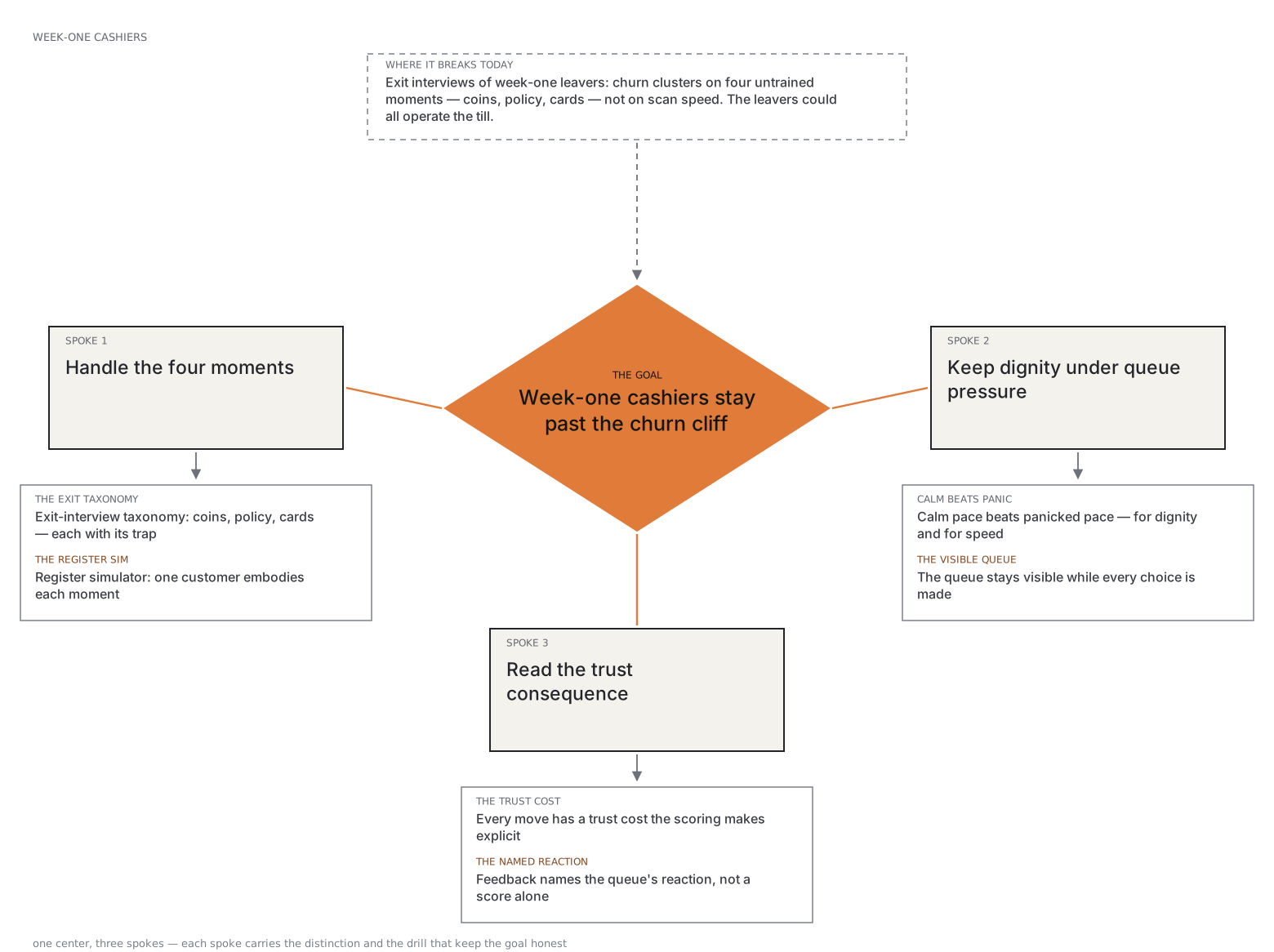
Exit interviews from week-one leavers cluster on four untrained moments, not on scan speed:
Training covers till mechanics and fraud rules. It never practices holding dignity and queue pressure in the same moment — which is what the job actually is.
Coins
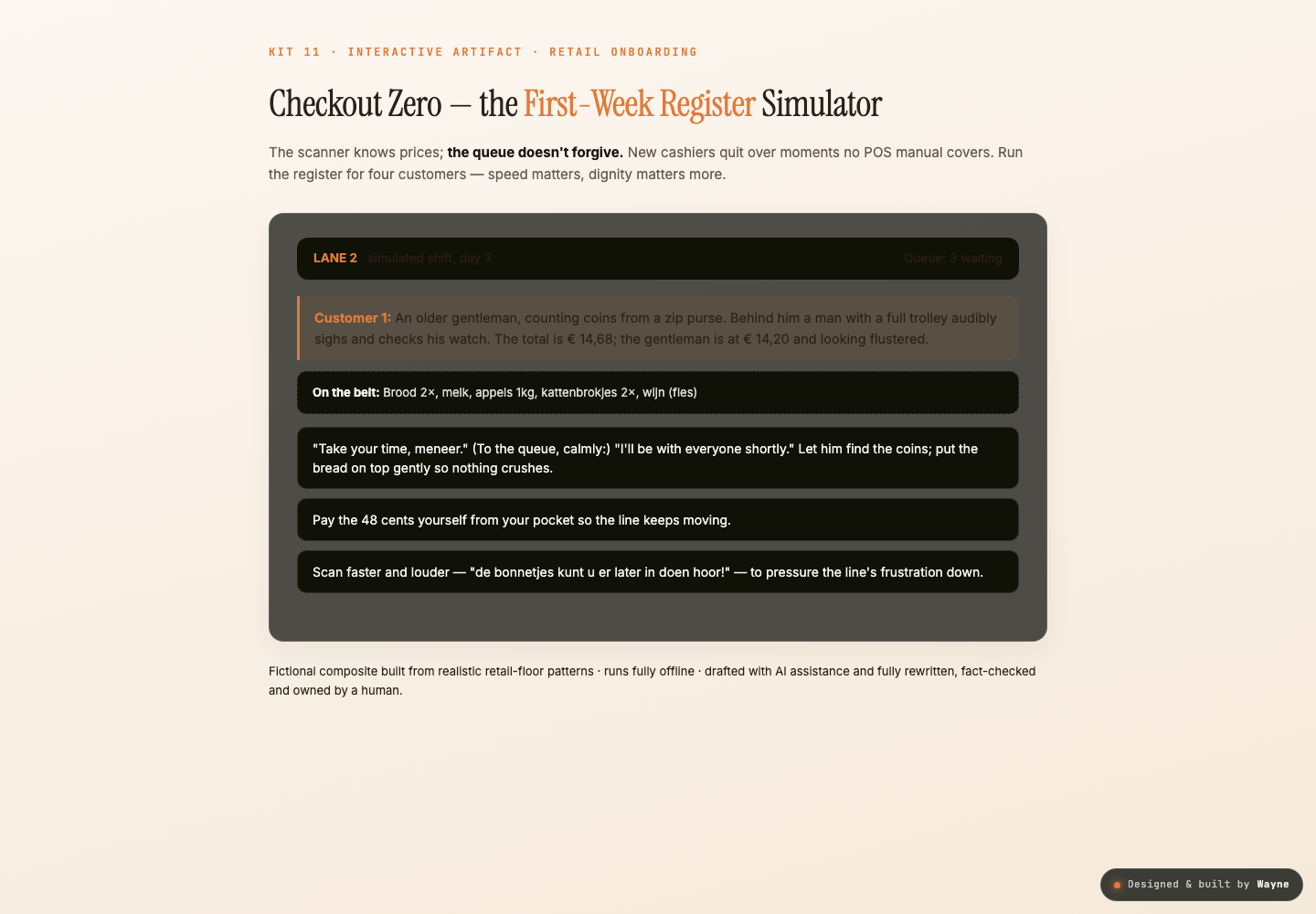
the slow elderly payer — humiliation is contagious to the queue
Policy
no-receipt returns — rule enforcement with or without a door
Cards
declined payments — the loudest failure a first-weeker fears
The problem was the client's. These were mine — the design and build constraints that shaped the solution.
Dignity without sermon
The scoring had to prove calm pace beats panicked pace for both dignity and speed — showing, not telling, so the lesson survives contact with a real Saturday rush.
The queue is the clock
Pressure must be felt, not narrated. The visible queue drives urgency honestly, so speed-panic stays tempting — and stays wrong.
Moments a team lead recognizes
Each customer embodies a real early-quit moment drawn from attrition patterns, not imagination — team leads should hear their own floor in the feedback.
A register simulator where each customer embodies one moment, the queue stays visible, and the scoring explicitly separates dignity from speed — teaching that the two usually align (calm pace beats panicked pace for both). Feedback names the trust consequence of each move.
The build itself, not a video about it — open it, make the calls, and read what each one costs.
From early-attrition data to a register simulator — the stages below are the actual production sequence.
Mapped from exit interviews of week-one leavers: the churn clusters on four untrained moments, not scan speed. The leavers could all operate the till — so the map routes everything through dignity under queue pressure.
The instructional-design foundations that informed this build:
Action Mapping (Clark)
Every behavior the kit produces is traced back to a business goal and a specific practice activity. See the linked action map for the full chain.
Cognitive Load Theory
The Three.js scene reduces extraneous load by visualising abstract systems. Learners focus on the decision, not the interface.
Situated Cognition
The environment matches the real context. Practice happens where the skill will be performed.
Kirkpatrick L1-L4
Evaluation designed for all four levels: reaction, learning, behavior, results. See the linked evaluation plan.
Pre-committed targets (agreed with stakeholders before build, not retrofitted):
"Harder than my real first week" — cashier pilot, ≥4/5
L1 · Reaction
"Harder than my real first week" — cashier pilot, ≥4/5
L2 · Learning
Full-run dignity score ≥7/8
L3 · Behavior
Mystery-customer interaction scores ↑ in week 4 vs control
L4 · Results
Week-4 cashier retention ↑ — one input among many; association, not causation
Week-one cashier churn was not a scanning problem — the leavers could all operate the till. The exits clustered on four untrained moments: the slow payer, the no-receipt return, the party cart, the declined card. Each is a dignity event under queue pressure. The proposal was a register simulator with a visible queue: those four customers, live, with dignity scored separately from speed — teaching that calm is usually also the fast path.
More POS system training considered · rejected
The obvious operational fix. Rejected because the exit interviews never mentioned the till — adding scanning drills addresses the one thing that wasn't failing while the queue keeps burning new hires.
A customer-dignity e-learning module considered · rejected
Well-intentioned and cheap. Rejected because dignity under pressure cannot be conveyed as content — it has to be felt with the queue visibly growing. The module would teach the value; the simulator trains the moment where the value survives or dies.