Fictional client — portfolio build · targets, not field results
Differentiation Practice: Diagnose the Barrier First
One lesson plan, four learning needs, forty minutes. Differentiation theory is easy — the fork is hard.
The Audience
Early-career secondary teachers (and their mentors) — especially in mixed-preparation classrooms; also teacher-PD programs seeking practice-based rather than theory-based training.
Responsibilities
Barrier taxonomy · classroom-moment design · pedagogically-defensible distractors · feedback that names costs — the diagnosis habit made practicable.
The Build
Classroom scenario design · misconception modelling (fractions, circuits) · feedback writing · AI-assisted drafting (disclosed)
How I used AI in this case
AI drafted classroom-moment variants and misconception phrasings; the barrier taxonomy, pedagogically-defensible distractors and cost-naming feedback were authored by me. Edited, verified and disclosed.
LO1 · Apply
Diagnose the learning barrier before choosing any intervention — the fork comes before the fix.
LO2 · Discriminate
Tell differentiation (changing the task's access) apart from adding a task.
LO3 · Perform
Respond to the four forks — early finisher, misconception, dyslexia access, failed-test face — with barrier-first moves.
By the end of this experience a learner can do the three things above — assessed by the full-run diagnosis score (≥7/8). Every interaction in the build exists to create the evidence for one of them.
Differentiation training teaches frameworks; the classroom demands split-second diagnosis. The predictable failures:
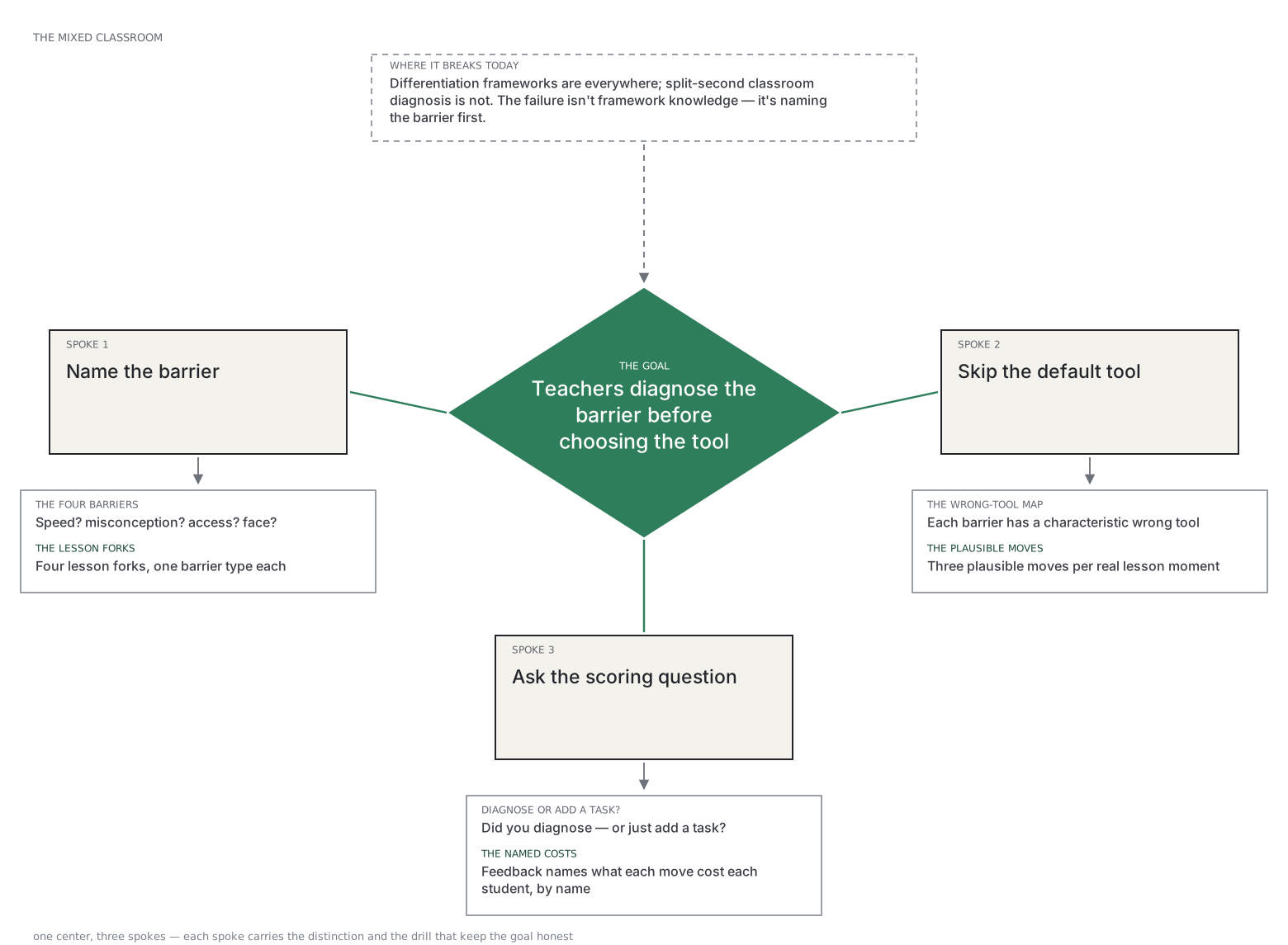
The gap isn't framework knowledge. It's the diagnosis habit: naming the barrier (speed? misconception? access? face?) before choosing the tool.
Peer
tutoring as default — the fast student manages, the stuck one waits for rescue
Rules
only — misconceptions survive beneath procedures and resurface later
Praise
for coping — avoidance gets decorated, and the wrong lesson lands
The problem was the client's. These were mine — the design and build constraints that shaped the solution.
Diagnose or add a task
The scoring lens is one question: did you diagnose the barrier or pile on another worksheet? Every distractor is a plausible task that skips the diagnosis.
Misconceptions as they are really taught
The fractions and circuits barriers must match how the misconception actually forms, so feedback lands for teachers who know the content cold.
Costs to real students
Feedback names what each choice cost each student — never a generic try-again. That specificity is what makes the habit practicable.
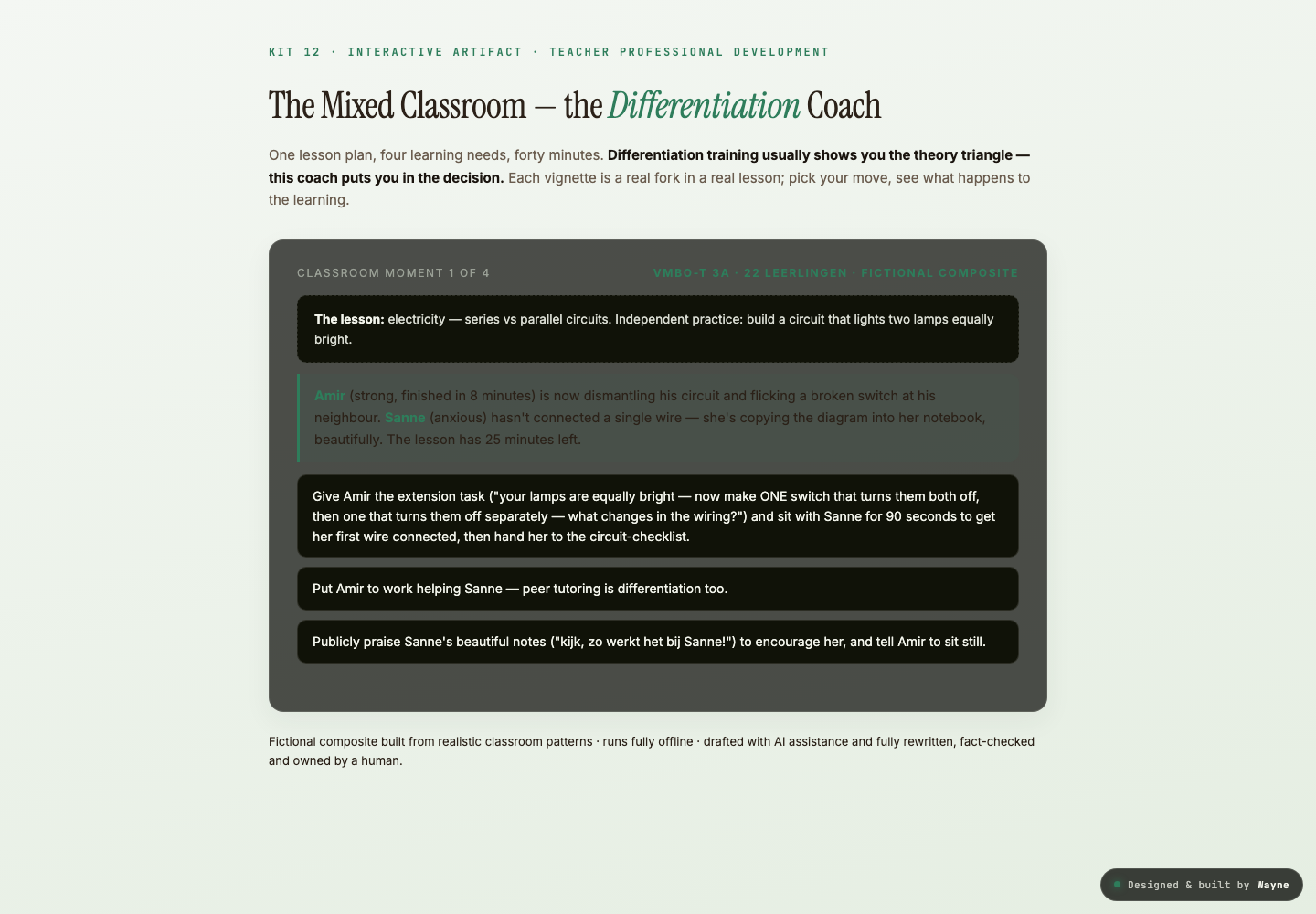
A decision coach built on four barrier types, each embedded in a real lesson moment with three plausible moves. The scoring lens is a single question — did you diagnose or did you add a task? — and feedback names what each choice cost each student.
The build itself, not a video about it — open it, make the calls, and read what each one costs.
From barrier taxonomy to a playable decision coach — the stages below are the actual production sequence.
Mapped from the gap between differentiation frameworks and split-second classroom diagnosis. The failure isn't framework knowledge; it's naming the barrier before choosing the tool — so diagnosis sits at the center of the map.
The instructional-design foundations that informed this build:
Action Mapping (Clark)
Every behavior the kit produces is traced back to a business goal and a specific practice activity. See the linked action map for the full chain.
Cognitive Load Theory
The Three.js scene reduces extraneous load by visualising abstract systems. Learners focus on the decision, not the interface.
Situated Cognition
The environment matches the real context. Practice happens where the skill will be performed.
Kirkpatrick L1-L4
Evaluation designed for all four levels: reaction, learning, behavior, results. See the linked evaluation plan.
Pre-committed targets (agreed with stakeholders before build, not retrofitted):
"Recognized my own classroom" — teacher pilot, ≥4/5
L1 · Reaction
"Recognized my own classroom" — teacher pilot, ≥4/5
L2 · Learning
Full-run diagnosis score ≥7/8
L3 · Behavior
Observed diagnosis-before-tool moves in coaching cycles ↑
L4 · Results
Formative-assessment quality scores ↑; equity gap in task completion ↓
Early-career teachers could recite every differentiation framework and still, mid-lesson, respond to a struggling student by adding a task. The gap was diagnostic: reading the barrier in the moment, under time pressure, with twenty-nine other children waiting. The proposal was a differentiation decision coach: one teaching day, four forks, three moves each — scored on a single question, did you diagnose the barrier or just add a task? — with feedback that names what each choice cost each student.
Another differentiation-frameworks PD day considered · rejected
The default request every term. Rejected because the frameworks were already known — the failure happened in the three seconds between noticing a barrier and choosing a response, which no framework slide reaches. Knowledge is upstream of the gap.
More lesson-plan templates with differentiation boxes considered · rejected
Concrete and auditable. Rejected because templates are filled in the evening for an imagined class; the skill needed is for the real child in front of you at 10:40 on a Tuesday. Planning supports diagnosis — it cannot replace it.