Fictional client — portfolio build · targets, not field results
Cold-Chain Goods-In: Decision Training for Dock Receivers
Your signature decides whether this pallet reaches shoppers — or becomes a write-off.
The Audience
Warehouse goods-in receivers at a mid-size chilled-goods logistics firm — new hires in their first season and veterans with decade-old habits; shift leads coach the borderline calls.
Responsibilities
Needs analysis · action mapping · storyboarding · visual design · eLearning development · animation & sound design · LMS/xAPI integration · evaluation design — end-to-end ownership.
The Build
HTML/CSS/JS authoring · WebAudio sound design · Figma-style wireframe→mockup flow · xAPI/SCORM packaging · Kirkpatrick measurement design · AI-assisted drafting (disclosed).
How I used AI in this case
AI-assisted drafting of narration pairs and scenario copy, disclosed in the kit's AI-disclosure doc. The needs analysis, action mapping, scoring design, xAPI instrumentation and every build decision were authored by hand.
LO1 · Apply
Apply the four gates of chilled receiving to a problem pallet and choose accept, reject or escalate — with a reason that survives an audit.
LO2 · Discriminate
Distinguish quality abuse from genuine temperature deviation before signing goods-in paperwork.
LO3 · Perform
Certify at ≥85% on a randomized 7-of-8 decision bank under dock-time pressure.
By the end of this experience a learner can do the three things above — assessed in-build by the certification gate (L2) and the four-gate routine. Every interaction in the build exists to create the evidence for one of them.
At VanDijk Logistics (fictional composite of EU chilled-goods operators), quality records showed 23 problem pallets in one quarter — and the pattern was not ignorance. Receivers are trained annually and pass. The failures clustered into three shapes:
Operations asked for "a short training about receiving chilled goods." But the receivers already knew the theory — they skipped the probe because the paper trail felt complete, guessed on borderline readings because no protocol moment existed, and froze loads because nobody had told them they were allowed to pause the dock clock. A content refresher would fix none of that.
43%
temperature abuse signed off on paperwork alone — discovered after acceptance
31%
unnecessary rejections of good loads — defensive guesses on borderline readings
26%
loads left on the ambient dock past 30 minutes while escalating "quickly"
The problem was the client's. These were mine — the design and build constraints that shaped the solution.
A probe people skip
The paper trail felt complete, so receivers skipped the temperature probe. The design had to make skipping feel dangerous — the signature moment had to cost something on screen, not in a footnote.
Permission to pause the dock
Receivers froze loads because nobody had told them they were allowed to hold the dock clock. Building an explicit protocol moment for pausing was a process change smuggled into training.
Borderline readings need stakes
Guessing on borderline temperatures was defensive, not lazy. The module prices the guess: reject a good load or accept an abuse pallet — both visible, both consequential.
A scenario-based certification program built on one rule: practice the decision, feel the consequence, learn the protocol. Not slides about cold-chain theory — a simulated goods-in desk where the wrong call costs a pallet, plays out on screen, and resets with a click instead of a write-off.
Gate 1 · Journey Logger Audit
Verify the 6-hour trip curve before touching the load. Flag mid-journey spikes (>8.0 °C) for wider core probing; quarantine loads with missing USB loggers in the Chill Bay while QA pulls carrier telematics.
Gate 2 · 3-Point Core Probe
Defeat both thermal traps: Ambient Edge-Warming (door-side corners at 8.9 °C while core is 5.1 °C → isolate corner zone, salvage core) and Late-Reefer Crust Masking (surface IR 3.1 °C hiding an 11.4 °C vaccine core → full reject).
Gate 3 · 30-Min Dock Clock & Recovery
Ambient bay (+18 °C) exposure is capped at 30 minutes. Park escalated loads inside the +4.2 °C Chill Staging Bay to pause the dock clock; borderline 8.1–8.5 °C excursions (<30 min) pass if core recovers <8.0 °C within 20 minutes.
Gate 4 · Audit-Ready Disposition
Every CMR sign-off or rejection logs four mandatory elements: Zone/Location, Measured °C vs. Limit, Unit Count, and Disposition Action — protecting the next shift and surviving vendor claims.
Three complementary builds — open the 21-point certification module, step into the interactive 3D Receiving Bay to probe and route three live pallets, or watch the 90-second pre-shift story explainer.
From incident data to shipped certification build — each stage below links the working document produced at that step.
More design docs
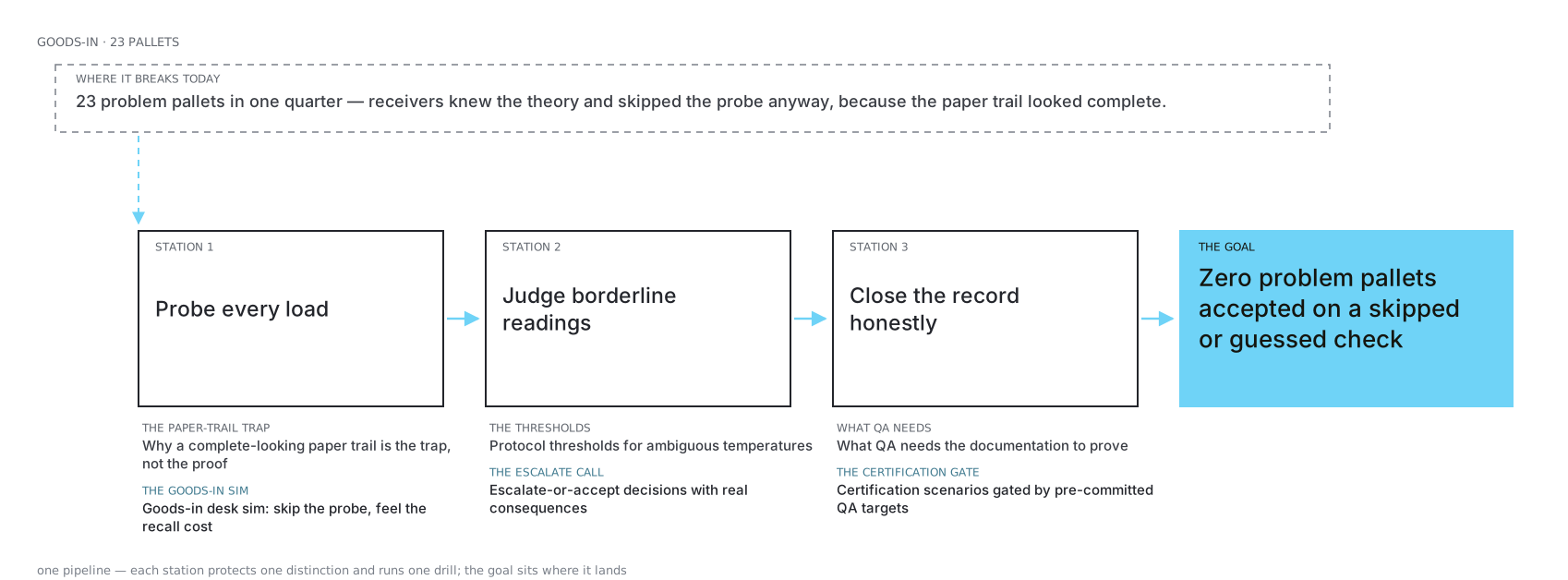
Mapped from 23 problem pallets in one quarter: the pattern was not ignorance. Receivers knew the theory — they skipped the probe when the paper trail felt complete. So the map practices the decision, not the doctrine.
The foundations that shaped this design — mapped to the specific decisions made in the build:
Merrill's First Principles
Problem-centered: the problem is not knowing SOPs but acting on the probe when the paper trail feels complete. The story explainer makes the failure visible in 3D before practice begins — active learning over passive knowledge.
Cognitive Load Theory
Reduced extraneous load by making the temperature abuse visible (surface vs core) before introducing the decision rules. The gauge keeps real data visible so no mental juggling is required.
Action Mapping
Business goal: reduce spoilage by 60%. Behavior: probe before signature. Skills: temperature measurement, reading core vs surface. Practice: the 21-point scenario certification module.
Kirkpatrick L1-L4
L1: >=4/5 usefulness on debrief surveys. L2: >=85% first-attempt certification, 7-of-8 randomized bank. L3: >=95% probe-before-signature on audited receipts. L4: abuse pallets down >=60%.
Pre-committed targets (agreed with QA before build, not retrofitted):
L1 · Reaction
Shift-lead debriefs within two weeks; ≥4/5 usefulness
L2 · Learning
≥85% first-attempt certification, 7-of-8 randomized bank
L3 · Behavior
Probe-before-signature on ≥95% of audited receipts
L4 · Results
Abuse pallets ↓≥60%; rejects <10% of intake
The needs analysis kept pointing at one moment: a receiver standing in front of a borderline chilled pallet with a signature in hand. The gap was not knowledge of the temperature limits — everyone could recite them. The gap was the decision under time pressure, with a queue behind them and a tolerances sheet that read like ambiguity. So the proposal was not a course about cold chains; it was a 21-point scenario-based certification module that reproduces that exact moment repeatedly, with a randomized 7-of-8 exam bank and a 90-second explainer for the pre-shift huddle.
Updated SOP memo + signature box considered · rejected
Cheapest option on paper. Rejected because the audit trail showed receivers who could quote the SOP and still sign the wrong pallet — knowledge was never the failure, the moment was. A memo adds a document, not a decision.
Instructor-led refresher day considered · rejected
Strong on discussion, weak on the actual constraint: shift coverage across a 24h dock. It also trains reflection on yesterday's cases, not the split-second call in front of a live pallet. Retained as a complement for the quarterly debrief instead.